- Home
- Fashion
HELLO! India Exclusive: Sanjay Garg on championing the power of Indian handloom at Raw Mango’s London Fashion Week 2026 debut
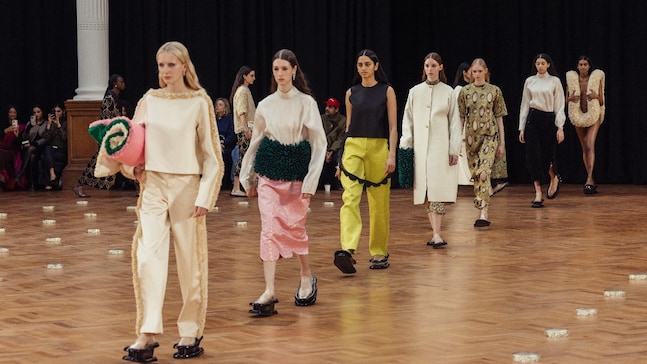
Raw Mango marks a milestone debut at London Fashion Week 2026, presenting a collection rooted in Indian handloom, cultural memory, and quiet luxury. Inspired by the symbolism of the garland, Sanjay Garg’s work reaffirms the brand’s commitment to craft, individuality, and meaningful storytelling on a global stage
offline
Share this:
When Sanjay Garg built Raw Mango nearly two decades ago, he didn't do it merely as a design house, but as a philosophy in a world where heritage and modernity constantly negotiate their place. The brand has stood apart quietly yet resolutely to champion the emotional, cultural and intellectual depth of Indian handloom. Now, as Raw Mango prepares to debut its Fall/Winter 2026 collection at London Fashion Week, presented by De Beers Group and featuring jewels by Forevermark, the moment emanates a natural continuation of a deeply personal dialogue that has always transcended geography. In conversation with HELLO! India, Sanjay Garg reveals, or rather confirms, that India's moment on the global fashion space isn't to merely fill a void, but to reaffirm India's position.
(Also Read: The timelessness of Indian weaves, from Chikankari to Kanjeevaram)
HELLO! India: Raw Mango has always been deeply rooted in India’s craft and cultural vocabulary. What does presenting the Fall Winter 2026 collection at London Fashion Week represent for you, both personally and as a brand milestone?
Sanjay Garg: Our work has received a lot of positive attention from this part of the world. Be it an ambassador or a first lady, artist or diplomat, we have been graced with a great audience. Add to that, our 18th anniversary is on the horizon, and I’ve always felt a deep connection to this city. That said, a stage is a stage. Presenting in London is as good as presenting in Kanpur, for me. At the end of the day, it is the work being presented that matters. And that doesn’t change according to who is viewing it, or where.
HELLO! India: London is a global fashion capital with its own layered history and aesthetic language. How do you see Raw Mango’s voice contributing to that international dialogue?
Sanjay Garg: That’s the thing, I’m curious to see that too. I know that Raw Mango has a unique perspective to share with a layered approach to aesthetic and craft—as distinct as anything else this stage has to offer. I know my collection is saying things that haven’t been explored before, in popular culture. But how London chooses to receive it, understand it and engage with it is up to London. I can only present my viewpoint, I can’t predict where the conversation will go from there. I don’t want to either; finding out is half the fun.
HELLO! India: After nearly two decades of building Raw Mango, why did this moment feel right to present on such a global platform?
Sanjay Garg: I don’t think there is a right or wrong time to have a show. It’s just happening now, and now happens to be an interesting time. There are conversations being had around India, craft and textile that weren’t possible maybe a few years ago. I think the world, and we, are coming to terms with the fact that India is a vast land filled to the brim with stories. There is also a growing chorus of creative voices from the subcontinent, of which we are one part, and one reflection. Over the last 18 years, Raw Mango in particular has been driven by a curiosity to understand the deliberate and spontaneous cultural movements that shape our values and systems as a society. The way we engage is so varied, and is very much reflective of an ongoing dialogue I have with myself and my own curiosity. We are not defined by a single idea or aesthetic, but rather by a constant questioning. And the world, right now, is ripe for some questioning. Maybe that’s why it feels right.
HELLO! India: Could you share the central narrative or emotional starting point behind the Fall/Winter 2026 collection?
Sanjay Garg: With this collection, I wanted the appreciation of Indian fashion to shift away from the “more is better” approach and towards a holistic approach of the garment and the weave being presented. But also, for those looking to wear these creations, I want them to feel special, and part of the arrangement that adorns them. That’s the emotional core of this work. For inspiration, we looked at the garland. Flowers remain an important part of South-East Asia and South Asia. But we don’t really have a culture of giving one individual flower to someone, like, say, a rose on Valentine’s Day. People do give but, as a culture, we are a country of garlands. Whether it’s a death, a birth, a wedding or a religious ritual, you see garlands, irrespective of the religion. So, I wanted to show through my collection (titled It’s not about the flower) how a 3D garland becomes the body rather than just a decoration. It’s not about one individual flower; it’s about the plurality. The arrangement, instead of the singular disembodied motif. The weave and the structure, instead of the golden threads on the surface. The body, instead of the adornment. Every flower in a garland is unique, and at some point, each of them loses their individuality as they become part of something larger than themselves.
HELLO! India: What do you hope an international audience unfamiliar with Indian handloom will understand or feel through this collection?
Sanjay Garg: Deep knowledge of handloom and craft have never been the barrier through which you must pass to be able to appreciate our creations. We want our audiences to come as they are, and have relationships with these garments in ways that feel authentic to them. We’ve drawn inspiration from the garland in this collection. It’s a way to engage with what can be seen as an aesthetic that is organic to India: garlands can be found decorating everything that is deemed important: a new car, an old tree, a lover’s bun, a doorway and those that walk through them. For those looking to wear these creations, I want them to feel special, and part of the arrangement that adorns them. These pieces blur the line between decoration and that which is decorated.
HELLO! India: In today’s fast-paced fashion landscape, craft often risks being reduced to a visual reference. How do you ensure it remains a living, evolving practice rather than just an aesthetic?
Sanjay Garg: I believe that for textile crafts to survive, they require design intervention. Textiles at Raw Mango often involve 1-2 years of research, design and sampling before being made. Throughout this, the weavers and stakeholders are present and the process is very much about possibilities on the loom, which they are the knowledge holders of. Our creative process is rooted in innovating on the loom. Our work is exploration, engagement and experimentation with craft. It is this constant collaboration that contributes to the living tradition. We are always thinking about the value we are adding. We make sure to look at our design contribution to the textile, not just its contribution to our work. What is the difference we are making for the industry, the weavers, the technique?
HELLO! India: How do you approach storytelling through textiles, especially when working with histories that carry both beauty and complexity?
Sanjay Garg: We engage with the visual vocabulary of India through measured interventions within traditional practices - be it design, material, tools, technique or colour. One of our key design interventions has been to update–or modernise–the visual language within textile cultures. In an early collection, we translated the cow motif from Rajasthani pichwais into chanderi saris. We also incorporated figurative elements—in Monkey Business, the brocade textiles featured the monkey, playful and mischievous yet honoured in Hindu mythology and Buddhism. We also introduced human shapes, angels that are ubiquitous across cultures, in chikankari embroidery with Cloud People. These elements were not part of the textile cultures before we came around. Our work with Chanderi changed the industry, the visual language we introduced is still used widely today.
HELLO! India: You’ve never defined a singular Raw Mango wearer. How do you see the Raw Mango woman—or wearer—evolving as the brand reaches a more global audience?
Sanjay Garg: Raw Mango has always spoken to the aesthetics and sensibilities of women who are conscious of quality, have a strong view on design and a confident sense of self. We are fortunate to have been able to have a dialogue and cultivate a relationship with a diverse set of clients who share these commonalities that transcend beyond age groups, professions, interests and geographies. I’ve also never been interested in defining my audience or catering to a particular subset of people. My interests lie in further exploring and articulating my design language which goes beyond borders, and seasons.
(Also Read: From Rihanna's naked dress to Cher in Bob Mackie, 10 red carpet looks that rewrote fashion history)
Advertisement