- Home
- Fashion
HELLO! India Exclusive: Stefano Canali on the future of luxury menswear and modern Italian tailoring
Inside the CEO’s vision for a maison nearing 100 years, India’s evolving style, and why “buy better” defines the next decade
offline
Share this:
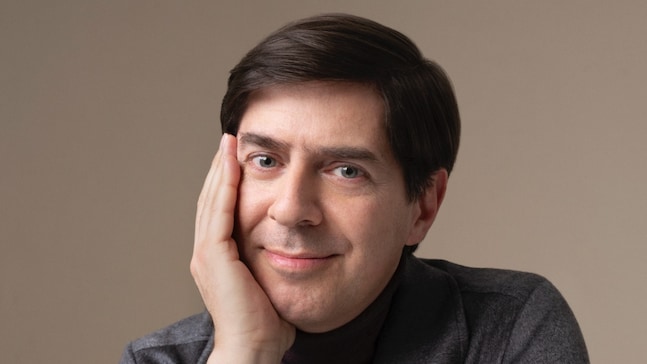
The afternoon light in New Delhi was fading as I walked through the Ashok Hotel, past its iconic latticework corridors, and into D’MONDE Members Club. It was here, in a corner framed by dark wood and frescoes, that Stefano Canali greeted me with a smile warm enough to disarm any intimidation that comes with interviewing the CEO of the almost-100-year-old Italian maison. Charming, unhurried, and beautifully dressed (but in that studied, imperceptible way only Milanese men can master), he instantly put me at ease. The CEO of an empire built on unstructured precision, he shakes my hand with the same philosophy: firm, but never forceful. Canali, as a brand, is inching toward its centenary. Yet Stefano speaks about its future the way young designers speak about breakthrough collections: with curiosity and clarity. “For a company with such a heritage,” he says, “the most difficult task is to reinvent yourself while staying true to yourself.”
That tension—heritage vs. relevance—forms the spine of our conversation and of Canali’s entire future.
A NEW LANGUAGE OF TAILORING
Before I can begin my questions, Stefano is already shrugging off his blazer. It collapses into his hands, then snaps back into shape with a single shake. “There are no shoulder pads. No stiffening. Nothing but canvas, stitched by hand,” he says, with the modest pride of someone who has seen this craft executed correctly for decades. In menswear, a fully canvassed jacket is the gold standard—a rarity in an industry now saturated with fused linings and gimmicky technical blends. But what Canali is doing goes further: removing internal weight while maintaining external form. It’s a balance that only a few Italian houses (the Milanese, specifically: the Romans prefer structure; the Neapolitans prefer slouch) have been able to master.
Stefano explains the engineering behind it; how tailors pre-shape the chest on a curved surface, how the roll line is coaxed by hand with invisible pick stitching, how the armhole is cut high and rotated forward for mobility, how the canvassing is eased into the cloth asymmetrically so the final drape reads effortless, not assertive. “It takes expertise,” he says simply. In fashion-speak, that is shorthand for: this cannot be mass-produced.
India, he notes, has long understood this nuance. “We have six stores now,” he says. The latest at Jio World Plaza in Mumbai is a space that feels more like a Milanese atelier than a retail outpost. One of Canali’s most incisive decisions in this market was the reimagining of the bandhgala—a silhouette steeped in Indian formal tradition but reborn through Italian discipline. The maison softened the shoulder, sharpened the neckline, substituted heavy brocade for silk-linen blends, and even introduced sleeveless variants. “It allowed us to sync instantly with Indian consumers,” he says. “Something familiar, interpreted our way.”
He laughs when I ask about India–Italy cultural overlaps. “Sometimes I get along better with an Indian person than an Italian,” he admits. “We’re closer than expected. Maybe we come from the same planet. Mars, perhaps.”
Across global runways, one truth has emerged: formalwear isn’t dying; it’s detoxing. Canali, mythologised as a sanctuary of suiting, is rewriting the silhouette. It now avoids siloed categories. Instead, it creates one lifestyle wardrobe, where a deconstructed blazer, a glen plaid overshirt, a suede bomber and a pair of double-pleated trousers are all part of the same visual sentence. “Consumers evolve,” he says. “They want comfort, credibility, and the right price-to-value balance.” And this is where Canali becomes quietly radical: while luxury prices balloon globally, Canali resists the temptation to inflate. “We’ve always believed in the right price point for the content we offer,” he says. “And that will matter even more in the coming years.” In other words: craft should cost what craft costs, not what hype dictates.
Sportswear, too, is interpreted through the maison’s codes. Stefano describes suede outerwear engineered with glove-making techniques: invisible stitching, micro-thin skins, weightlessness that feels almost contradictory to the category. “As comfortable as the jackets I showed you,” he says. Everything must move with the body, not control it—an ethos increasingly shaping modern luxury.
THE CANALI WAY FORWARD
Cinema once influenced menswear in seismic waves. Italian tailoring owes entire decades to films from La Dolce Vita to American Gigolo. But for Canali, influence now travels differently. “We’ve collaborated with Hollywood,” Stefano says, “but today, style is shaped elsewhere.” Enter Inter Milan. The partnership is a Milanese marriage of heritage and performance. Executives receive immaculate navy tailoring; players are given relaxed overshirts, tailored joggers, ribbed knits and sneakers—a demonstration of how Canali’s lifestyle vocabulary spans age, profession, and temperament. “It’s an effective amplifier,” he explains. “New, different from movies but very us.”
He brings up tennis player, Stefanos Tsitsipas. “Very handsome, very nice,” he says. “Inner beauty matters.” In the age of celebrity dressing as brand strategy, this sounds almost subversive. But it is sustainability—not the buzzword but the practice—that animates him. Durability, he insists, is sustainability. Craft is sustainability. Fair labour is sustainability. Honest pricing is sustainability. “Buy less fast fashion,” he says. “Buy better.”
(Also read: HELLO! India Exclusive: Daniel Roseberry and his big dreams for Schiaparelli)
It’s a philosophy he has repeated in panel discussions from Florence to Dubai. And he’s right: a Canali jacket survives years, even decades. A cheap one survives a season. “If you ask me to chase streetwear,” Stefano says, “I will say no. Not because it cannot be successful—but because it is not credible coming from us.” Credibility, he believes, is the only luxury that matters.
By the time our conversation comes full circle, the takeaway is clear: as it nears its hundredth year, Canali isn’t just adapting to the shifts in menswear—it’s helping set the direction for what comes next. In an industry increasingly obsessed with the ‘next new thing’, the maison is offering something rarer: clarity, consistency, and clothes that feel as good as they look.
RAPID FIRE WITH STEFANO CANALI
Favourite film: The Lord of the Rings
Favourite food: Pasta
Favourite place to visit: Venice
Favourite dessert: Tiramisu
Perfect night out: A traditional Italian restaurant
India in one word: Fascinating
(Also read: HELLO! India Exclusive with the 'fearless, enigmatic, timeless,' Zuhair Murad)
Advertisement