- Home
- Fashion
HELLO! India Exclusive: The art of couture collectibles
Celebrating a decade of artistic collaboration, Dior invites creators from around the globe to reimagine the coveted Lady Dior, merging contemporary artistry with the house’s revered craftsmanship. HELLO! speaks with Eva Jospin and Marc Quinn, two of the leading voices shaping the 10th anniversary edition of the iconic handbag
offline
Share this:
For nearly three decades, the Lady Dior — the much coveted quilted handbag with an architectural silhouette and softly, clinking charms — has occupied a rare space in fashion: instantly recognisable, endlessly open to reinvention. What began as an experimental exchange has now matured into one of Dior’s most anticipated annual projects: Dior Lady Art, where artists from around the world reinterpret the bag through their own visual and cultural frameworks.
To mark the 10th edition, Dior assembled a roster of artists whose practices span sculpture, painting, digital experimentation and material research. Together, they honour the house’s legacy while challenging how a couture object can carry so much meaning beyond fashion. At the centre of this anniversary chapter sit Eva Jospin and Marc Quinn, two artists whose approaches to form, scale and materiality push the Lady Dior into new conceptual territory — without ever losing its identity.
We delve into their atelier...
TRANSLATING THE LANDSCAPE INTO COVETED CRAFT
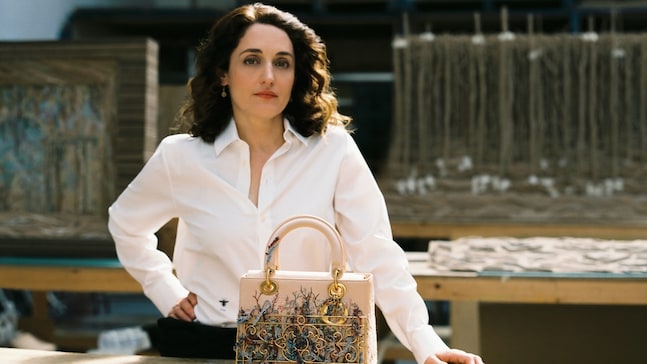
Eva’s world is built through layers — forests rendered in carved cardboard, architectural follies reimagined in relief, and embroidered landscapes that appear to breathe. Her reinterpretation of the Lady Dior brings these languages together in a remarkably compact format. In her celebrated ‘Balcon’ series, Eva explores vantage points and symbolic views; for Dior, she adapts this idea into what she describes as a “portable balcony.”
On one side, the bag becomes a sculptural façade — a miniature balustrade, stylised through metal and thread, referencing 30 Montaigne, the first Dior boutique in Paris that remains the cradle of the maison’s couture ateliers. On the flip side, an embroidered spring garden unfolds in dense, colourful relief. Working with the artisans of the Chanakya School of Craft in Mumbai, Eva scaled down her monumental gestures into micro-detail. Hundreds of tests were carried out to achieve the right density, sheen and precision on silk-satin — the kind of technical rigour that couture demands but rarely reveals. Her vision of seasonal renewal, rooted in Proust’s observations on fashion and change, is transposed into a tactile field of vines, petals and organic ornamentation.
Eva’s references are wide-ranging — from painting and tapestry to the architecture of garden grottoes, and the inventive material usages of the 20th century. Yet, in her hands, the Lady Dior becomes less a sum of influences and more a distilled portrait of her artistic identity. “The artist’s imagination unfolds in this object,” she tells HELLO!. “It becomes a portrait — a way of thinking, embodied.” Her interpretation offers a reminder of what Dior Lady Art signifies at its best: a couture object reconfigured as a sculptural encounter, miniature in scale but expansive in intention.
THE BODY, TECHNOLOGY & THE DESIRE TO SEE
Where Eva’s work evokes the rhythms of landscape, Marc approaches the Lady Dior from the standpoint of visibility — how we see, how we are seen, and how identity is constructed through both natural and digital lenses. His longstanding fascination with the iris as a symbol of perception and individuality is central here. Two of his bags are covered with AI-generated eyes, created from a system trained on his own iris paintings — a merging of algorithmic imagination and painterly intuition. The result is a surface alive with enamelled pupils, an optical field that simultaneously feels intimate and otherworldly. He calls it, “AI dreaming of what we look like.”
Another version returns to a foundational motif in Marc’s practice: the fingerprint. He previously sculpted Christian Dior’s thumbprint for La Galerie Dior, working with 1940s ID cards stored in the archives. The motif reappears here as an abstracted topography, where figuration and abstraction meet in metallic relief. What distinguishes Marc’s contribution this year is not only the conceptual clarity but also the attention to sensual detail. He highlights the presence of sound — tassels and articulated elements that create movement as the wearer walks. “They’re living sculptures,” he says. “They come alive in motion.” His approach underscores the entire purpose of the Dior Lady Art project: luxury objects that function not as status markers but as pieces of art that accompany daily life.
THE PERSISTING POWER
The enduring relevance of Lady Dior lies in its ability to hold two positions at once: an icon of the house and an invitation to reinterpretation. Its architecture — structured yet open, recognisable yet adaptable — allows artists to transpose their practices without diluting Dior’s codes. Each collaboration reveals the prowess of the atelier’s savoir faire, whether through micro-sculpture, complex embroidery, digital-printing hybrids or unconventional materials like raffia, faux fur, or enamelled metal.
What emerges in this 10th edition is a portrait of Dior — not as a custodian of legacy but as an active participant in contemporary artistic conversation. The Lady Dior becomes a site of exchange, a bridge between disciplines, generations, and cultural histories. As Eva puts it, “Fashion is a studio laboratory,” and Marc adds, “It’s about expanding what the object can be.” A decade in, the Lady Dior continues to evolve — not by chasing novelty but by inviting the world’s most compelling artists to see the icon anew.
SIX ARTISTS, ONE ICONIC BAG
Although Eva and Marc anchor this edition, the remaining artists reinforce the global scope of the Lady Dior’s impact. And together, these reinterpretations illustrate the elasticity of the iconic bag as an object that can hold maximalist ornamentation, conceptual minimalism, digital experimentation, and sculptural intervention without losing its form or significance.
SOPHIA LOEB: Sophia Loeb examines humanity’s relationship with nature through texture. Her four bags move from impressionistic floral vistas in pearls and thread, to a monochrome red piece resembling molten metal, complete with a painted interior — a revelation reserved for the wearer.
LAKWENA: Lakwena, known for bold colour and subversive optimism, constructs a trio of patchworked Lady Diors layered with metallic finishes and embossed phrases such as “LOVE ME,” “HOLD ME” and “CARRY ME.” Her signature hand motif appears as a sculptural charm, merging pop energy with symbolic intimacy.
INÈS LONGEVIAL: Inès Longevial brings her chromatic portraits — faces treated as landscapes of light and shadow — into three Lady Dior variations. Her bags incorporate multidirectional embroidery, patchwork, miniaturised canvases and a crown of ostrich feathers. Inside, a starry sky lining and celestial motifs honour Monsieur Dior’s lucky star. What distinguishes Inès’ approach is how the Lady Dior becomes an extension of her painted surfaces, translating brushstrokes and emotion into thread, texture and tactility.
LEE UFAN: For the 10th edition, Korean minimalist and Mono-ha philosopher Lee Ufan contributes three monochromatic designs rooted in gesture and material tension. Faux fur, miniature fringes and virtuoso relief embroidery foreground a single vivid brushstroke — a crystallisation of his pursuit of purity and spatial encounter.
This story was featured in the Vol 1. Issue 6 of HELLO! India. For more exclusive stories, subscribe to the magazine here.
Advertisement