- Home
- Fashion
Indian bridalwear beyond the red and gold
Every region has its own way of dressing a bride, and the most striking looks are the ones you haven't seen yet.
offline
Share this:
India is known for many things, and the big fat Indian wedding is pretty high on the list. The Indian wedding comes with a number of unique features that make it stand out across the continents, wiIth its massive ceremonies, boatloads of indulgent food, choreographed performances and most importantly, the opulent garments that never fail to turn heads. Indian bridalwear has been at the heart of Indian culture as long as weddings have existed. Brides, families, designers and artisans alike have understood this for generations, making sure that every bride feels special.
After all, it is a popularly understood idea that you can never upstage a desi bride. However, Indian bridalwear as we know it has been limited to certain drapes and garments that do not accurately represent the diverse cultures scattered across the country. While the lehenga-choli and saree are an integral part of Indian culture, there exists a myriad of garments and silhouettes that have never been introduced to the public eye. In fact, the same exact garment could exist in variations across India’s landscape based on how it is draped, accessorised and executed.
(Also Read: The state of India Couture Week)
A few steps toward the North East of India already provides a new perspective on what Indian bridalwear can look like. Manipur’s potloi diverges completely from any silhouette as it features a stiff, cylindrical skirt made of thick fabric and heavily ornamented with mirrors, sequins and bright satin to form a barrel shape. Worn by Meiteis, the outfit consists of the barrel-shaped skirt, a velvet blouse and an innaphi, a sheer and delicate muslin shawl. No outfit is complete without its accessories and an integral part of the ensemble is the kajenglei or leitreng, a traditional headdress crown.
To the west of Manipur lies Assam, with yet another bridal ensemble to offer - the Mekhela Chador.
The Mekhela Chador is derived from two words, representing the two major components that make up the outfit: the Mekhela, which is the wraparound skirt and the Chador, a drape over the shoulder that provides interest in the outfit. Unlike a traditional saree that requires intricate pleating and draping, the Mekhela is characterised by its simplicity and the muga silk that it is made from. The Mizo Puanchei is defined more by the weaving process of the textile which is worn and draped rather simply. Often made in cotton, the fabric is woven in three segments of red, black, green, or white,and wrapped around the waist to hit the ankle, commonly found with motifs of flora, fauna, geometry and the traditional Siniar motif. The Khasi Jainsem, two pieces of soft silk draped from the shoulders and paired with a gold or silver headdress is another of the many variations of wedding attire found in North East India.
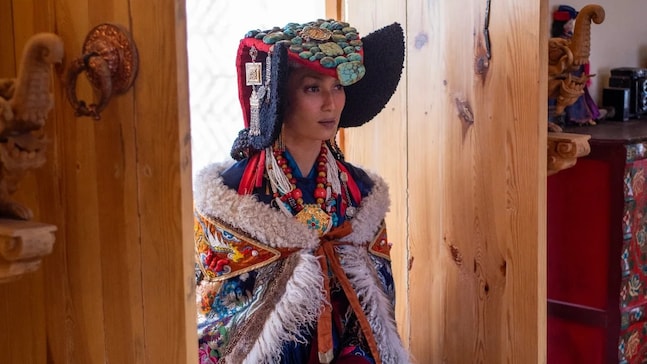
Travelling to Ladakh, there is the traditional goucha, a woven woollen robe that acts as the centrepiece at a Ladakhi wedding, often paired with an elaborate headpiece known as the perak. The perak is a long, cobra shaped leather headpiece which is heavily encrusted with hundreds of vibrant turquoise stones alongside red coral, pearl, and silver ornaments. It acts as a cultural crown, representing wealth status and spiritual protection and is often passed down as a family heirloom.
(Also Read: How Ranveer Singh breaks the rulebook as a bona fide fashion chamaleon)
While there exists a potpourri of wedding ensembles across the country, many share similarities. The saree is an essential part of Indian culture and every culture has taken this iconic drape and translated it through their own cultural lens. The same idea can be imagined in novel iterations in various traditional prints and fabrics to create something entirely unique to a particular culture. The Maharashtrian nauvari is a traditional nine-yard saree that differentiates itself with the way it is draped. Illustrated by the dhoti tuck as part of its draping, the history of the nauvari saree spans over two centuries, popularised by warriors and working women as the draping style allowed for more movement.
The Tamil madisar also follows a similar logic. Worn by Tamil Brahmin women, this drape also follows the method of passing the fabric between the legs and tightly wound around the waist, creating a dhoti-like drape called the kachcham. The cloth is usually Kanjeevaram silk with a rich zari border. Even the famed Banarasi saree comes with tweaks and additions that change it as it traverses across regions. The Bengali Banarasi saree is worn in a rich red or maroon, with the sola-pith crown, shakha-pola bangles, and chandan dots.
It is safe to say that there are as many variations of Indian bridalwear as there are cultures in India. A small glimpse at the different outfits that emerge beyond the popular garments already showcase a wide range of draping techniques, fabrics, and silhouettes. From the long, easy stride of a Tamil madisar to the barrel-shaped sweep of a Manipuri potloi, each look carries the craft, climate, and memory of the place it comes from. Some of the most striking bridal looks aren't the newest at all, but the ones that have been waiting patiently in a family trunk.
Text by Judah Abujam
Edited by Sabrina Mathews
Advertisement