- Home
- Fashion
The Met bets on John Galliano’s complicated legacy
The Costume Institute’s next blockbuster exhibition will celebrate one of fashion’s most influential designers while confronting the anti-Semitic scandal that changed his career forever
offline
Share this:
Nicole Kidman wore him to the Oscars. Jennifer Aniston slipped into one of his silver bias-cut gowns for the SAG Awards 2020. Amal Clooney chose one of his sculptural black creations for the Cannes Film Festival 2025. More recently, Zendaya paid homage to his extraordinary imagination in Maison Margiela Artisanal at the 2024 Met Gala. Three decades. Four women. Countless unforgettable red-carpet moments. Few designers have shaped the visual language of celebrity quite like John Galliano—precisely what makes the Metropolitan Museum of Art’s next blockbuster exhibition in New York so fascinating. Because, perhaps, there’s no question in fashion as uncomfortable as this: can you really separate the art from the artist?
(Also read: From the theme to the celebrity attendees, here's what to expect from the Met Gala 2026)
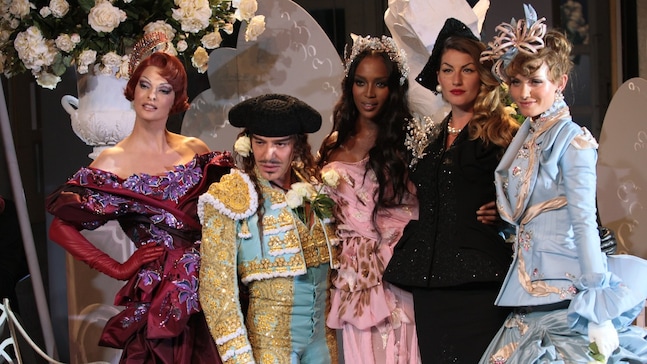
Next spring, the Costume Institute will devote its annual exhibition—and, by extension, fashion’s biggest night—to Galliano. John Galliano: Horizons will become the first major museum exhibition devoted to the British designer and only the third solo retrospective dedicated to a living designer by the Met department, following Yves Saint Laurent in 1983 and Rei Kawakubo in 2017. The exhibition will trace four decades of Galliano’s work through garments, sketches, toiles, research books, and archival material drawn largely from the Met’s own collection, the largest holding of his work anywhere in the world. It is, by any measure, fashion’s highest institutional honour—and also its most complicated.
Galliano is not simply one of the industry’s most influential designers. He’s also the man whose anti-Semitic remarks in a Paris café in 2011 led to his dismissal from Christian Dior, the collapse of his eponymous label, and a criminal conviction in France. For many outside fashion, those remarks—not the extraordinary designs—became the defining image of his career.
The Met knows history cannot be ignored. In fact, it has made confronting it part of the exhibition itself.
According to The New York Times, museum officials spent months consulting Jewish leaders before confirming the exhibition. Andrew Bolton, the Costume Institute’s curator in charge, Anna Wintour, and Galliano himself met privately with rabbis and community representatives to discuss the implications of honouring a designer whose anti-Semitic remarks remain painfully remembered. Rather than avoiding difficult conversations, the institution actively sought them out.
That consultation matters. It suggests Horizons is attempting something more ambitious than a conventional retrospective.
THE ARTISTE BEHIND THE ART
To understand why the Met is willing to take this gamble,one has to understand what Galliano gave fashion. Few designers have altered its emotional vocabulary so completely. When he graduated from Central Saint Martins in 1984, his collection Les Incroyables announced the arrival of a singular talent. Inspired by the excesses and eccentricities of post-Revolutionary France, it earned the rare distinction of being purchased in its entirety by Browns.
Where many designers looked to trends, Galliano looked to centuries. History would remain his greatest obsession. He drew on Victorian mourning dress, Belle Époque glamour, military uniforms, Japanese kimono, Spanish flamenco costumes and 18th-century tailoring, collapsing distant periods into garments that somehow felt both historical and startlingly modern.
Perhaps nowhere was that more evident than in his mastery of bias cutting. Inspired by French fashion designer Madeleine Vionnet’s revolutionary technique, Galliano used fabric cut diagonally across the grain to create gowns that skimmed rather than constrained the body. Satin appeared to ripple like water. Silk clung, released, and floated with astonishing ease. His dresses did not merely move; they breathed.
Yet technical brilliance was only part of his genius.
For Galliano, clothes were never isolated objects. Every collection unfolded as a complete narrative. The runway became a stage populated by imagined characters—aristocrats, sailors, courtesans, geishas and drifters—each inhabiting an emotional universe of their own. Fashion ceased to be a product and became sheer storytelling.
That philosophy reached its fullest expression during his 15 years at Christian Dior. Appointed in 1996, Galliano inherited one of fashion’s most storied houses at a time when luxury was becoming increasingly global. Rather than simply modernising Dior, he transformed it into the industry’s grandest theatre. Each couture show became an event that editors, buyers, and celebrities travelled in droves to witness, never quite certain what world they would enter next.
His influence soon extended beyond the runway. Nicole Kidman’s chartreuse Dior gown at the 1997 Academy Awards remains one of the defining Oscar looks of the modern era. Jennifer Aniston’s ivory bias-cut slip distilled Galliano’s extraordinary understanding of elegance into a silhouette that still feels contemporary. Years later, Amal Clooney’s Cannes 2025 appearance and Zendaya’s embrace of his Maison Margiela creations would underline the remarkable longevity of his vision. Fashion changes every season. Galliano’s imagination proved harder to date.
THE DOWNFALL & HUMBLE RETURN
Then came 2011. In February that year, video footage emerged of Galliano making anti-Semitic remarks at La Perle, a café in Paris. Within days, Dior suspended and then dismissed the designer who had spent over a decade reshaping its identity. His eponymous label followed suit. What had been one of fashion’s most extraordinary careers unravelled almost overnight. Galliano later apologised publicly, entered rehabilitation for alcohol and substance abuse, and was convicted by a French court.
For several years, he disappeared almost entirely from public life. When Renzo Rosso appointed him Creative Director of Maison Margiela in 2014, the reaction was cautious rather than celebratory. It was not simply another designer changing jobs—it was one of fashion’s most consequential second chances.
Galliano approached it with a humility rarely seen during his Dior years. The flamboyant curtain calls disappeared. In keeping with Martin Margiela’s long-standing philosophy, he often chose not to take a bow at all, allowing the work to speak louder than the personality behind it. Collection by collection, he rebuilt his reputation—not by chasing headlines, but by returning to the craft that had always distinguished him.
The culmination arrived in January 2024. Staged beneath the underbelly of Pont Alexandre III in Paris, Galliano’s Maison Margiela Artisanal collection instantly entered fashion folklore. Models emerged with porcelain-doll faces created by Pat McGrath, their bodies reshaped by extraordinary corsetry, wrapped in layers of lace, latex, tulle, and antique textiles that seemed to belong to another century altogether. The response was immediate. Critics described it as one of the defining couture collections of the decade. At a moment when much of luxury had become increasingly commercial and algorithm-driven, Galliano reminded fashion what untrammelled imagination could achieve, offering the emotional intensity that has always distinguished his work.
Long before the modern obsession with “fashion moments,” Galliano understood that audiences rarely remembered a garment in isolation. They remembered how it made them feel. A Dior couture collection might evoke nostalgia for a world that never existed. A Margiela Artisanal presentation could leave viewers unsettled, heartbroken or exhilarated. The clothes demanded an emotional response. That philosophy continues to influence an entire generation of designers.
Jonathan Anderson has frequently acknowledged Galliano’s importance to his own creative development. His recent Dior couture debut even included a quiet tribute to the man who once defined the house, inviting Galliano back into the ateliers for the first time since his departure and incorporating cyclamen flowers—brought by Galliano himself during that visit—throughout the collection. It was an act of respect and recognition for Galliano’s imprint on Dior that’s impossible to erase.
That influence extends beyond designers. The continued willingness of celebrities to wear Galliano’s work speaks to the enduring power of his vision.
WHAT DOES THE MET HAVE TO SAY?
The clothes have outlived trends. Whether they have outlived the controversy remains a far more difficult question. The Met appears determined not to answer it but to frame it.
According to its official announcement, John Galliano: Horizons will explore “how artistic achievement should be understood alongside ethical accountability.” Museum curator Andrew Bolton described every Galliano collection as “a journey among things separated by time, place, or medium,” adding that the exhibition considers not only how the designer “remapped the world through fashion,” but also “how his conduct, its consequences, and changing cultural values have reshaped our understanding of his work.”
Anna Wintour was equally direct. “There’s no one more deserving of an exhibition of this scale than John Galliano,” she told Vogue, describing his work as a collision of “erudition and creativity, darkness and light, the past, the present, the future.” She also acknowledged that his career “isn’t defined by a moment”—a recognition that artistic achievement and personal failure can coexist without one cancelling out the other.
Perhaps the exhibition’s most revealing voices, however, came from outside fashion. Rabbi Rick Jacobs, president of the Union for Reform Judaism, one of the Jewish leaders who privately met Galliano, told The New York Times that he appeared “open” and “sincere,” recalling that he “looked right at us and spoke in a clear way, not as if he had memorised talking points.”
That consultation makes all the difference. It suggests Horizons is attempting something more ambitious than a conventional retrospective. Museums now recognise that objects cannot always be separated from the hands that created them. Context has become as important as craftsmanship.
The Met is neither asking visitors to forgive Galliano, nor is it pretending the controversy never happened. Instead, it is presenting something rarer: the possibility that museums can hold contradictions. That extraordinary beauty and profound moral failure may occupy the same gallery without cancelling one another out.
Whether audiences accept that proposition remains another matter entirely. Perhaps that’s exactly why Horizons already feels like one of the most important fashion exhibitions in years. Not because it celebrates one of haute couture’s greatest visionaries, but because it asks a question fashion has spent more than a decade trying—and largely failing—to answer. Can we admire the work without absolving the maker? The Met believes the conversation is worth having. Next spring, millions of visitors will decide whether it is right.
(Also read: Indian celebs at the Met Gala over the years)
Advertisement