- Home
- Lifestyle
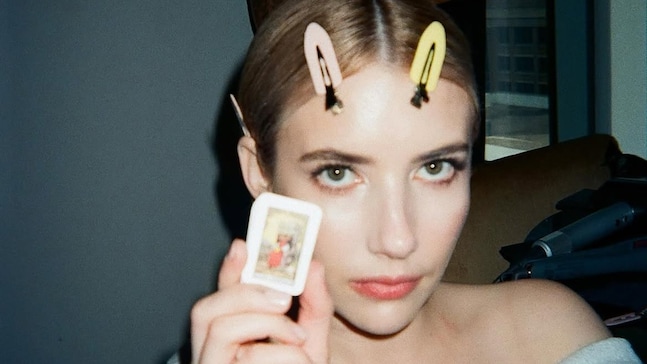
From Dua Lipa to Emma Roberts, all the cool girls tarot now
Tarot has undeniably gained widespread popularity, becoming the new accessory for celebrities and more. But is it still relevant in its very mystical sense? Or have we just lost another thing to social media saturation?
offline
Share this:
Forget the "it bag." This season, the accessory every cool girl actually reaches for isn't from a runway show - it's a deck of 78 cards. And what makes this trend feel different from past celebrity wellness fads is that it isn't about optimisation - no routines, no supplements, no five-step plans.
Tarot, as people describe it, is closer to journaling with props and manifest: a low-stakes way to pause, reflect, and access feelings that might otherwise stay buried under a packed schedule. And its reach keeps widening; it is not just confined to celeb circles but making rooms in the lives of regular folks - some carry a deck as a quiet daily habit, others turn to a favourite reader before a big event. It's portable, it's aesthetic, and it photographs beautifully. But this article, unlike others, looks past the aesthetic and the ritual, and focuses on what's actually happened to tarot in the mainstream. It is less a spiritual revival than a case study in three things: massive market saturation, social media trivialisation, and diluted symbolism.
Although tarot has quietly become a shared language of Hollywood’s most magnetic women, ranging from pop stars to Oscar-nominated actresses- it wouldn't be wrong to say that the aesthetic decks are no longer niche finds from an occult bookstore or a reading passed quietly between practitioners - they're mass-produced by major corporate publishers and sold in mainstream bookstores like trendy stationery, stacked next to journals and candles rather than tucked away in a metaphysical section. That shift is exactly what's made tarot so easy for celebrities and regular folks to fold into their everyday lives.
Emma Watson carries a deck - a gift from a friend - specifically so she can do a quick reading whenever she travels, pulling it out in a "What's In My Bag" segment the same way she might a lip balm. Anya Taylor-Joy has carried cards wherever she goes for roughly six or seven years, alongside a rotating collection of crystals like carnelian, obsidian, and rose quartz, treating the whole practice as a tactile, portable habit rather than something requiring specialised access. Emma Roberts has taken the saturation even further into fashion, hosting Dior's Cruise 2018 Tarot Collection pop-up at The Webster in Miami - an event built around Maria Grazia Chiuri's tarot-inspired designs - where she was photographed carrying a Dior tarot-motif clutch. When a luxury house is selling tarot as a seasonal motif, the cards have fully left the esoteric shelf and joined the accessory aisle.
Instagram and YouTube algorithms reduce complex archetypal structures down to rapid-fire, generalised "pick-a-pile" readings built for entertainment and watch-time, not depth. As a result, the messages often feel meaningful to some viewers, irrelevant to others, and, in most cases, amount to broadly applicable advice. The format rewards a fast pull and a relatable soundbite over the slow, layered interpretation tarot was traditionally built on. Dua Lipa's use of the cards fits this pattern in its own way: songwriter Sarah Hudson, who co-wrote hits like "Physical" and "Levitating" with Lipa, has described bringing tarot into the studio purely as an icebreaker, with a single word or feeling from a pull sparking the emotional core of a lyric rather than any deeper reading.
Lipa herself has said she'd rather not have her future predicted for her, treating a daily card pull as a quick personal check-in - a bite-sized ritual, not unlike a horoscope scroll, that fits neatly into a packed schedule. Watson's on-camera pull of the World card follows the same shape: a single card, a quick reflection, delivered inside a bag-check video built for a feed rather than a sit-down session.
Decks now feature pop-culture themes - cats, movies, or fast-food brands - stripping away centuries of dense esoteric and philosophical tradition in favor of something scrollable and shareable. No one illustrates this better than Christina Ricci, who turned her own filmography into a full 78-card deck. Released in 2024, Christina Ricci's Cat Full of Spiders Tarot Deck and Guidebook pairs a complete Major and Minor Arcana with original artwork inspired by her Hollywood career, swapping centuries-old archetypes for stills and imagery drawn from Wednesday Addams, Sleepy Hollow, and The Lizzie Borden Chronicles.
Ricci has described tarot as a tool for self-knowledge, explaining that how someone interprets a card depends on the experiences they bring to it - a genuine sentiment, but one now filtered through a deck built around a single actress's screen career rather than the Rider-Waite tradition it's modeled on. Where the Major Arcana once carried universal archetypes like the Fool or the Hierophant, a deck like this replaces them with a specific celebrity's back catalog, however lovingly designed.
Taken together, these three forces explain why tarot's celebrity moment looks the way it does. Its popularity around famous women - Lipa's studio ritual, Taylor-Joy's party trick, Watson's bag-check pull, Ricci's branded deck, Roberts' designer clutch - isn't incidental to the saturation, trivialization, and dilution described above; it's the mechanism driving it. Every red-carpet mention, every algorithm-friendly pick-a-pile clip, every pop-culture deck adds to the same effect: tarot as a widely visible, accessible, highly photogenic accessory rather than a dense esoteric practice. Whether or not you believe the cards hold any true predictive power, the mysticism surrounding tarot has undeniably lost its edge to profanation. What's left is still appealing in its own way - a quiet ritual, a moment of pause, a compelling conversation starter at your next dinner party - but it's a version of tarot that has traded centuries of tradition for a permanent seat on the accessory shelf.
Text by Mriganka Singh
Edited by Sabrina Mathews
Advertisement