- Home
- Lifestyle
HELLO! India Exclusive: How Jahnavi Mehta is bringing a new perspective to legacy
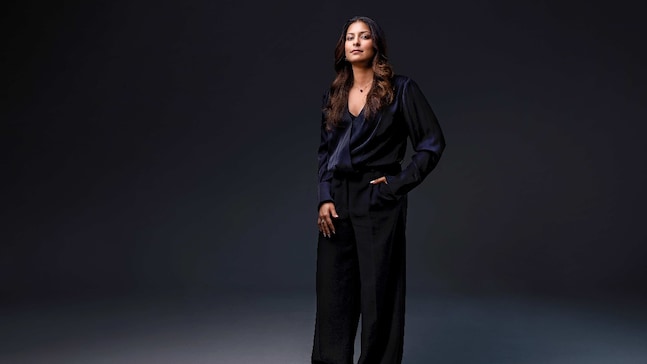
Juhi Chawla and Jay Mehta’s 25-year-old daughter is flipping the star-kid playbook, one IPL auction at a time. In her first-ever interview, she shares her dreams for her legacy — both earned and built
offline
Share this:
In an era where social media is overflowing with PR-polished and cosmetic-surgeon-chiselled star kids, pre-packaged for public consumption, Jahnavi Mehta is flipping the playbook and going old school—she is letting her work do the talking. The 25-year-old daughter of Juhi Chawla and Jay Mehta, who is heir to the Mehta family's stake in KKR as well as the Mehta Group, has happily traded red-carpet drama for high-stakes IPL auction war-room action.
“I've always been very private. I just don't feel the need to be too active on social media because I've always been very happy sharing what I'm up to and what I'm doing with the people who need to know. I think it's just not a part of who I am—it is a lot of work and it can take over your life in a way,” says the scion of a multi-generational business empire.
In an age of relentless self-promotion, this discretion has become her bulwark against ubiquity. In fact, for a generation raised online, the new status symbol is the ability to step away from the algorithm while still commanding attention. But ask her whether her vehement refusal to become paparazzi catnip is part of a strategy of selective visibility and she laughs it off and attributes it to her being never really exposed to the world of media while growing up. “Hence, I am not very comfortable with the attention. Even at the first auction I went to, I was so uncomfortable doing interviews and things like that because I'd never really been exposed to any of this before,” she says.
This might seem a tad odd given that she happens to be the daughter of Bollywood star and '90s icon Juhi Chawla. “She was very particular about shielding my brother and me from the paparazzi and the media.”
Although she grew up in Mumbai, her family always maintained a measured distance from the spotlight, ensuring that Jahnavi and her brother enjoyed a normal childhood away from the media glare. Then, at 16, she left home for the UK. From there, she moved to New York for her undergraduate studies. It has been seven years since. “I was really able to figure myself out—who I am, what I want to do—away from any attention. There haven't been eyes on me scrutinising my every move,” she explains.
In fact, she insists that while growing up, she never really felt like a star kid. “I don't think it ever really struck me that she was a big movie star. This is embarrassing to admit, but to this day I haven't watched any of her movies. She's always just been Mom!”
She admits that she found watching her mother on screen a tad bit odd. You've only ever really known her as your mom. And then she's in these movies, playing romantic leads, and is just a different version of herself. I always found it a little off-putting,” she says, pointing out that Bollywood has had very little influence on her life and that she was never smitten with the idea of becoming a Bollywood heroine like her mother. “I'm definitely not someone who likes being in front of a camera, so it's really not for me,” she says.
That doesn't mean she is immune to the charm of cinema. “My dad is a huge movie buff. He loves Westerns. I grew up on a robust diet of Star Wars and Indiana Jones films. Even now, I love going to the cinema and watching movies. I go alone, and it's mostly Hollywood.”
But it is sport that has always been her true calling. She grew up playing football and tennis. She skied, dabbled in squash and golf. Yet it was the Indian Premier League—launched in 2008 seducing Indian cricket fans one floodlit evening, one last-over thriller and one towering six at a time, while shifting cricket's economic centre of gravity decisively towards India—that completely captivated seven-year-old Jahnavi.
“Since I was seven years old, IPL has been a huge part of my life. In the first few years, my parents were heavily involved with KKR—my dad was managing the team. Because I was so young, and because my parents were so involved, there was so much emotion attached to it that I just got swept away by it. But over the years, that emotional connection evolved into a curiosity about how a team actually works. The one thing that never changed was my obsession with winning the IPL,” Jahnavi says with a laugh.
Recognising her passion and curiosity, Venky Mysore, CEO of Knight Riders, took her under his wing at a young age and began introducing her to the inner workings of the franchise. It was he who first got her to the IPL auction in 2018. “The whole thing was pretty intimidating. I was just 16, still learning about the game and how auctions worked. I'd never been part of something that big before—and then it was a televised event!” she recalls. But she is not the one to buckle under pressure. She not only thrived, she instantly became a talking point. The country was introduced to a 16-year-old star kid and heir to a sprawling multi-generational business empire, sitting alongside seasoned executives and owners armed with player lists and bidding paddles.
For Jahnavi, the experience proved transformative. “I think I just fell in love with the whole world. I fell in love with the industry, the people, the pressure and the stakes. I wanted to be in the cricket world.” She got her start with a short internship at Knight Riders in 2021, during the pandemic.
“My dad encouraged me and said, 'If you have the time and you're interested, why not go and see what the commercial side of the IPL is like?' I worked with the marketing team for a few months. We had an auction in the middle of that period, and I got to see how the marketing team prepared for it.
“But it was equally fascinating to see what goes on behind the scenes during the off-season. When you're not playing cricket, so much goes into keeping the fan base engaged and excited for the next season,” says Jahnavi who then went on to earn a Master's degree in Sports Management from Columbia University. “I just wanted to learn more about this world that I'd fallen in love with!” she quips.
Today, five IPL auctions in, Jahnavi has learnt that running a cricket franchise requires far more than a passion for the game. From an IPL fan, she is evolving into one of its future custodians.
Her biggest lesson? Leave emotion at the door. Players may become friends, but successful franchises are built on contingency plans, strategic discipline and difficult decisions. Yet it is not just about assembling a squad. Beyond the floodlights lies an intricate ecosystem of talent management, culture-building and constant human engagement. Great teams aren't merely bought at auction; they're built behind the scenes. “This is very much a people-oriented venture. You have to make sure that every single person feels cared for because that's what makes a great team,” she says.
The blueprint, however, comes from her father. He taught her that relationships are as valuable as revenue. “He's always stressed the importance of people in business—you need to have friends not only in your industry but also in other industries. They can become crucial sounding boards,” she says.
In an age obsessed with metrics and performance, it is a lesson that may prove to be one of her greatest advantages. She also hopes to imbibe his sense of integrity into her own business DNA. “I think it's very important to be honest with anyone you're dealing with, whether in a transaction or a relationship.”
Another quality she deeply admires is his ability to weather professional storms without allowing them to spill into family life. “He has turned around quite a few businesses that he inherited. It must have been extremely stressful, but I didn't even know what he was dealing with at work.”
She hopes to carry forward these qualities but rather than merely inheriting a legacy, she wants to build one of her own. “I have the utmost respect for what both my parents have done, and for what my grandfather [Mahendra Mehta] and great-grandfather [Nanji Kalidas Mehta], who started the family legacy, created. But I want to carve out my own path and build my own legacy,” says the fourth-generation businesswoman navigating the intersection of legacy and modern leadership.
And she wants her legacy in sport to be measured not by titles won, but by the opportunities she creates. “I would love for my legacy in sports to be one not just of commercial excellence or winning championships, but also one where I've helped sports—not just cricket, even though that's where I would probably start—grow in India in terms of access. I want India to grow into a sporting powerhouse. I would love to be part of that story, and I would love to leave my mark in that way. It definitely a big dream, and I would love for my legacy to be defined, at least in part, by that,” Jahnavi signs off.
PHOTOGRAPHY: PETER HURLEY
MAKEUP: LUIS GUILLERMO DUQUE
Advertisement