- Home
- Lifestyle
HELLO! India in conversation with Avani Rai on the big Pirelli moment
The ace photographer takes us behind the scenes of the 2027 Pirelli Calendar — an homage to classic glamour and her father Raghu Rai — with a stellar line-up of Indian stars
offline
Share this:
For renowned photographer Avani Rai, the question of legacy became “very real” when the Pirelli Calendar came her way. She took over the project after her father, renowned Indian photojournalist Raghu Rai, passed away in April, committing to realising his plans for the exclusive, highly anticipated annual publication.
However, this legacy, to her, wasn’t about “reproducing” what anyone had done. It was more about understanding what she was given and deciding what to do with it. “Being part of the calendar was an opportunity to carry something forward but also to make it my own,” Avani tells HELLO!. “I was entering the Pirelli Calendar’s long visual history through my father, but I was also venturing into it as myself.”
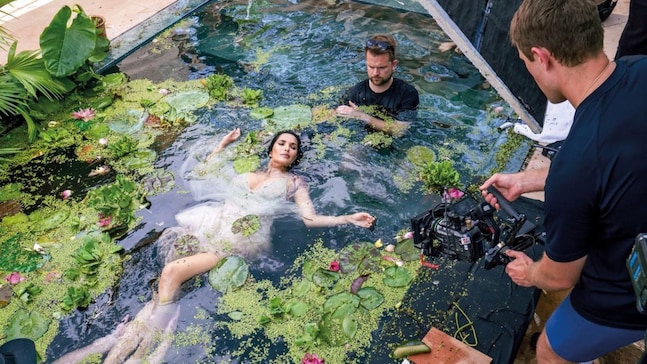
Born in 1964, the Pirelli Calendar — also known as ‘The Cal’ — has been bringing together the world’s most captivating faces and in-demand photographers: think Kate Moss being captured by Herb Ritts for the 1994 edition, or Annie Leibovitz photographing Serena Williams in 2016. Carrying that glamorous tradition forward, the 2027 edit turned its lens on India — like much of the world of fashion. It was shot entirely in India, spanning the streets of Delhi and historic locations in Rajasthan such as the Jaigarh Fort in Jaipur and Ajabgarh in Alwar.
Actors Aditi Rao Hydari and Freida Pinto, models Lakshmi Menon, Bhavitha Mandava and Padma Lakshmi, and sitar player Anoushka Shankar are the familiar faces in the pages this year. Also, for the first time in its history, the calendar features the work of two photographers: Besides Avani, Norwegian photographer Sølve Sundsbø returned to the project once again after conceiving the 2026 calendar based on ‘The Elements.’ While Avani’s work features street photography, Sølve focussed on the portraits for which he is renowned.
In this interview, Avani takes us through how the calendar took shape and the perception of India she hoped to portray
HELLO! India: The Pirelli Calendar has historically been a powerful document of changing ideas around beauty, identity, and representation. What does it represent to you today?
Avani Rai: For me, it represents a conversation about who we choose to look at and how we choose to look at them. Ideas around beauty are ever-changing because the world is always changing. It exists in the way people carry themselves — in spaces, in relationships, in age, in vulnerability, in confidence. What interests me is not necessarily trying to redefine beauty but being open to where beauty appears.
For this calendar, I wanted to photograph people and places without separating them into ideas of subject and background. The woman, the landscape, the clothing, the light, the architecture, the history all existed together. As I perceive it, the beauty was somewhere within that relationship.
And, perhaps, that is what the calendar represents today: an opportunity to keep expanding the way we look at things rather than arriving at another definition.
HELLO! India: What was most challenging while creating this body of work?
Avani Rai: I constantly thought about how I could take something someone had started and make it my own, while maintaining the dignity of what they had begun. It’d have been easy to try to imitate my father, but one would have had to be the person he was — living in the time he did and seeing the India he saw — to make those photographs. So, I had to accept that I could only photograph India from where I stand today.
He photographed India for 60 years and I, for the last decade. The India I’m looking at has changed dramatically. Technology, cities, fashion, aspirations, and the way people communicate and see themselves have all changed. The challenge, if there was one, was to allow that difference to exist rather than trying to bridge it artificially.
HELLO! India: What do you think the next chapter of representation in fashion photography should look like?
Avani Rai: Fashion doesn’t just exist in luxury or on a runway. It’s how people dress for work, how they move through a city, celebrate, relate to one another, and present themselves to the world. In fact, the most interesting fashion images are often the ones where the clothing is only one part of the story.
So, I believe the next chapter of fashion photography should look beyond the traditional idea of fashion as a product or an image of perfection. Rather, it should look towards how people live with fashion and what it means to them — in class, culture, gender, tradition, and modernity.
HELLO! India: The calendar has always played with the relationship between fashion, beauty, and art. How did you navigate between creating an image that is visually striking and one that has something deeper to say?
Avani Rai: I don’t think of them as two separate entities. Photography can have great ideas and philosophies around it, but at the end of the day, it involves taking photographs. You pick up the camera, look through the viewfinder, and have to be receptive to what’s happening in front of you. That’s where the image begins. In the photos [for the calendar], I wasn’t thinking about the landscapes as the backdrops and the women as the subjects. The spaces, people, clothes, lighting, and everything happening around them were all part of the same photograph. Nothing is completely foreground or background. The value of being visually striking comes from that relationship, rather than from trying to make something look beautiful.
HELLO! India: India is often photographed through familiar visual tropes. What did you want your version of the Pirelli Calendar to portray about the country that it may not have seen before?
Avani Rai: I didn’t set out to uncover an India that no one had ever seen. That feels almost impossible. I just wanted to photograph the India I actually know and live in. It isn’t a single image. It’s a place where the deeply ancient and the intensely modern sit right next to each other, where total chaos lives alongside moments of deep quiet. There is real beauty here, but it’s bound by constant contradictions. I wanted the images to give those contradictions space to breathe.
HELLO! India: With the calendar reaching a global audience, did you feel a sense of responsibility in presenting your interpretation of India?
Avani Rai: I did but in my own way. I didn’t feel a responsibility to explain India to anyone. The moment you try to explain a place this complex, you strip away what makes it real and flatten it into something simple. My only responsibility was to be completely honest about the India I know. I wanted these photographs to feel like invitations rather than definitive statements. Something that sparks curiosity instead of handing over a neat answer. If someone looks at a frame and feels like there’s a layer there they hadn’t quite figured out yet, then the image did its job.
HELLO! India: Raghu Rai created some of India’s most enduring images. What was it like to bring his visual language into the work? And how did you approach using his photos without his legacy overshadowing your artistic vision?
Avani Rai: In this work, they are much closer to the centre of everything. For me, his photographs are the most important part of the visual history [of the calendar] I’m entering. When I place one of his photographs within my image, I don’t imagine it as an image sitting behind mine. I imagine my father standing in front of me, taking that photograph. And then there’s me, standing there, decades later, looking at the same world — or what remains of it — and seeing how it now relates to that image. That’s what I attempted to do. It became a strange kind of conversation across time. He stood there and looked at India then. I stood behind him, much later, and looked at what India had become, and also at how his way of seeing continues to exist within it.
So, visually, his photos weren’t an archive I borrowed from. They denoted his presence. Also, I don’t really think about being overshadowed by my father’s work. He took his photographs. I take mine. And somewhere between those two acts, there is a conversation.
INPUTS FROM: MIRANDA THOMPSON
BTS PHOTOS: ALESSANDRO SCOTTI
This story was featured in the Vol 1. Issue 10 of HELLO! India. For more exclusive stories, subscribe to the magazine here.
Advertisement