- Home
- Lifestyle
India Design 2026 was the culmination of innovation and Indian craftsmanship
From sculptural marble and tactile wallcoverings to performance-driven surfaces and fluid home concepts, India Design, this year, proved that Indian design is not just participating in global conversations but shaping them.
offline
Share this:
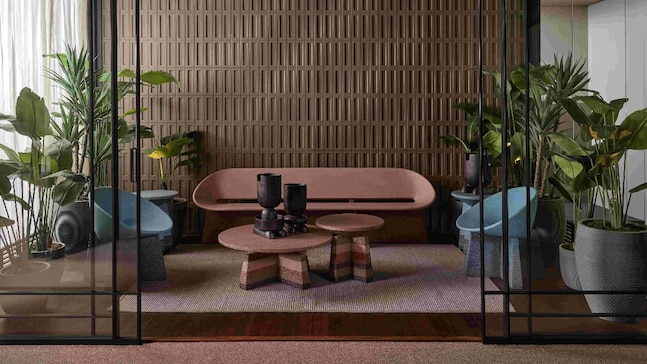
India Design 2026 returned this year with an energy that felt noticeably different. More than just a display of beautiful objects, the exhibition unfolded as a thoughtful exploration of how contemporary Indian design is evolving. It evolved into a stage where craftsmanship, material innovation, and cultural memory came together to shape the future of the spaces we inhabit.
At the centre of this conversation was A-Class Marble, whose installation immediately set the tone for the exhibition. Titled The Cleft and conceptualised by 42mm Architecture, the space invited visitors to reconsider marble not as a decorative surface but as a structural, architectural element. With the unveiling of the striking Zambian marble Angelo Fiore and the dramatic outdoor installation Carved by Time, the brand demonstrated how stone can transcend its traditional role—becoming a medium that shapes volume, light, and spatial experience.
A more intimate narrative unfolded at Beyond Designs, where The Velvet Chateau transported visitors into the romantic atmosphere of a European country home. Vaulted ceilings, softly aged wooden floors, and carefully placed objects created a setting that felt both nostalgic and quietly luxurious. The space balanced old-world charm with a contemporary sensibility, offering a reminder that design is often as much about emotion as it is about aesthetics.
At Coast to Coast, veneer took on an unexpectedly playful identity. The pavilion began with a bold piñata-inspired façade, an energetic entrance that opened into a warm, tactile interior. Inside, the material revealed its versatility—moving seamlessly from exuberant expression to understated sophistication, demonstrating how veneer can shape environments that feel both lively and refined.
Walls themselves became protagonists at Drapesy, which presented its installation under the theme Modern Grandeur in collaboration with Arte. Here, wallcoverings were not treated as background elements but as immersive landscapes that defined the mood of a space. Rich textures, layered patterns, and thoughtful compositions transformed surfaces into sensory experiences.
Global retail brands also brought distinctive perspectives to the exhibition floor. West Elm embraced its signature mid-century modern vocabulary, presenting its collection inside a striking plywood structure punctuated with Mondrian-style blocks of colour. Each piece was curated almost like an artwork within the architectural shell. In contrast, Pottery Barn leaned into a softer aesthetic with their signature pastel hues, classic wooden forms, and delicate floral accents that celebrated the idea of home as a place of comfort and familiarity.
For Sarita Handa, the focus remained inward. The space distilled traditional techniques into a refined, architectural language that celebrated India’s rich craft heritage. Lime-washed walls and sharp geometric forms framed kantha-quilted sheer linen bedspreads and tactile cushions from the Geo Rhythm and Frondage collections. The result was a harmonious blend of heritage and restraint, where craft felt quietly contemporary.
Meanwhile, VOX shifted the discussion toward performance and functionality rather than mere aesthetics. The brand highlighted its systems-driven approach to interiors by demonstrating how materials can influence durability, comfort, and adaptability within modern environments. It was a reminder that design innovation often lies in the unseen layers of a space.
At Wriver, the theme Living Re-Defined marked a new chapter for the brand. The introduction of the Genesis collection alongside its debut wardrobe category presented a vision of the home as fluid and evolving, where spaces were seen to adapt to the rhythms of contemporary life rather than remaining static.
Amid the visual richness of the exhibition, artist Vibhor Sogani offered a contemplative moment with Dance of Balance. The kinetic installation explored the idea of equilibrium—both in physical form and in the broader dynamics of society—encouraging visitors to pause and reflect.
What emerged from India Design 2026 was not simply a display of products or trends. Instead, it felt like a collective statement about where Indian design is heading in the near future. Materials were reimagined, craft traditions were reframed, and spaces were conceived not only as visual environments but as experiences.
And perhaps the most powerful takeaway was this: Indian design is no longer just responding to global conversations. Increasingly, it is leading them.
Advertisement