- Home
- Lifestyle
Prasad Bidappa on the ultimate question of cultural appropriation: Who owns the hand?
When Indian craft becomes global luxury, why does our country so rarely receive the credit — or the value? Prasad Bidapa, eminent fashion stylist, consultant, and choreographer shares his two cents.
offline
Share this:
Cultural appropriation is nothing new. What is new is that India has finally begun to question it. For centuries, the world has borrowed from India — our textiles, motifs, dyes, embroideries, silhouettes, jewellery, and extraordinary artisanal knowledge. I have no objection to cultural exchange. The realm of fashion would be quite dull without it. Civilisations have always borrowed from one another, and some of the most beautiful things in the world have emerged from this cross-pollination of ideas.
The problem begins when inspiration becomes extraction — when the source is erased, the vocabulary is conveniently changed, the craftspeople disappear from the story, and something that has existed in an Indian community for generations suddenly reappears as a European luxury “discovery.”
We’ve seen this happen for centuries. Take chintz, for instance. The word comes from the Hindi chint, associated with patterned or spotted cloth. In the 17th and 18th centuries, Indian painted and printed cottons became so desirable in Europe that England and France restricted their import to protect domestic manufacturers. Subsequently, European manufacturers learnt to imitate the brilliant colourfast cottons. The object, technology, aesthetic travelled — what gradually disappeared was India from the centre of the story.
Paisley offers another example. The buta or boteh motif traversed through Persia and India, and became intimately associated with the magnificent shawls of Kashmir. European demand became enormous and industrial production followed, particularly in the Scottish town of Paisley. Think about the extraordinary power of that act of labelling: A centuries-old Asian design vocabulary became so successfully industrialised elsewhere that the world remembers Paisley more readily than Kashmir.
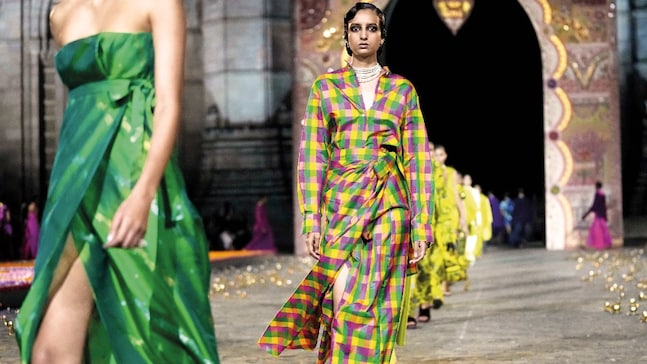
The glorious handwoven chequered Madras cottons exported through their port travelled across continents and eventually became an emblem of American Ivy League dressing. “Bleeding Madras,” famous for colours that softened and changed with washing, became hugely fashionable in the 20th century. But somewhere between the Indian loom and the American lifestyle advertisement, the Indian hand became invisible.
And that, to me, is the real issue.
INSPIRATION VS EXTRACTION
The Prada controversy made this imbalance almost absurdly visible. In 2025, the house showed leather sandals in Milan bearing an unmistakable resemblance to the Kolhapuri chappal, initially without publicly identifying that provenance. The irony was particularly sharp because the Kolhapuri is not some vague aesthetic floating freely through fashion history; it is a registered Indian Geographical Indication associated with the specific regions of Maharashtra and Karnataka.
After the controversy, something important happened. Prada acknowledged the inspiration, and in April 2026, they launched a limited-edition collection explicitly called “Made in India x Inspired by Kolhapuri Chappals,” manufactured by skilled artisans in the two states. The brand also announced a three-year training programme intended to reach 180 artisans.
Prada’s response ultimately provides a useful model because it proves that credit, collaboration, and economic participation are not unreasonable demands. They are entirely possible when a global luxury house decides that provenance matters.
My question is simply this: Why should outrage have to precede acknowledgement?
Ralph Lauren recently found itself in a similar debate over a skirt the brand described as a “Print Cotton Wrap Skirt” in a “Tie Dye Multi” colourway, despite its obvious visual relationship to bandhani. The distinction matters because bandhani is not simply a pattern — it is a technique, a body of knowledge, and an extraordinary exercise in patience. To present its visual language merely as a “print” can reproduce the appearance while eliminating the very hand-skill that gave birth to it.
India is hardly alone in confronting this. Mexico has repeatedly challenged international fashion companies over the use of indigenous embroidery and craft traditions without adequate acknowledgement or benefit to the communities concerned. The debate is global, and it will only become more urgent as fashion searches the world for “authenticity.”
For me, the ethical test comes down to three things: credit, collaboration, and compensation. If you draw materially from a living craft tradition, identify it. If specialised knowledge is required to make it, involve its practitioners. And if enormous commercial value is being created from that heritage, allow some of that value to return to its custodians. That isn’t charity. It’s ethical luxury.
THE INVISIBLE INDIAN ATELIER
There is, however, another side to this argument that makes me deeply uncomfortable: We cannot blame the West for everything.
For decades, some of the world’s greatest luxury products have passed through Indian hands. Extraordinary embroiderers in Mumbai and elsewhere have executed work that require levels of dexterity that very few ateliers anywhere in the world can equal. Yet, when the finished garment arrives in Paris, the Indian artisan often disappears, and the European house acquires the authorship, mythology, prestige, and margin.
Dior deserves acknowledgement for helping to change that conversation. Its spectacular 2023 Mumbai presentation openly celebrated the house’s long relationship with Chanakya and Indian craftsmanship. That recognition was important, but part of me inevitably wondered: Our embroiderers were always good enough to make European luxury. Why did it take decades for these Indian hands to become worthy of being part of its public story?This brings us to a much bigger question: Why has India remained one of the great ateliers of the world without becoming one of its great luxury capitals?
We possess almost everything required to create extraordinary international luxury houses. We have Banarasi brocades, Kanjeevarams, jamdanis, patolas, Paithanis, Chanderis, muga, eri, ajrakh, kalamkari, bandhani, chikankari, zardozi, and so much more. We have extraordinary leather work, jewellery, metal work, and embroidery. We have splendid designers and craftspeople who accumulated knowledge over generations. And today, importantly, we also have enormous capital.
So, where is India’s Gucci? Where is our Hermès?
INDIA HAS THE CRAFT. WHY NOT THE POWER?
After decades of organised Indian fashion, why have we not created a global luxury house with the cultural authority of Gucci, Hermès, Chanel or Louis Vuitton?
Perhaps the uncomfortable answer is that we have been very successful at creating designers but less successful at building houses. Indian fashion became extraordinarily adept at selling expensive clothes to wealthy Indians, particularly bridal couture. But international luxury is a completely different architecture. It requires accessories, leather goods, fragrance, beauty, eyewear, home, hospitality, retail, communications, archives, and a carefully constructed universe that can survive beyond the personality of its founder.
And now, India’s largest corporations have entered the equation. Aditya Birla acquired a majority stake in Sabyasachi. Reliance Brands has invested in some of India’s most prominent designer businesses. This should represent an extraordinary opportunity. Indian capital has become sophisticated enough to invest in luxury, but has it demonstrated the same ambition in exporting Indian creative and intellectual capital?
The conglomerates cannot view Indian designer acquisitions simply as attractive domestic portfolio investments. If they own some of India’s most powerful creative names, they have an opportunity to build global luxury institutions. Our designers, too, must accept part of the responsibility. International luxury cannot survive indefinitely on personality. A great house eventually has to become larger than its founder.
France and Italy did not become luxury capitals simply because they possessed superior craftsmanship. They learnt how to convert craftsmanship into authorship, provenance, mythology, scarcity, and economic power. India possesses craftsmanship prowess. Too often, we have surrendered the authorship
WHO OWNS BANDHANI?
There is also the question of law, and here the problem becomes extremely complex. India does have protections. Kolhapuri chappals have GI registration. We have the Handloom Mark intended to authenticate genuine handwoven products, and legislation exists to reserve certain textile articles for handloom production. Yet, anyone who has worked seriously with Indian textiles knows how easily powerloom cloth enters the marketplace masquerading as handloom. Sometimes, it takes an expert eye to tell the difference, and the ordinary consumer has very little chance.
There is an even deeper problem. Our intellectual-property systems are essentially designed to protect ownership, whereas Indian craft frequently represents collective authorship. A corporation can trademark a logo. An individual designer can protect an original design. But who owns bandhani? Who owns a weaving grammar perfected by thousands of anonymous craftspeople over centuries? Who files the copyright? Who receives the royalty?
India urgently needs to become more sophisticated about protecting its collective intellectual capital. GI registration cannot simply be a certificate filed away somewhere. It has to become an internationally understood mark of provenance and value.
THE ₹500 HAND & THE €1,000 LABEL
Luxury is not simply workmanship. It is authorship, provenance, storytelling, presentation, scarcity, distribution, and desire. France and Italy understood this magnificently. They did not merely preserve their crafts; they constructed mythology around them. They taught the world to revere the atelier, the archive, the master craftsman, and the ‘Made in Italy’ or ‘Made in France’ label. India has spent decades selling products, whereas Europe spent decades selling provenance.
That must change. Every significant Indian craft needs rigorous provenance systems. GI protection must become internationally assertive rather than domestically ceremonial. Handloom authentication should become traceable and almost impossible to counterfeit. Artisan clusters need access to designers, lawyers, branding experts, and international markets. And when international companies materially use identifiable Indian traditions, provenance should be clearly disclosed, and the communities that preserve those traditions should participate meaningfully in the value being created.
Most importantly, we must stop treating craftspeople merely as labour. A master weaver is not simply a pair of hands executing a designer’s instruction. He or she is a repository of intellectual capital — of colour systems, mathematical structures, materials, techniques, symbols, and knowledge accumulated over generations. The hand itself is an archive, and that archive has value.
I do not want India to respond to cultural appropriation by becoming culturally possessive. Quite the opposite. When the world wears India, I want it to know that it is wearing India. And I want the people whose hands preserved these traditions through generations — often through poverty, indifference, and changing fashions — to participate in the prosperity when the world suddenly decides that what they make is desirable.
Cultural exchange enriches everyone. Cultural extraction enriches everyone except the culture that created the value. For centuries, India has supplied the world with extraordinary materials, techniques, and ideas. Perhaps the next chapter of Indian luxury must be about something much larger than protecting ourselves from appropriation. It must be about reclaiming authorship.
The future cannot simply be Made in India.
It must be created in India.
Text by Prasad Bidappa
Advertisement