- Home
- Lifestyle
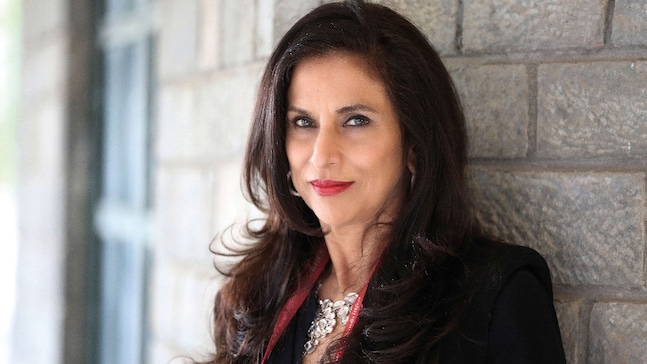
Shobhaa Dé unfiltered and unapologetic with HELLO! India
As the lit fest season takes off, the prolific columnist, author and opinion-shaper expands on observations on life, love, sensuality and sexuality from her latest book, The Sensual Self
offline
Share this:
HELLO! India: You described The Sensual Self as one of the most difficult books you have ever written. It certainly offers delicate personal insights. How does the over-sexualised dating culture of today feel to you?
Shobhaa Dé: This book was a high-wire, tight-rope act for me! I had to strike the right balance between the personal, anecdotal and universal. I’m not the least judgemental about the millennial and Gen Z ethos — I’m concerned! More like a dadi or nani. The supersonic speed at which this generation is changing every conceivable construct deserves undiluted admiration. We had the last big shift with the Sexual Revolution of the 1960s. That was the major seismic switch that shook the world. I’m all for change and questioning the status quo.
HELLO! India: We appear to have a modern swayamwara in dating apps. Yet it tends to be about hookups…
Shobhaa Dé: Maybe hookups are the answer for a generation in a tearing hurry. Marriage needs to be slow-cooked — like the best dum biryani. Marriage demands patience. Hookups are like satisfying instant noodles eaten out of throwaway containers!
HELLO! India: At your recent Tata Theatre discussion, a young woman said it felt alien for her generation to think of being monogamous. She called it a life sentence!
Shobhaa Dé: A “life sentence” is an apt description for a majority of marriages in patriarchal societies. Monogamy is crucial if children are a part of the decision to marry. But given the socio-political changes today, women have as much agency over their choices as men have always enjoyed. I’m pretty confident a new social order will emerge from this churn.
HELLO! India: You write on sensuality as a creative woman: “A book pregnancy is worse. Your mind and heart are taken.” How accommodating has Mr. Dé been, towards a “book pregnancy?”
Shobhaa Dé: The word “accommodating” has a condescending ring to it. I prefer “evolved.” An evolved partner does not compete with a book! An equal partnership takes creative commitments seriously… And f inds them sexy!
HELLO! India: You made a pertinent point about how a “spreadsheet” approach rules over everything. You write, “Who needs a condom when no real sex is on the agenda?” We even hear of robo dolls! So what is “real” sex?
Shobhaa Dé: “Real” sex starts in the mind. It’s not acrobatics, or a Pilates substitute. Real sex engages partners on all levels — cerebral, emotional and physical. It can’t be compartmentalised. Without emotional engagement, it’s mere copulation, not love-making. Sex robo dolls are programmed to stimulate the body and satisfy the customer. But pleasure and fulfillment come only from a meeting of bodies, imagination, fantasy and pleasure.
HELLO! India: You made a sharp observation that Gen X, Y, and Z must suffer a lot more emotional damage with today’s unstable coupling. You write, “Heartbreak demands the deep red of wounds that never heal.” What are your views on heartless liaisons?
Shobhaa Dé: The words “heartless liaisons” are harsh reminders of what we are rapidly losing — tenderness, love, compassion and grace. Spreadsheets over bedsheets! How cold and unromantic that sounds. There’s a lot to be said for old-fashioned wooing and courting that enhances love-making and dignifies the partners indulging in it. Animals mate. Human beings make love. Huge difference!
HELLO! India: Earlier, women were seen as forced actors in their sexual representation in public media. Today, they play the bold card to get ahead — be it your Uorfi Javeds, Rakhi Sawants, or new actresses. How do you respond to such sexual selling?
Shobhaa Dé: These are individual choices made by protagonists who think of it as a performative act for public consumption. They build careers around a certain kind of provocatively clad persona. In the Insta-verse, which is a huge equaliser, everything goes. The very fact that people like Uorfi and Rakhi rack up a million views each time they step out says as much about them as it does about the voyeur lurking inside all of us.
HELLO! India: Would you choose to be born again as a young woman in these times, in an era where women are buying the drinks, picking men up for dates, getting bored with one partner, and experimenting with open marriages?
Shobhaa Dé: Not sure how “liberating” the chaos is in reality. Or is it just another compulsion? Every generation has its own set of compulsions — rebellion can also be just that, as can defiance. Both are essential if social norms have to be redefined and recalibrated. Chaos is exciting! It shifts the boundary line, and that’s always a good indicator of a dynamic society in the throes of major change.
HELLO! India: You have dwelled on the cult of heartbroken songstresses — Diana Ross, Whitney Houston, Mariah Carey, and now Taylor Swift. However, Chetan Bhagat recently shared that since men don’t talk easily, heartbreak devastates them far more…
Shobhaa Dé: I agree with Chetan Bhagat. We rarely stop to think about male rejection and how it can be equally crushing. Male heartbreak is also overdramatised in cinema — let’s call it the Devdas syndrome. Society generally mocks a man who’s been rejected, whereas a woman nursing a heart break generates far more empathy or sympathy from her close-knit circle.
This story was featured in the Vol 1. Issue 6 of HELLO! India. For more exclusive stories, subscribe to the magazine here.
Advertisement