- Home
- Lifestyle
The enduring legacy of Satish Gujral, in Raseel Gujral Ansal's words
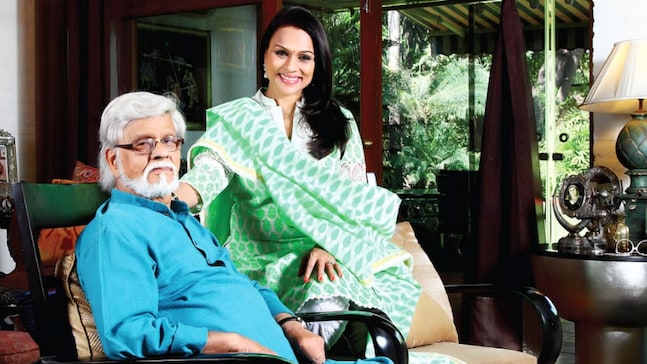
Raseel Gujral Ansal pays tribute to her father, Satish Gujral, on his birth centenary, reflecting on his extraordinary legacy and the values that defined him.
offline
Share this:
I was born when my father was nearing forty. By then, much of the turbulence of his early life had given way to a remarkable period of creative energy. The man I knew was deeply Punjabi in spirit. There was never calculation in him, only intensity.
Perhaps that is why he instinctively treated me as an equal. We argued often. We challenged one another constantly, and neither of us yielded easily. Looking back, I recognise that we shared more than a familial bond. We shared a temperament.
For the first thirty-five years of my life, he was, above all, my father. I had always known that I was growing up with an extraordinary artist. What changed, almost imperceptibly, was that he began to let me into his world. Our conversations deepened. At some point, my responses ceased to be those of a daughter and became part of an ongoing dialogue. Nothing was ever announced. It simply lived in the conversations we kept returning to.
It was during those years that I came to know him more completely. I saw his fragility as clearly as his fortitude. I saw disappointment and moments of disillusionment, but never cynicism. Beneath his formidable presence lay an immense purity. There was nothing performative about him. He never confused recognition with identity, nor success with purpose. Creation, for him, was never a profession. It was simply the way he inhabited the world.
People often describe him as a multidisciplinary artist, but that never felt like an adequate description. He never thought in disciplines. Painting, sculpture, architecture and design were simply different languages through which an idea found its most natural expression. He approached each with the same instinctive fearlessness and expected the same conviction from those around him. I remember telling him that although I had spent years practising interior architecture and furniture design, I didn't have a formal architectural degree. His response was immediate: "People spend five years acquiring a degree. You've spent fifteen years in practice. Go out and own it. Don't be a reluctant participant." He measured people not by qualifications, but by curiosity, commitment and belief in themselves.
His relationship with the art world reflected that same independence. His distance from galleries and the auction market was deliberate because he believed the work itself should remain at the centre of artistic life. In later years, there were moments when he wondered whether the perception of his work had always kept pace with its significance. We spoke about it often, and I would remind him that his responsibility had never been to keep pace with the market, but to remain faithful to his own vision. History would decide the rest.
As we celebrate his centenary, I find myself thinking less about milestones and more about those conversations. Of course, a hundred years is an occasion to honour an extraordinary artistic legacy—one that reshaped Indian art across painting, sculpture, architecture and design. His influence cannot be contained within a single discipline because he himself refused to recognise those boundaries. But for me, this centenary is equally about remembering the man behind the work: his generosity, his integrity and his unwavering belief that the only thing an artist truly owes is honesty to the work itself.
One of the most moving moments of this centenary is the release of a commemorative postage stamp featuring one of his rare self-portraits, painted around 2010. It is one of only about four self-portraits he ever created. To see such a deeply personal image become part of the country's collective memory is profoundly moving.
For me, the stamp carries an even deeper significance because it completes a remarkable full circle. My father's relationship with the Department of Posts did not begin with this honour. In 1996, he designed the commemorative stamp marking the 125th anniversary of Videsh Sanchar Nigam Limited, choosing a sculptural spiral to symbolise the universal flow of communication rather than relying on literal imagery. More than two decades later, he designed the 2019 Financial Inclusion commemorative stamp, interpreting the idea through the Indian Rupee symbol, a horse representing strength and forward movement, and abstract interconnected forms that spoke of progress and accessibility.
Today, the artist who once designed commemorative stamps for the nation is himself being commemorated on one. There is something quietly poetic about that journey. His work has never felt like something to be possessed or protected. It has a life of its own, continuing to evolve through everyone who encounters it. If this centenary allows a new generation to discover not only the artist but also something of the man behind the work, then I cannot imagine a more fitting tribute.
Text by Rasel Gujral Ansal. Founder & Creative Director, RGA Design LLP, Casa Paradox Luxe, Casa Pop, Raseel Gujral Art Legacy, Arzaani Atelier. Raseel Gujral Ansal stands at the forefront of Indian luxury design, with nearly four decades of multidisciplinary expertise spanning architecture, spatial design, bespoke furniture, art, and lifestyle. Born into the illustrious Gujral family, Raseel is the daughter of the renowned Padma Vibhushan recipient Satish Gujral and celebrated ceramist Kiran Gujral, and the niece of former Prime Minister Inder Kumar Gujral.
Advertisement