- Home
- Fashion
HELLO! India Exclusive: Fashion is limitless for Dhruv Kapoor
At his Gurugram atelier, where artisans embroider crystal-encrusted swatches and bugle beads bloom across crisp shirts, the designer reflects on craftsmanship, cultural exchange, and the philosophy shaping one of India’s most distinctive brands
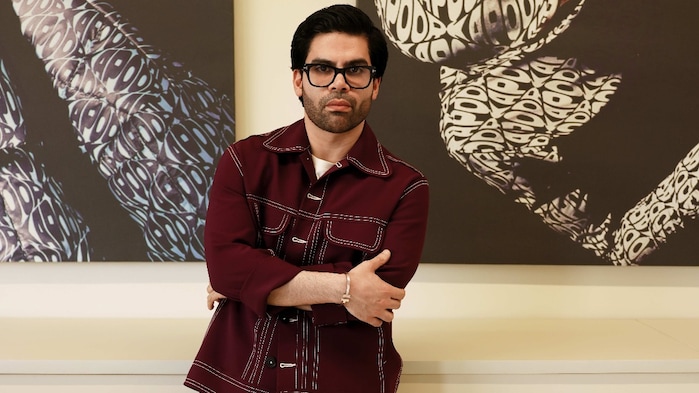

Dhruv Kapoor arrives at exactly 10 a.m. Not 10:03. Not 10:07. Ten o’clock sharp. The punctuality feels revealing. For a designer whose clothes are often covered in crystals, embroidery, and bugle beads, Dhruv’s life appears organised around precision. Having made our way through Gurugram’s traffic-clogged arteries on a blistering summer morning,
we’ve arrived at an atelier that’s surprisingly minimalistic.
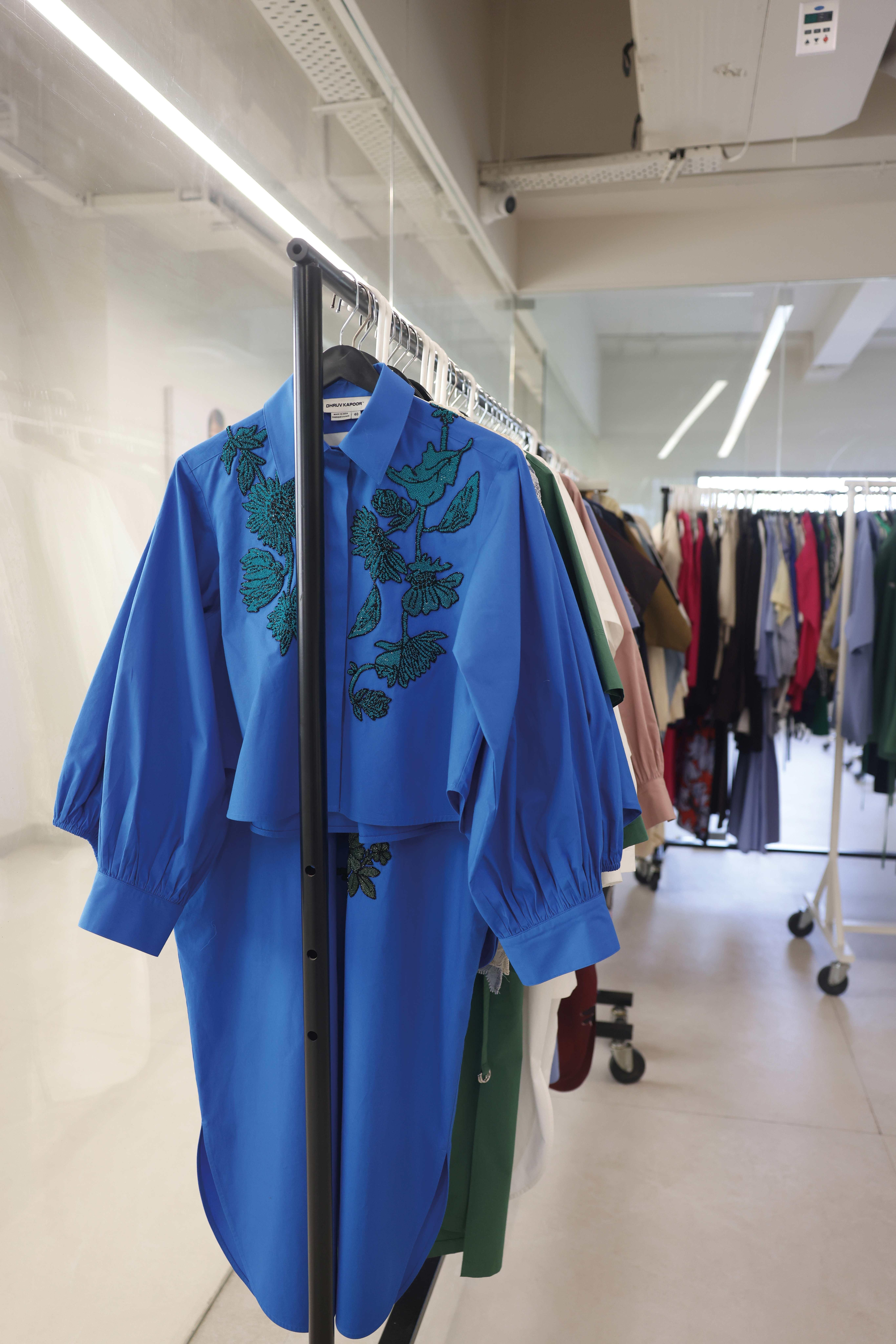
White walls, white panels, and clean interiors provide a stark backdrop to the clothes on display. Across one table, glass and bugle beads are arranged like a mural. Nearby, flora and fauna unfurl across development swatches in glittering Swarovski crystals, paillettes, and painstaking hand embroidery. A cobalt blue shirt blooms with bugle-beaded flowers that trickle down its surface like creeping vines. A felt coat sliced at the midriff is studded with floral embellishments. A lace-inlaid shirt sits beneath a translucent veil of blush-pink chiffon. Along another wall hangs a collection development timeline mapping the sketch-to-sample journey, while artisans demonstrate embroidery techniques that can take hours, sometimes days, to complete. The clothes are intricate, expressive, and intensely worked.
Dhruv, dressed in an oxblood workman jacket, Tom Ford glasses, and polished brogues, is remarkably measured. Fashion has long romanticised the image of the designer as a chaotic creative force, but Dhruv’s practice seems rooted in something else entirely. He wakes at 5:30 every morning, goes for a run, meditates, practises pranayama, and is usually asleep by 9:30 p.m. “I’m very boring,” he laughs. The joke lands because it is only partially true. Spend an hour in his company, and it becomes clear that the discipline is not incidental to the work; it is the work.
His earliest inclination towards fashion, Dhruv explains, came through cartoons, animation, and fairy tales. As a child, he became fascinated by the way clothing was used to instantly communicate character. “The kings would have one dress code, and the common man would have another,” he recalls. “Fashion was used to communicate your entire life or who you are, what you stand for.”
Those observations eventually evolved into the philosophy underpinning his label. If dress codes once reinforced social hierarchies, Dhruv became interested in what might happen when those distinctions dissolved.
“We’re currently in a time where there are no codes as such that you need to forcefully follow,” he says. “It was very exciting for me to move in this direction where we could fuse everything together.” Ask him who the Dhruv Kapoor consumer is, and he refuses to offer a conventional answer. “It’s practically everyone who has self-awareness. They have desires, they have ambitions, they are centred; they know who they are, how they wish to feel, and they command presence in a room.”
Then comes the line that perhaps best explains his approach to design: “We’re only here to assist them to become the best or better versions of themselves.” It’s a surprising sentiment in an industry built on reinvention. That philosophy is, perhaps, most visible in his enduring fascination with the shirt, a category that has become synonymous with the brand. The designer laughs when we suggest he has spent years reinventing said shirt.
“We’d make very tiny tweaks,” he says, even though the garment remains central precisely because of its familiarity. “These are items in anybody’s closet that they’d always reach for.”
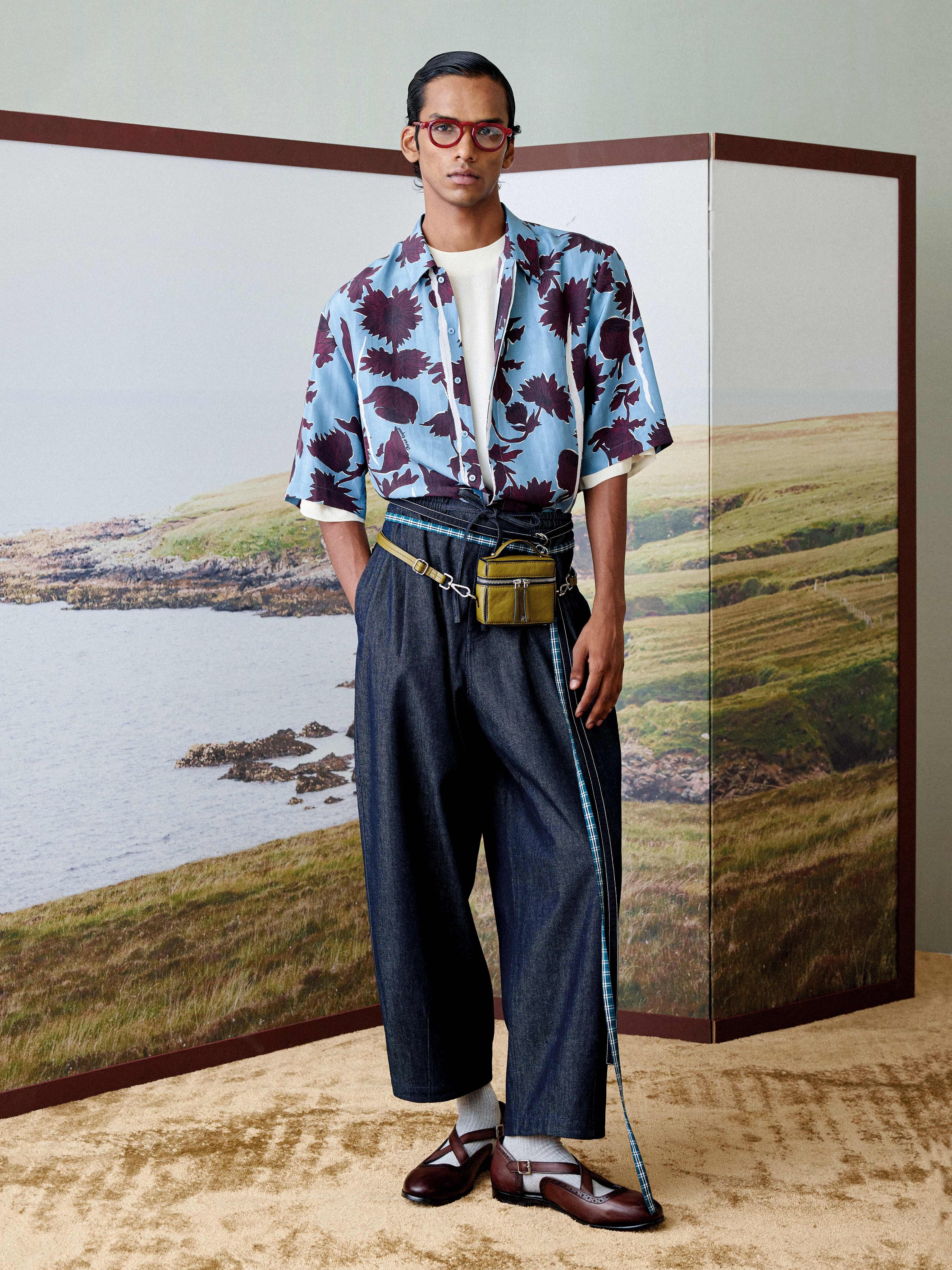
One of Dhruv Kapoor’s biggest successes emerged almost accidentally when a drawstring lying in a nearby drawer was incorporated into a fitting. The resulting tie-up shirt took nearly a year to gain traction.
“I’m bored of it,” Dhruv says in jest. “But the client isn’t!” The same thinking informs his relationship with craft. While much of Indian fashion remains tethered to bridalwear, Dhruv has spent years attempting to translate couture-level techniques into garments that exist beyond weddings and celebrations. “How do you take that craft? How do you tweak the material, the application, but borrow their skill set?”
The answer surrounds us throughout the atelier. The beadwork, embroideries and embellishments may be rooted in generations of inherited knowledge, but they appear on shirts, jackets, and ready-to-wear separates destined for wardrobes in Australia, Peru, the Middle East, and the United States. Dhruv speaks enthusiastically about borrowing the technical brilliance of Indian couture while presenting it through formats relevant to global wardrobes.
“How do you take all of that and repackage it into something that’d be worn every day, also by international clients?” The same tension surfaces when the conversation turns to Prada’s interpretation of the Kolhapuri sandals. Dhruv is notably less outraged than many of his contemporaries.
“I don’t know why they make such a fuss,” he says. Yet the debate around Prada was never really about borrowing itself but attribution, acknowledgement, and power — who gets credited when craft travels across borders. Dhruv acknowledges as much when he praises brands that visibly credit the artisans and communities they collaborate with.“Give them a fair share,” he says. “That’s all there is to it.” It’s also why his own work rarely relies on overt signifiers of Indianness.“It was intentionally decided that it does not matter where I come from,” he says. “If you enjoy the feeling the product gives you, please go for it.”Yet traces of India remain embedded throughout his practice — in the craftsmanship, the embellishment, the vibrancy, and the philosophies he chooses to foreground.
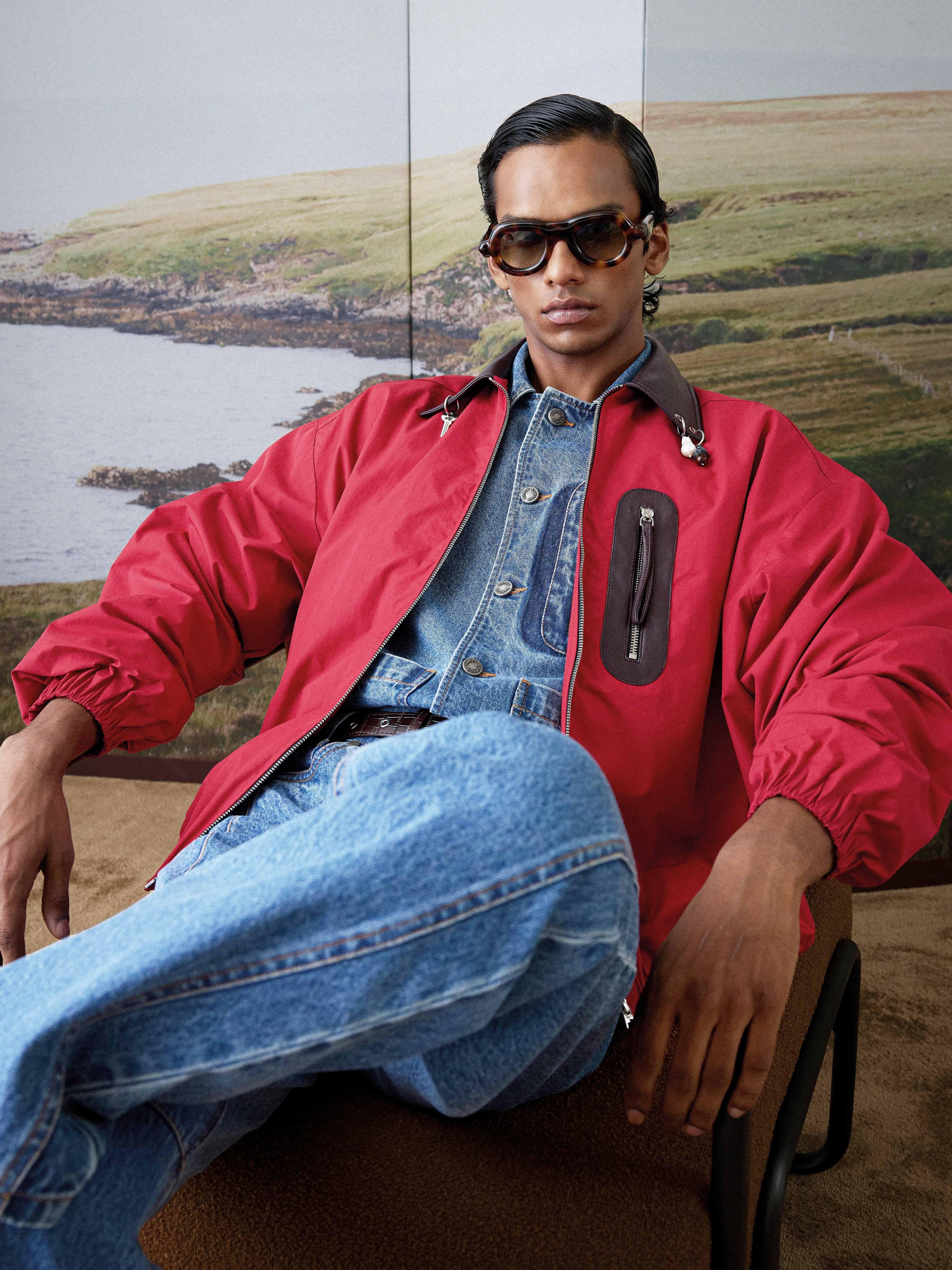
“The vibrancy, the maximal aspect of India, which was later washed with a little bit of minimalism or the sharp tailoring from Milan — that combination is the brand today.” That same hybrid thinking extends beyond clothing. Last year, Dhruv opened his first flagship in Delhi, a space that feels less like a conventional luxury boutique and more like a physical manifestation of his worldview. The store is Vastu-aligned, a detail he speaks about with genuine enthusiasm. Much like the atelier itself, it’s surprisingly austere — white and almost monastic — an unlikely counterpoint to the exuberance of the clothes. “I primarily wanted the client to first come and feel the space and shop second,” Dhruv explains.
At its centre stands what he calls a “speaking pillar” — a monolithic structure displaying a rotating affirmation that changes every month. Visitors are encouraged to pause, read, and reflect before moving through the space. It sounds unusual until one realises it belongs to the same universe as the breathwork manuals hidden inside shirts and the colour guides inspired by Vedic philosophy. Dhruv is not simply interested in dressing people; increasingly, he appears interested in shaping the worlds around them.
Evidence of that worldview appears throughout his office. Neon-coloured magazines sit alongside fashion monographs and coffee-table books. Love magazine occupies one shelf; elsewhere are books devoted to fashion, design and visual culture. Dhruv remains deeply attached to print. “I still cannot read from a Kindle,” he admits. “I have to get that book, and I have to hold it in my hand.”
He speaks admiringly of Sabyasachi Mukherjee and Miuccia Prada, not because of the products they create but because of the worlds they have built around them, for “they think first and act second” — an observation that also describes this designer himself. The clothes may be what first draws people into his world, but increasingly, they seem only one part of a much larger proposition. By the time the shoot with HELLO! wraps up, the atelier has returned to its rhythm. Artisans resume work on embroidered swatches. Samples disappear back onto racks. Dhruv has already moved on to the next task. He speaks of community gatherings, emotional well-being, and holistic spaces that combine ancient wisdom with technology. The ambitions are expansive, but when asked what he’s looking forward to most, the answer is unexpectedly simple.
“The monsoon,” he says. “The weather will change. It’s too hot.” It is tempting to describe Dhruv as a fashion designer, but the term increasingly feels incomplete. The clothes are the entry point; the larger project is about creating frameworks for how people experience the world around them.
After an hour spent discussing craftsmanship, spirituality, retail, and the future of fashion, his answer feels befitting. In Dhruv Kapoor’s world, attention is paid equally to the monumental and the mundane — to a hand-embroidered shirt, a breathing exercise, a changing season. The weather will turn. The work, meanwhile, continues.
PHOTOGRAPHY: TONGPANGNUBA LONGCHARI
This story was featured in the Vol 1. Issue 9 of HELLO! India. For more exclusive stories, subscribe to the magazine here.