- Home
- Lifestyle
HELLO! India Exclusive: Step inside Surbhi K. Modi's artistic world
In a world that screams for attention, this artist, curator, collector, and patron chooses a quieter language of expression — yet remains a cultural catalyst. She invites HELLO! into her universe of creation, spirituality, and deep artistic inquiry
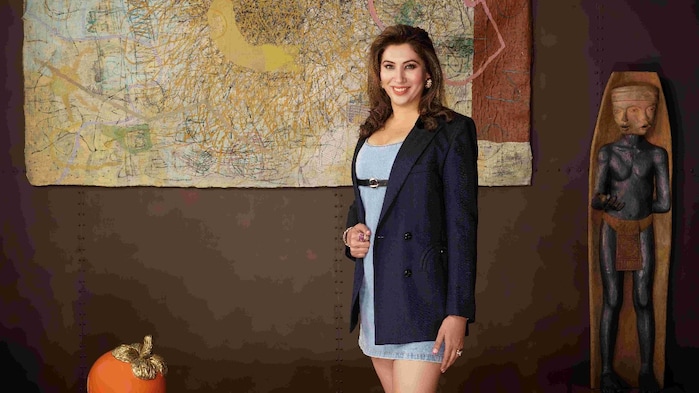

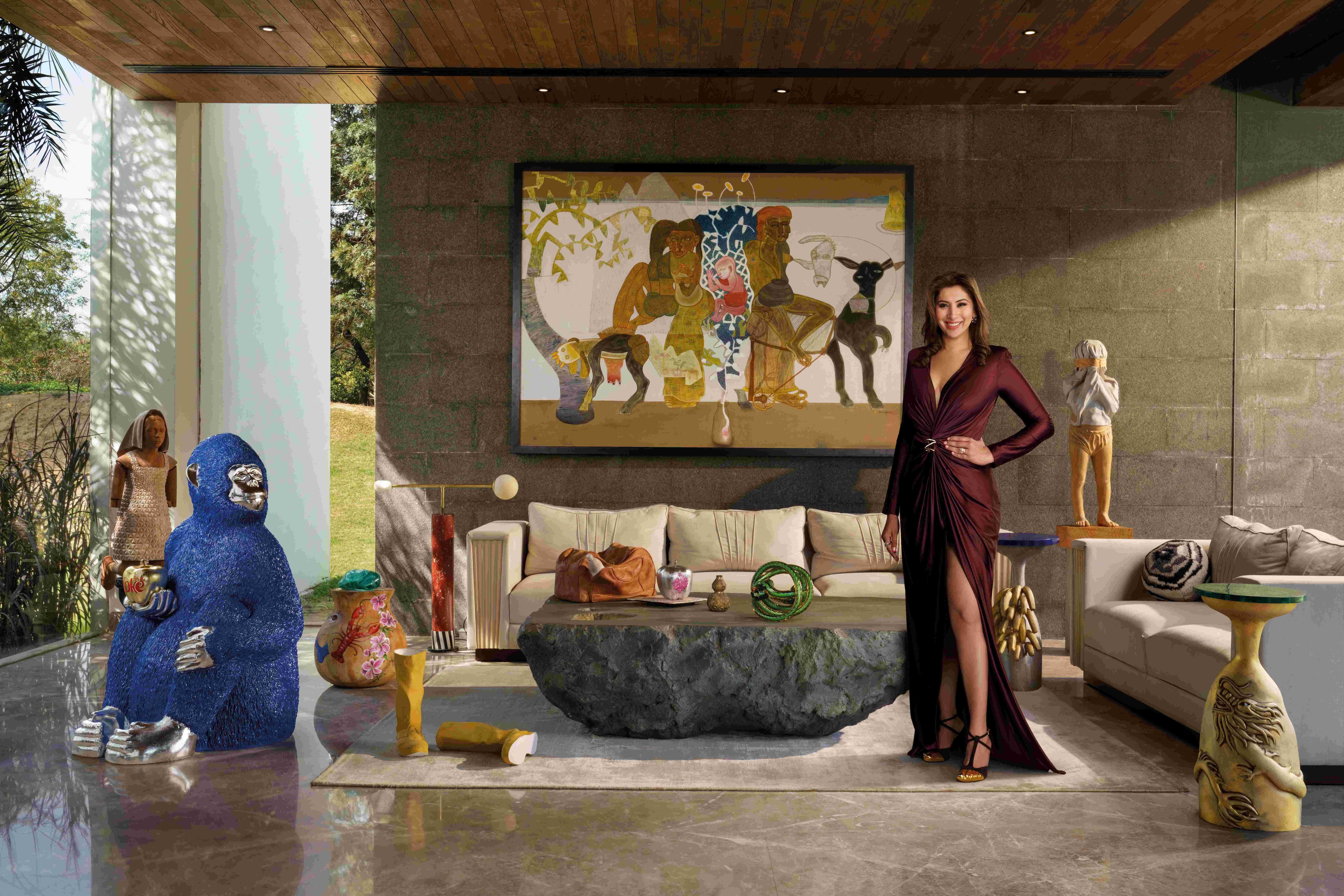
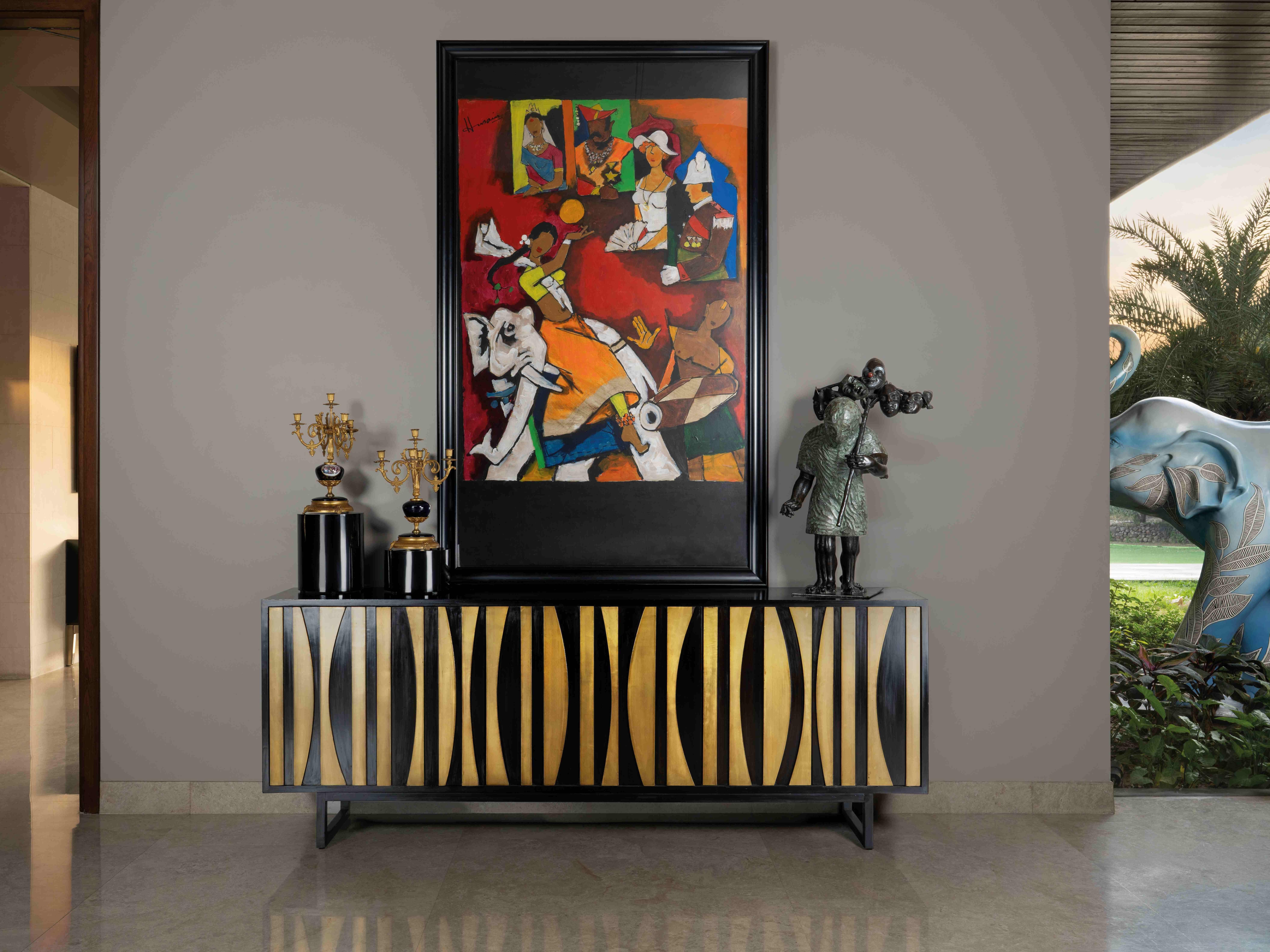
Surbhi Modi neither announces herself at full volume, nor does she chase moments. Instead, she shapes them. Artist, curator, collector, and patron, she occupies a unique position within India’s contemporary cultural landscape, moving seamlessly between society, business, and the arts with a confidence that comes not from performance, but depth and authenticity. We’re at Surbhi’s sprawling museum-esque farmhouse in Chhatarpur, New Delhi, which reverberates with art in every corner. As we sip from a cup of double espresso, we can’t help but marvel at the documented history around us — from MF Husain, Paresh Maity, Manu Parekh and Arpana Caur, to works by numerous budding artists, there’s space for everyone in Surbhi’s eclectic world. Also dotting the living room, bedroom and dining space are her own sculptures, with each space exuding the warmth and humility of her personality.
The home looks lived in yet straight out of an art museum, and there’s mind-boggling detailing in the curation. Her keen eye for detail also spills over to the HELLO! shoot, where she tweaks everything to her liking, from the height of the stool that holds her painting, to the breakfast spread before us. “I built this collection over the years. I liked a lot of Western contemporary art and global Indian works, not anything too ethnic,” she shares. “That’s how the journey began.”
A KALEIDOSCOPIC WORLD
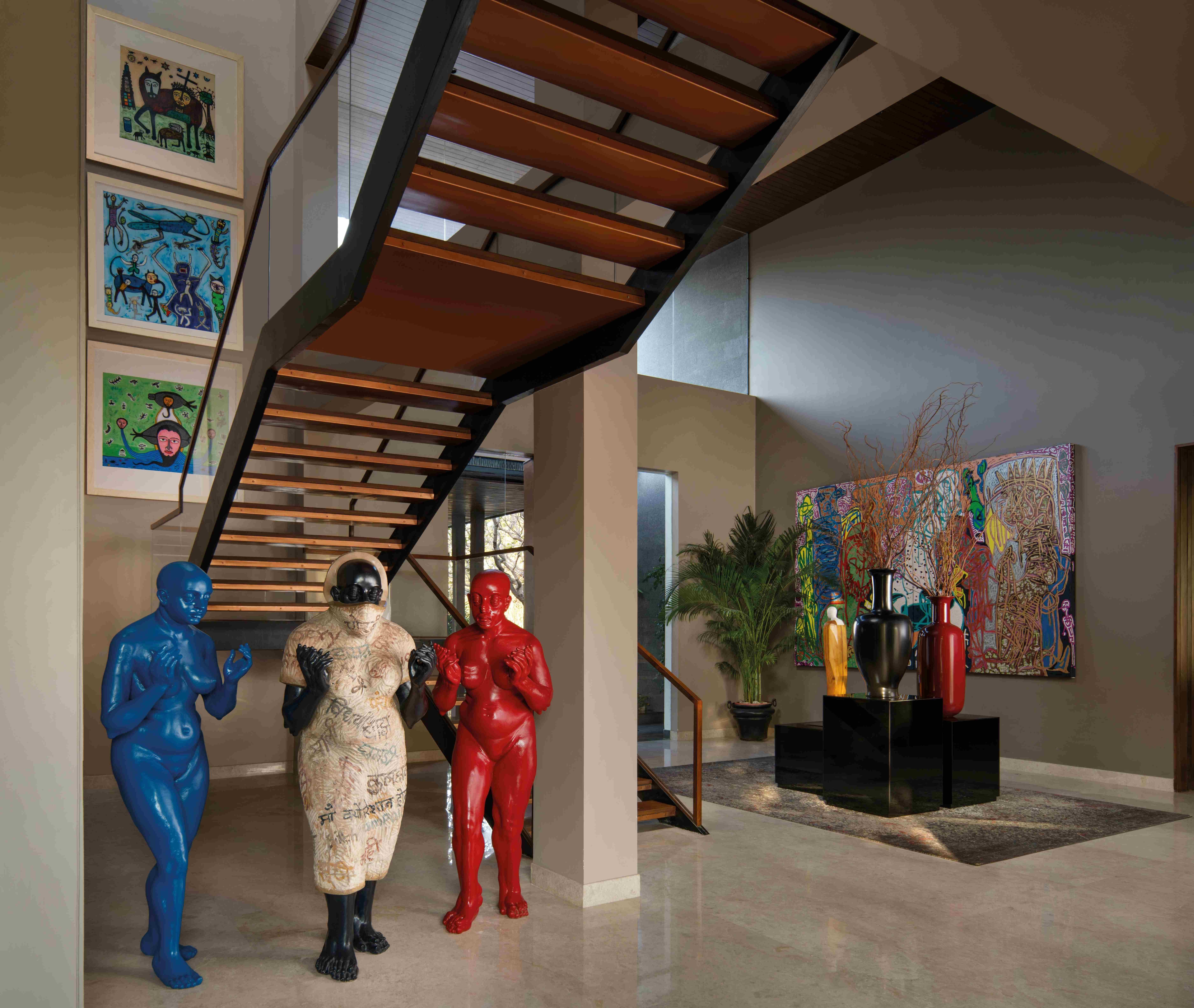
Designed by architect Raghav Mathur, Sachin Gupta of Beyond Designs, and Surbhi herself, this house is a Post-Modernist marvel with art as the focus. Taking us on a tour of the mansion, she says, “The walls were kept grey as it’s not stark and overpowering, serving as the perfect canvas for the art. The colour palette was intended to keep the warmth intact.” A melange of artworks welcomes us in the lobby — a vibrant painting by Bhuwal Prasad from his ‘Banaras’ series; an MF Husain from his ‘British Raj’ series; and a Paritosh Sen work. Drawing the eye as you walk up the winding staircase is Madhvi Parekh’s work.
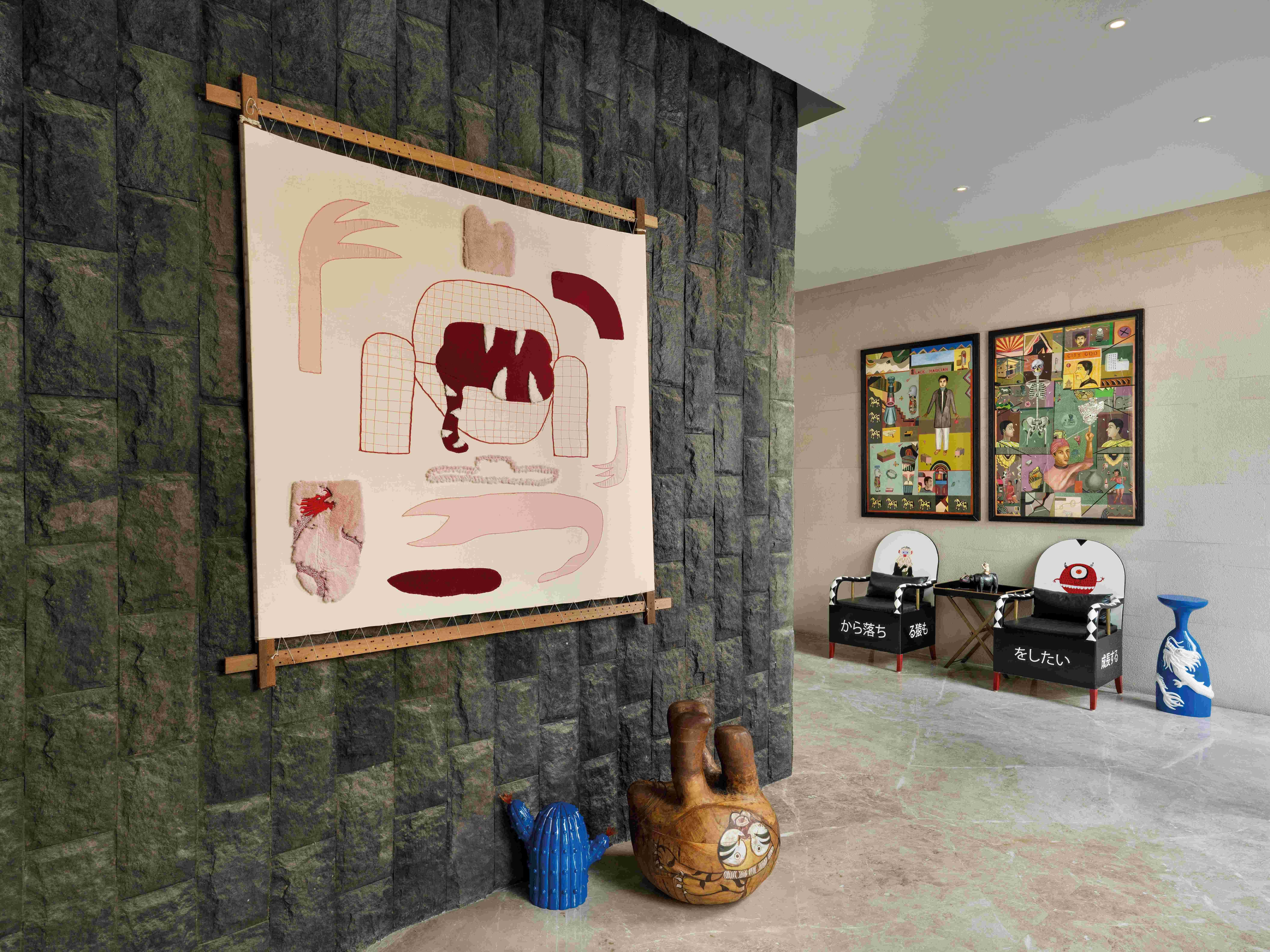
Three sculptures by Arun Pandit are ready to be admired in the foyer, and as you settle in the anteroom, Surbhi’s ‘Orange Coconut’ functional art glows in the sunlight, beside an edgy Kanchan Karjee sculpture. The 160-ft-long floating wall in the new wing of the house, which she curated herself, was inspired by German-American architect Ludwig Mies van der Rohe’s home at the Barcelona Pavilion.
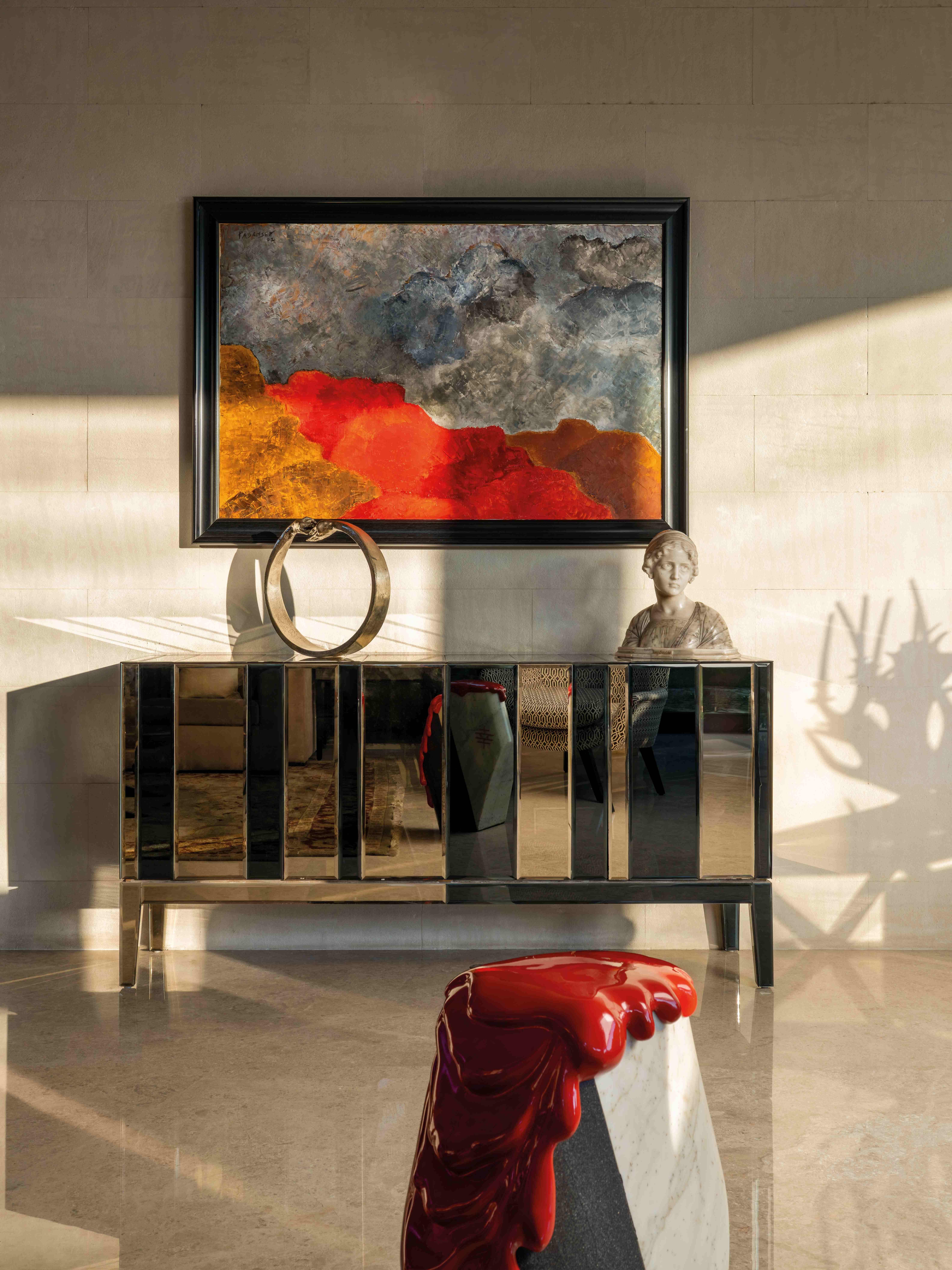
“The new wing has a younger vibe, an amalgam of Western contemporary art,” says Surbhi, pointing at the ‘Black Madonna’ by Tristan Pigott, based on Picasso’s ‘La Reve.’ “The old wing, comprising the dining and living areas, boasts works by Manu and Madhvi Parekh, Akbar Padamsee, SH Raza, and Paresh Maity.”
FROM PENS TO SCULPTURES
Surbhi’s fascinating life story is not one of rebellion or reinvention; it’s one of synthesis. While she was raised around structure, discipline, and enterprise, creativity was always subtly embedded into the fabric of her upbringing.
As a child, she says, she was rarely without a pencil in hand — drawing, sketching, mapping imaginary worlds. Even within the family business, the iconic Stic Pens, art found its way into her being. In the 2000s, for instance, Surbhi had judged one of India’s largest children’s colouring competitions.
“This was an early indicator of my instinct to remain close to creative expression,” she reflects, even though her formal path was headed elsewhere. She went on to study business, and eventually completed her MBA. On paper, it was the expected trajectory. In reality, it was preparation for what was in store for her future. In 2010, Surbhi moved to London with her husband Karan Modi, a relocation that would quietly but decisively alter the course of her life. It was there, immersed in one of the world’s most sophisticated cultural capitals, that she chose to formally pivot toward the arts.
Surbhi studied Art History and Curatorial Practice at the Sotheby’s Institute of Art, which matured her relationship with the field, becoming less interested in it as a solitary object, more fascinated by the ecosystems surrounding it. “Art, I realised, doesn’t exist in isolation. It needs context, support, and intelligent visibility.” Her return to India translated this belief into action. In 2011, she founded the Floodlight Foundation to integrate contemporary art into everyday life through mentoring programmes, commissions, and public art initiatives, beyond galleries, to bring exclusivity into shared cultural spaces.
Surbhi also became deeply involved in reviving an artist residency programme in Modinagar, Uttar Pradesh, originally established by her parents-in-law, Abha and Satish Modi. The place holds significance in India’s contemporary art history — the famous Khoj Studios hosted its very first residency here, a formative space where artists like Subodh Gupta and Bharti Kher developed their early works. She carried this legacy forward, welcoming Indian and international artists into an environment defined by exchange, experimentation, and intellectual freedom.
The founding of the International Institute of Fine Arts in Modinagar further cemented the family’s long-term commitment to arts, education, culture, “and an inherent belief in institution building rather than one-off gestures.” Moreover, in 2013 and 2016, she organised Publica, one of India’s first public art festivals in contemporary art spaces, across Delhi, Mumbai and Modinagar.
THE ART FINDS THE ARTIST
For years, she chose to firmly remain behind the scenes, supporting artists, building platforms, and curating conversations. Yet, “definitely quietly, something else was taking shape within me.” As fate would have it, while the unspecific thought continued to brew internally, she met American artist Peter Nagy, founder of Nature Morte Gallery.
“We were talking about a commissioned work when he told me, ‘You should be an artist. You think like an artist.’ At that time, I was already learning how to sculpt.”
And thus, the seed was sown, and she soon set up her studio. Sculpture, with its physical presence and emotional weight, came naturally to her. Her first major work, ‘Sloth’ (2010), was a defining moment. Crafted from skin-like silicone and resin, it depicted a stoic, hyper-real figure — a portrait of the common man paralysed by inertia and powerlessness. Unsettling yet magnetic, ‘Sloth’ announced Surbhi “for its enduring fascination with emotional tension: between attraction and discomfort, realism and unease.”
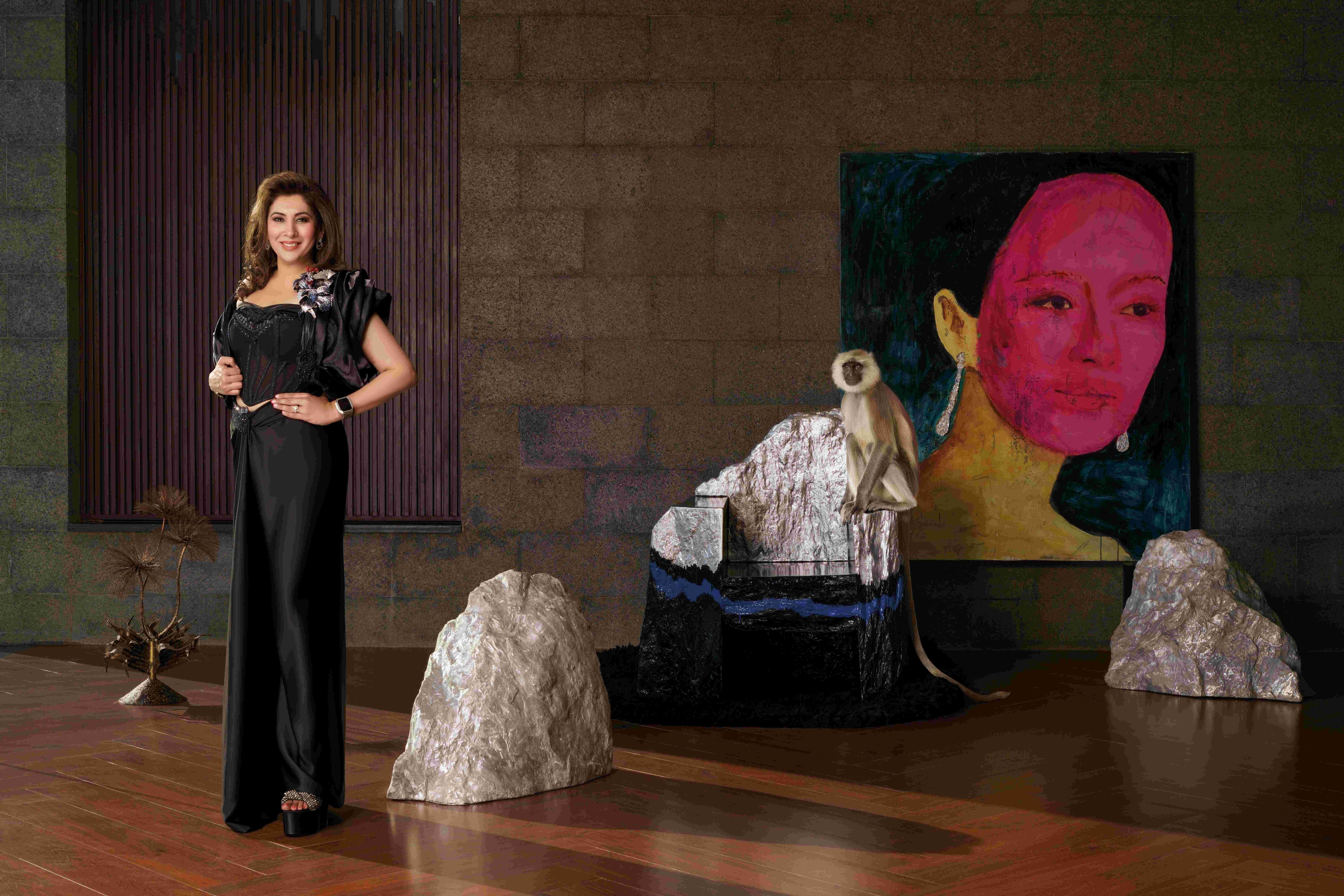
For her, the unusual is not a strategy; it’s instinct. Surbhi often describes artists as alchemists, problem-solvers who transform material into meaning. That belief found unexpected expression when she was building her home. Travelling through Milan and London, for instance, she searched for furniture that felt sculptural, objects that weren’t just functional but carried presence. “When I couldn’t find what I was looking for, I designed and created them myself!”
What began as a personal necessity evolved into a functional art practice around 2015. Surbhi began questioning long-held boundaries. Why should art exist only on walls? Why should furniture be reduced to utility? Her pieces — tables, chairs, and other objects — became vessels of narrative and emotion, designed to be lived with. In a cultural context where walls often carry inherited paintings, she proposed a new idea: that furniture itself could become heirloom, holding memory, touch, and time. Over the years, her spiritual leanings found expression through her art. Take, for example, her ‘Bandar’ and ‘Parvat’ series.
“The ‘Bandar’ series is an invocation of Lord Hanuman, to showcase this notion that Hinduism is a very tolerant religion that brings people together,” says Surbhi, highlighting each hair on the body of the monkey she sculpted. “The idea is that we’re all different, but together, we are one beautiful whole.” Continuing along the lines of this series, Surbhi was invited by the Grosvenor estates, Brownhart Gardens in Mayfair London, to make four large-scale monkeys. And on a side note, she shares that the farmhouse has a pet langur! Similarly, Surbhi’s mini silver ‘parvats’ find a pride of place in several corners of her house. The series is an abstraction on Lord Shiva, Sumeru Parvat, and the idea of contemporising religion. She believes, “Religion should bring people together and not divide. It’s quite a neo-Hinduist idea.”
SPREADING HER CREATIVE WINGS
In recent years, her practice took on a new material focus. Surbhi set up her own metal foundry and now works extensively with brass and aluminium, challenging materials chosen not only for their sculptural beauty but their permanence. “For me, durability, weather resistance, and usability are integral to the design process, especially in my functional pieces. These are works designed to endure, to outlive their maker.”
She is currently preparing for her exhibit at the Dulwich Picture Gallery in London, where her work will be displayed as a response to the Dutch Van Heusen painting, rooted in Neo-Hinduism. In a world that rewards noise, Surbhi chooses resonance. In a culture that chases trends, she builds permanence. And that, perhaps, is her quiet superpower…
INTERVIEW: NEEVA JAIN & REWATI RAU
PHOTOGRAPHY: ASHISH CHAWLA
STYLING: MINAKSHI
This story was featured in the Vol 1. Issue 7 of HELLO! India. For more exclusive stories, subscribe to the magazine here.
Continue Reading