- Home
- Lifestyle
HELLO! India Exclusive: Subodh Gupta 'steels' the spotlight, every moment he gets
Applauding three decades of sculptural brilliance and recent Met Gala moments, HELLO! catches up with the celebrated artist to explore how his Indian roots inform his extraordinary vision

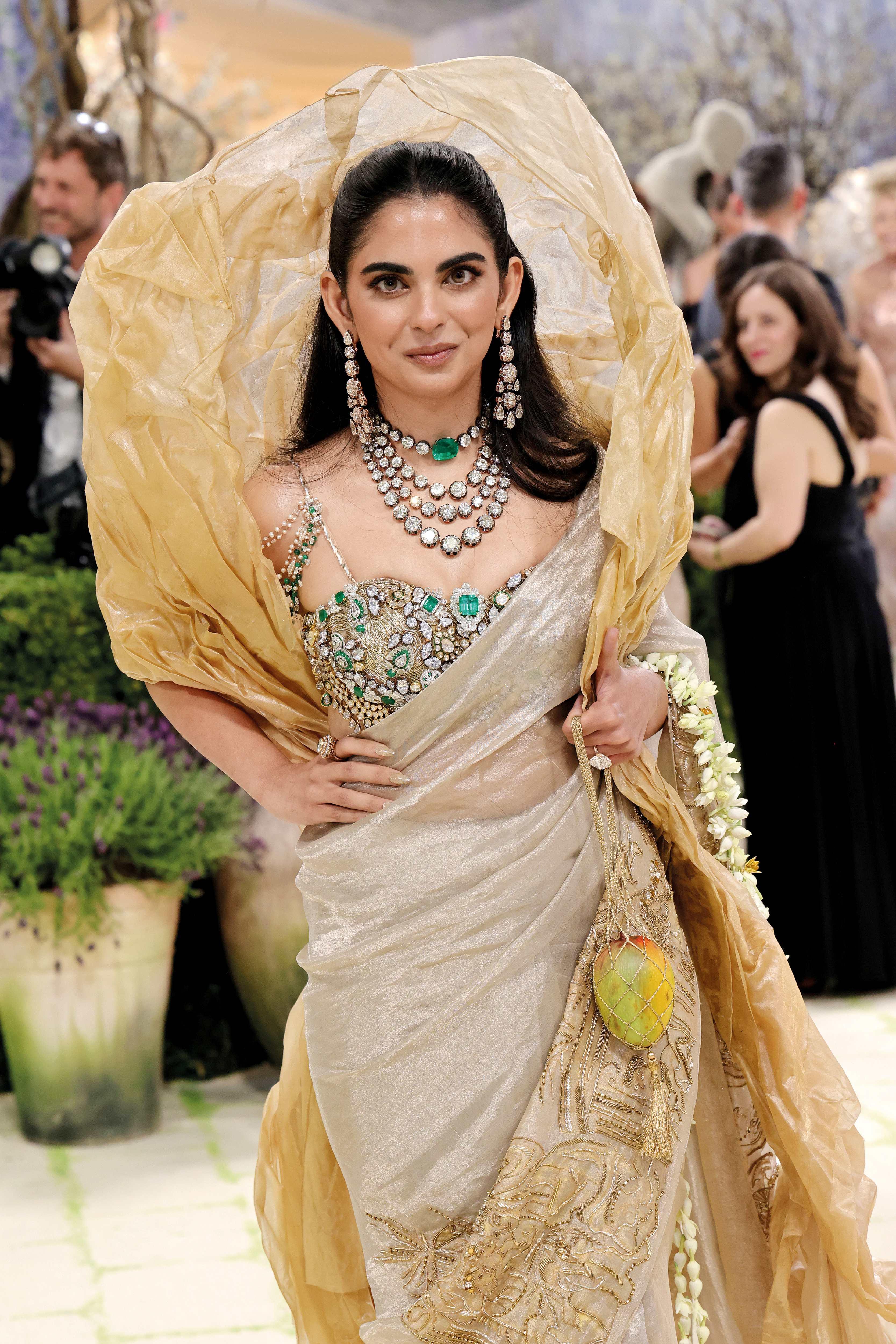
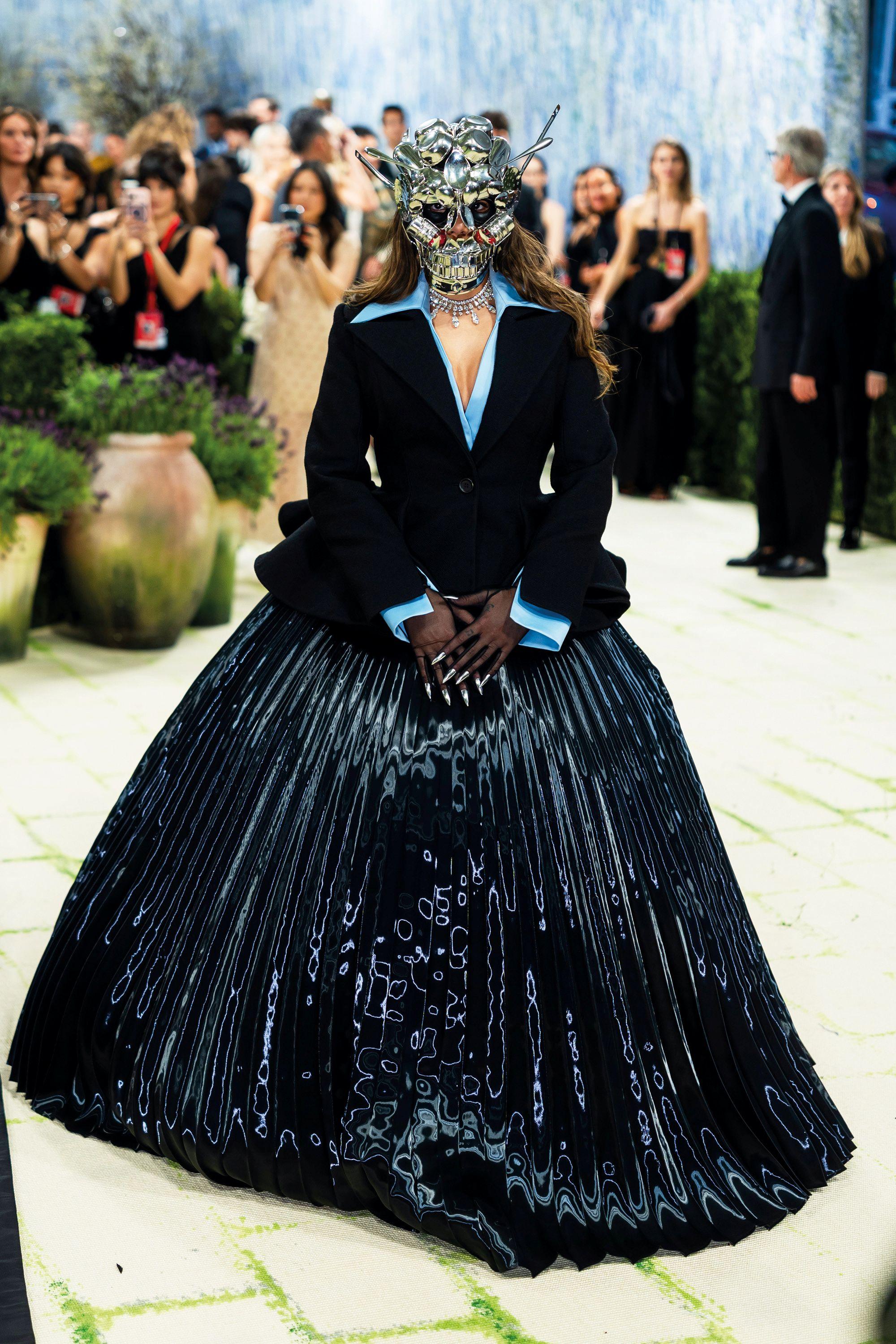
Decades before Isha Ambani Piramal owned the Met Gala red carpet with her ‘aam aadmi’ clutch, and Ananya Birla turned heads in a striking steel mask, Subodh Gupta had already been elevating the everyday vocabulary of Indian kitchens on the global stage. Plates, bowls, spoons, ladles, rolling boards, and tongs — objects of daily ritual — found new meaning through the maverick sculptor’s creativity. So expectedly, his work’s debut on fashion’s grandest stage felt entirely in sync with his artistic language.
“I did not create something entirely new for the Met Gala — both the mango and the skull forms have been part of my work for several years, so it came naturally to me,” says the virtuoso, with the nonchalance of someone who simply loves what he does — and happens to do it exceptionally well.
Just weeks before his Met Gala moment, India’s art circles were immersed in Subodh’s world at ‘A Fistful of Sky,’ an exhibition at Mumbai’s Nita Mukesh Ambani Cultural Centre. Conceived as both a spatial and emotional journey, the show moved through memory, migration, and the layered nature of lived experience. Structured as a vertical progression through the venue, each level unfolded like a carefully staged environment where domestic ritual, dream, motion, and reflection intertwined.
Bringing together some of his most significant works alongside newer pieces, the exhibition offered a deeply personal lens into the artist’s understanding of everyday life in India. “I had hoped people would think about their childhood, memories, and experiences after the exhibition. Ideally, they should have talked more about themselves than about my work.”
ROOTS & SHOOTS
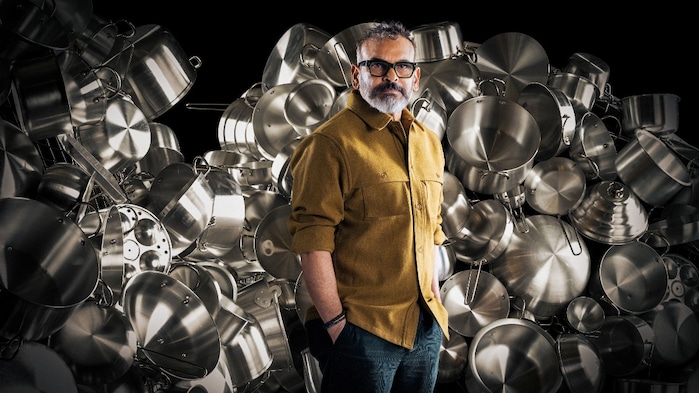
A globally recognised name from the Indian art fraternity, Subodh’s wizardry thrives on his connection with his roots. Never can an art connoisseur separate his pieces from his formative years spent in our country’s hinterland. Take, for example, his 2006 work ‘Very Hungry God’ — arguably one of his most prominent artworks. Using ubiquitous steel tiffins, pots, and plates, the three-dimensional skull first shown at the Palazzo Grassi, Venice, not only symbolised his childhood memories but also carried a dark, symbolic meaning. “I am the idol thief. I steal from the drama of Hindu life. And from the kitchen… These pots, they are like stolen gods,” Subodh had said in one of his interviews back then.
Then there’s the 2008 work titled School that organised steel tiffins — including the typical Indian wooden patra (stool) and a steel thali (plate) with bowls — into disciplined formations to denote collective order. The work conjures an image almost forgotten by millennials and never seen by Gen Z, but Subodh rarely ever misses a reference to his origins.
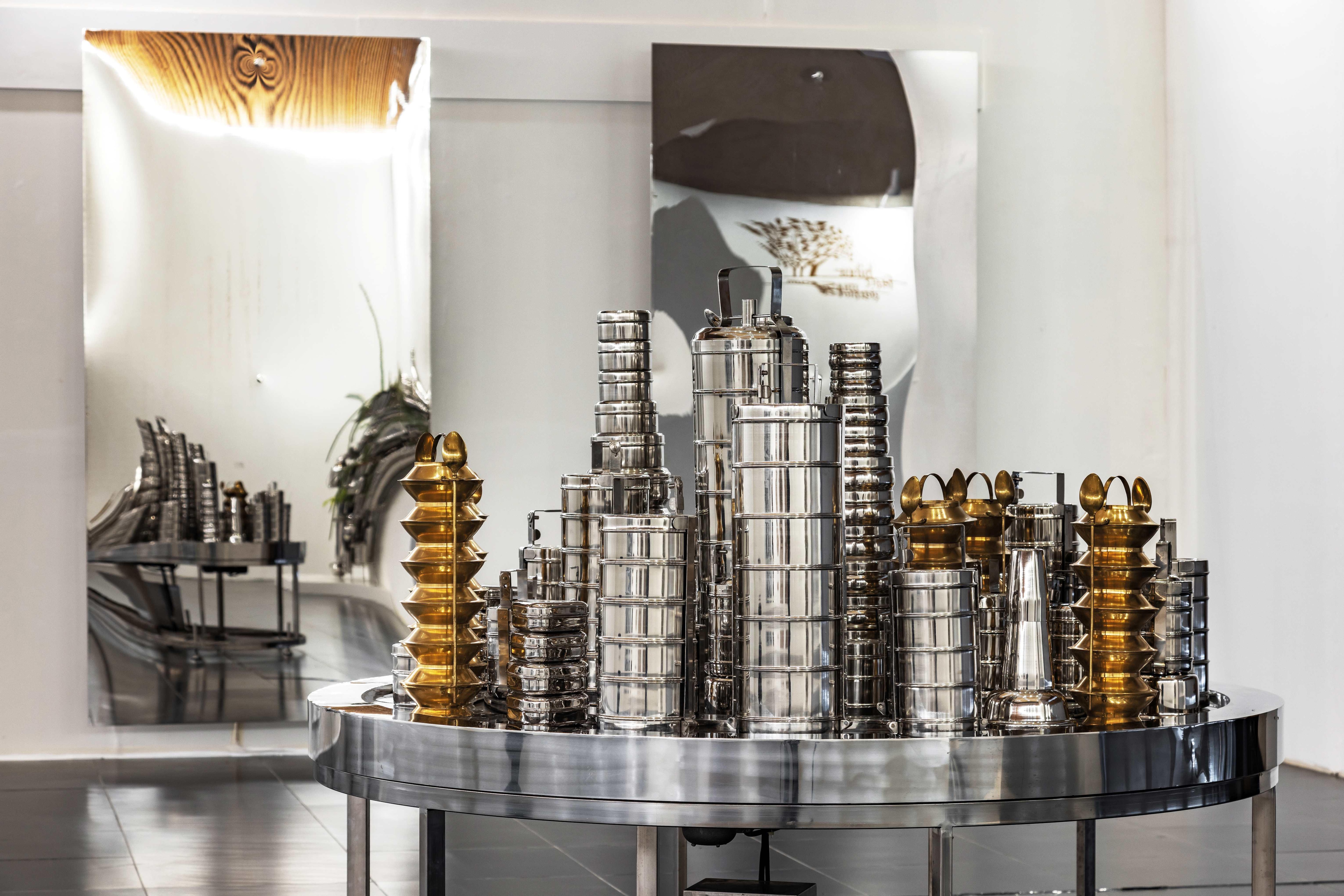
“‘School,’ for me, is quite significant and strong,” says Subodh, comfortable in his Gurugram studio, his steel sculptures gleaming in the background. “Back in our town, we ate all our meals sitting on the patra. In fact, most rural folks, 40 to 50 years ago, sat like that to eat. This is our chair, no?”
From one of his visits back home, the artist brought a patra to his Gurugram studio to cast — ‘School’ was the result — signifying how the most mundane objects carry the deepest memory and emotion. “We are always surrounded by these utensils, beds, containers, gestures, people, and energies all the time. Although they gradually become invisible to us, they are important as they sustain life. The objects I work with, they all come from that space. When I fold them into my work, I am not changing them. The art is making us pause and look again.”
PAGES FROM THE PAST
Growing up in a railway colony in Khagaul, a historic but nondescript township in Bihar, his mother’s kitchen and the rhythms of domestic life became an important visual memory for Subodh — he gravitated towards steel as a medium, too.
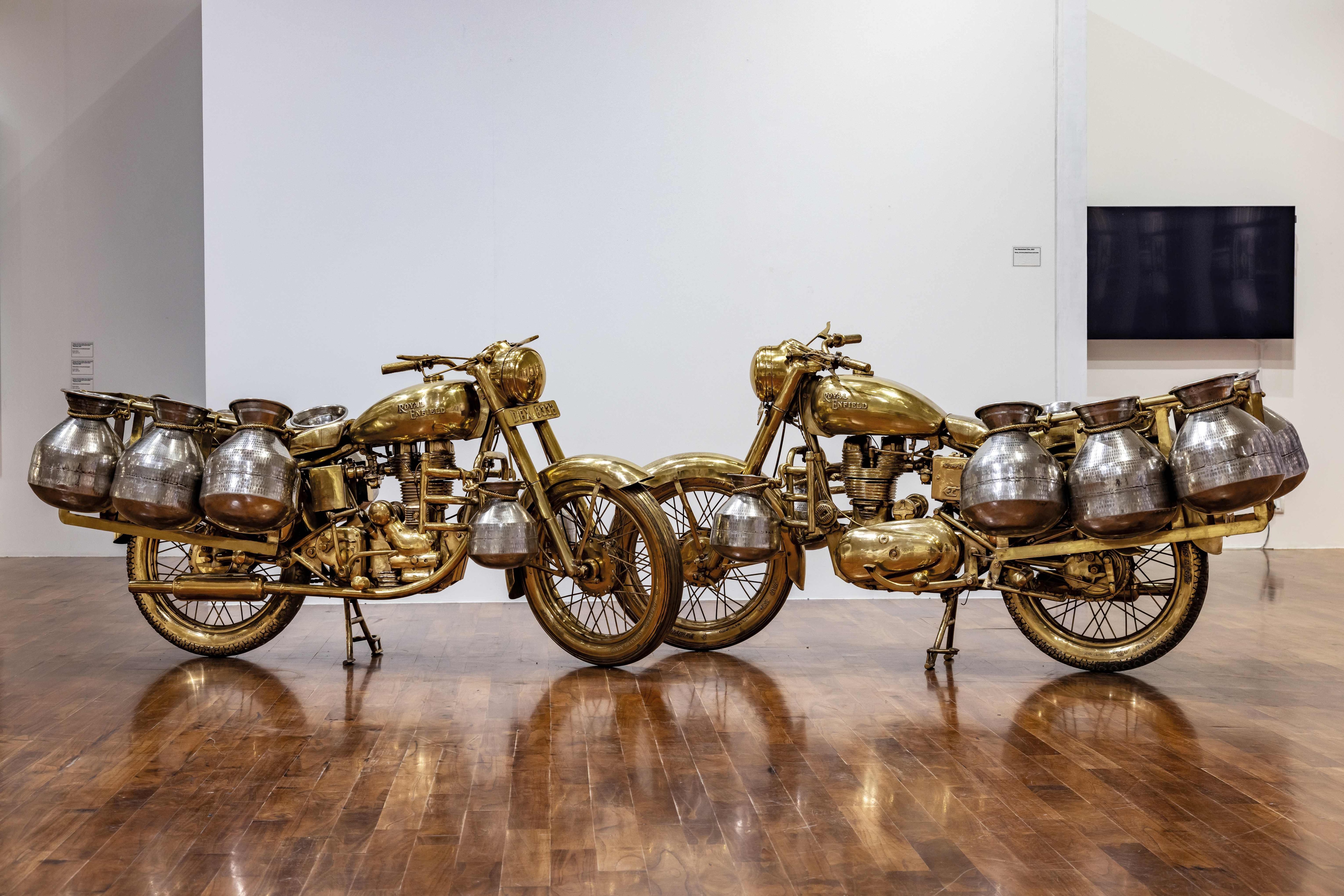
“When you grow up with them, use them every day, you don’t really notice them in that way. Similarly, when you work with them, the material is no longer just a material; it becomes a language. Steel — and I also mean utensils — became part of my thinking and way of seeing. Through it, I could speak about everyday life, memory, labour, even desire and dreams,” says the sculptor who’s married to Bharti Kher, another prominent Indian artist.
For the uninitiated, Subodh began his career with street theatre. From acting to hand-painting posters, participating in that visual form shaped his approach to artworks, where space is activated through movement, repetition, and the presence of the viewer. “Since I started with theatre, that way of thinking stayed with me. My creations feel like they are performing in space, where people decide for themselves how they want to interact with them. When I create an installation, I am in the process of performing the work. The energy, movement, and feeling become part of it. So in that sense, the space can feel a little like a set, or even like an opera,” Subodh explains.
Perhaps that’s why each of his installations weave in a bit of Subodh and his life — like the centrepiece of his latest exhibition, ‘A Fistful of Sky (Nine Beds)’ that takes the onlooker back to simpler times, when people would sleep on the terrace under mosquito nets.
“At home, in Khagaul, I slept on the veranda under mosquito nets. That and a bed give a sense of safety and protection. It’s similar to how people feel when they pull a duvet over themselves — there’s comfort, security, and intimacy in that feeling. I wanted to bring together that sense of cosiness with memory and dreams,” the artist shares. With that, Subodh’s reflections continue, while his audience stays mesmerised by his quietly profound world, one ‘steely’ sculpture at a time.