- Home
- Lifestyle
Jitish Kallat takes HELLO! India through his immersive creative journey
The renowned artist takes us through his immersive visual universe, the science, history and existential inquiry that drive his creativity

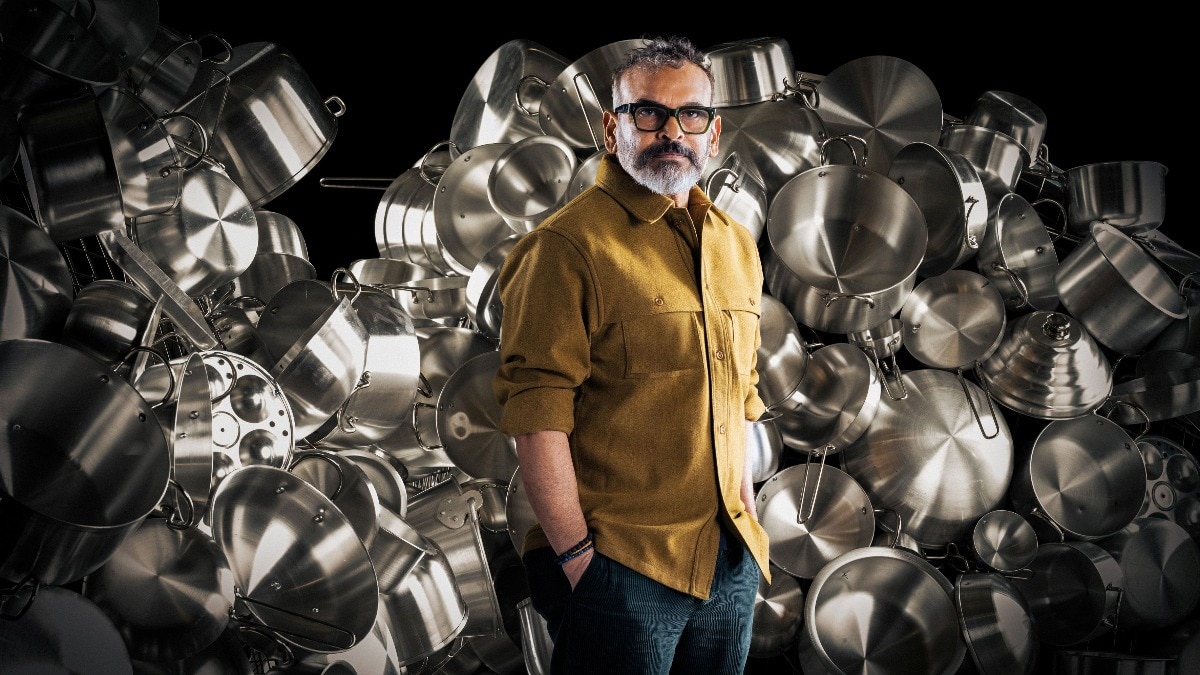
Jitish Kallat’s art isn’t easily comprehensible for all. His approach to artmaking is akin to the entire premise of Interstellar — the artist probes the world through the entanglements of time and space. For the uninitiated, Jitish is patient, and calmly explains the ideas that drive his creative universe: “I don’t necessarily experience the everyday and the cosmic as opposites. We’re materially continuous with the cosmos, aren’t we? The elements that compose us were forged in stellar processes. It’s often useful to place our everyday questions against a wider backdrop to see how scale alters their meaning and reveals unexpected points of convergence.”
Unsurprisingly, Jitish’s studio is anything but run-off-the-mill — it’s described as part archive, part laboratory, and part observatory. But then, he’s far more than just a painter — his practice intersects science, historical memory and existential inquiry, and paints a picture of our place in the cosmos.
One of India’s foremost contemporary artists, Jitish’s diverse body of work transcends mediums, subjects and approaches, spanning abstraction, schematic forms, historical texts, and varied modes of representation that often juxtapose the present with the historic, the terrestrial with the celestial. From the Tate Modern in London and Martin-GropiusBau in Berlin, to the Gallery of Modern Art in Brisbane, and Pirelli Hangar Bicocca in Milan, his art has earned remarkable acclaim the world over.
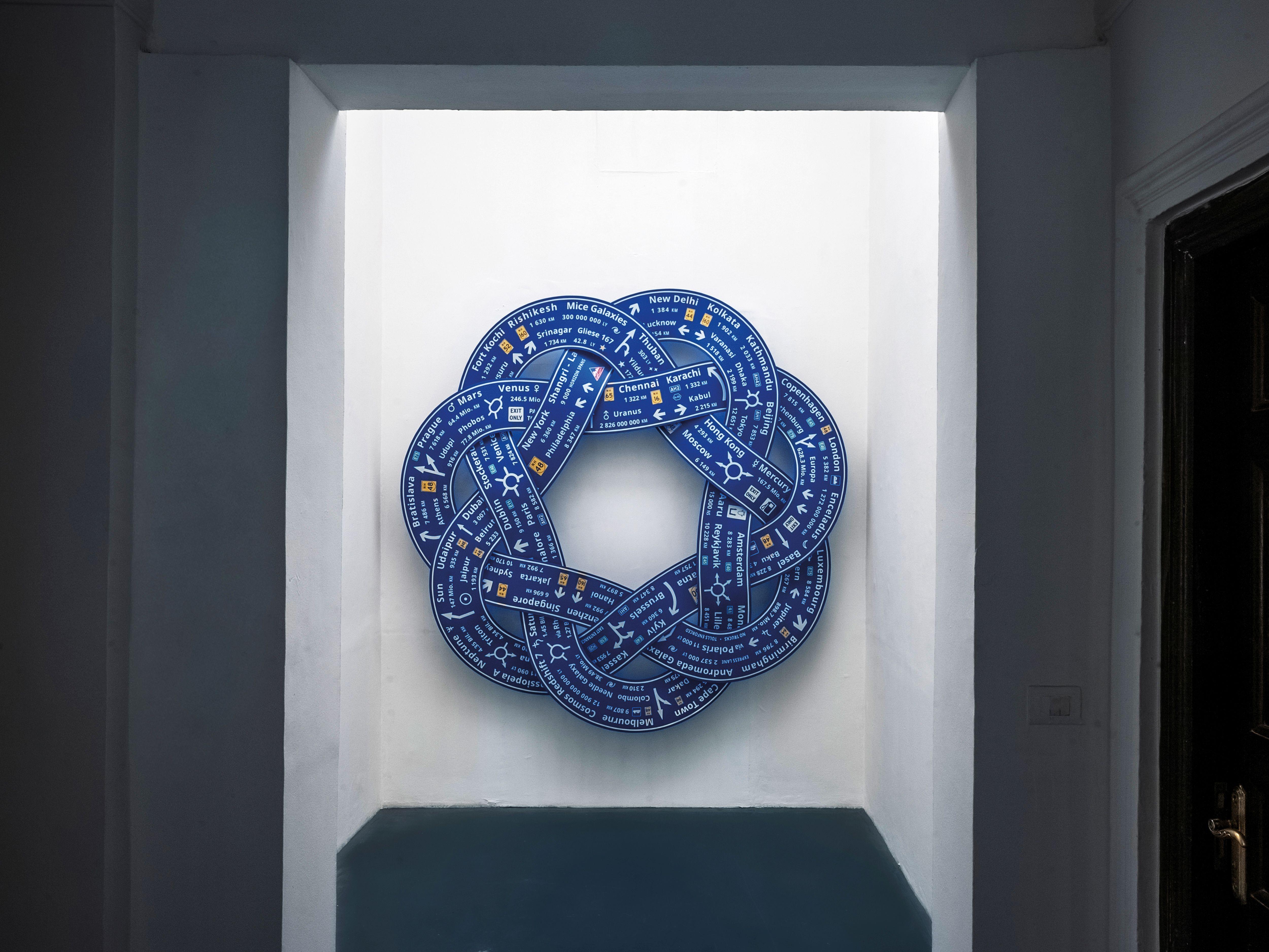
In 2017, he displayed over 100 artworks at the National Gallery of Modern Art in Delhi; a mid-career retrospective, ‘Here After Here’ was a compilation of his creative expression over 25 years. Nearly a decade later, just ahead of India Art Fair 2026, Jitish showcased at the city’s Bikaner House, bringing together his recent projects across multiple media, tracing his trajectory over the past 10 years. ‘Conjectures on a Paper Sky’ featured 16 projects, including paintings, drawings, sculptures, and installations. He also recently exhibited at London’s Pushkin House, exploring themes of planetary address and archival traces like the Mir space station launched by Russia.
HIS ALTERNATIVE UNIVERSE
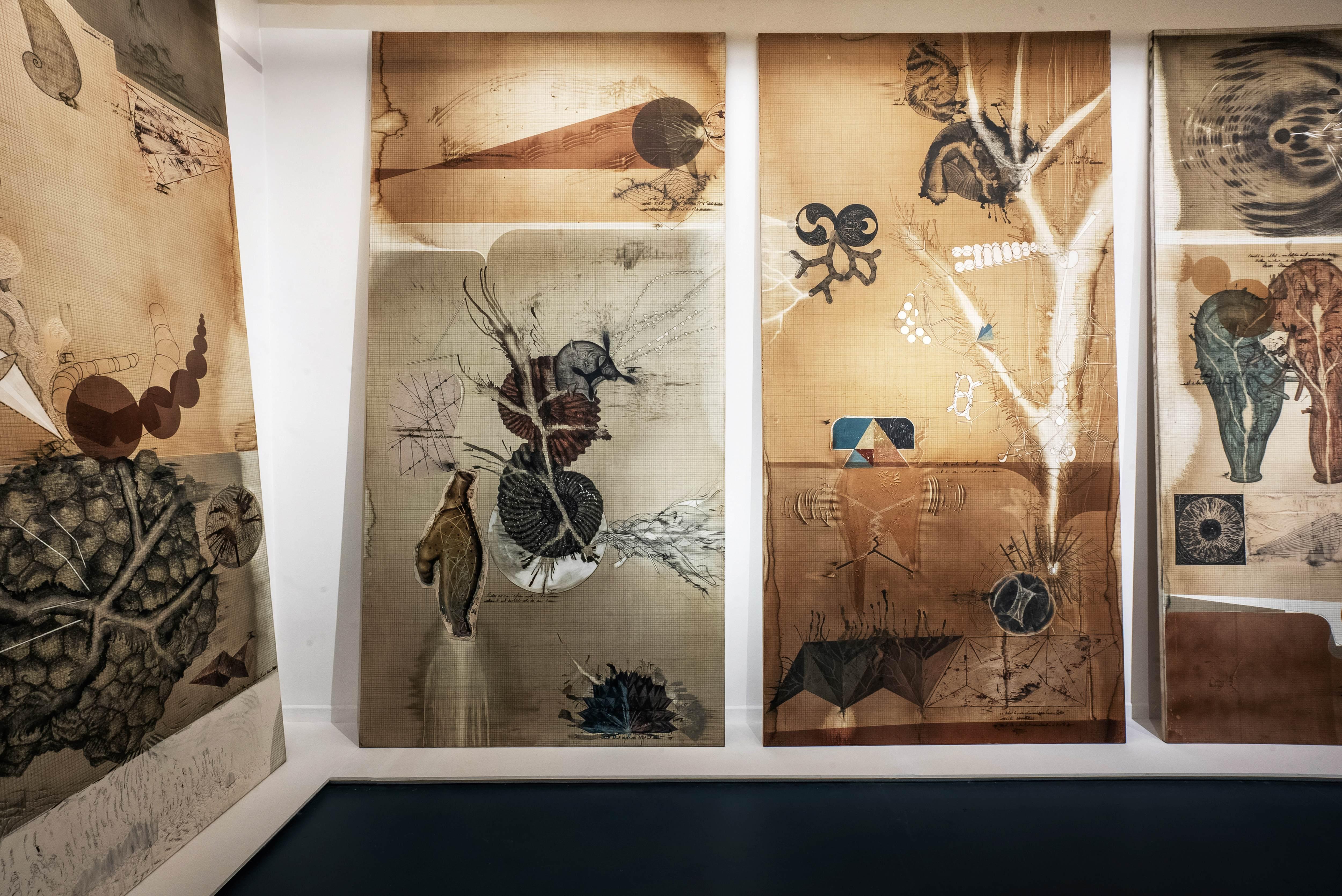
Amid a motley gathering of art patrons and connoisseurs, Jitish remained his quintessential calm, almost otherworldly self. His new structured canvasses showcased in Delhi were reminiscent of graph paper, with an all-over grid drawn in watercolour pencil. Layered with gouache, acrylic, gesso, lacquer and charcoal, the materials are allowed to crackle, drip and pool, to create surfaces that feel both measured and unpredictable. The exhibition depicted themes of orientation, measurement and shifting perspective, also portraying intuitions of light, temperature and reflection. There are many others stained in an aged tone known as cosmic latte, the scientific term for the average colour of light emitted from the observable universe.
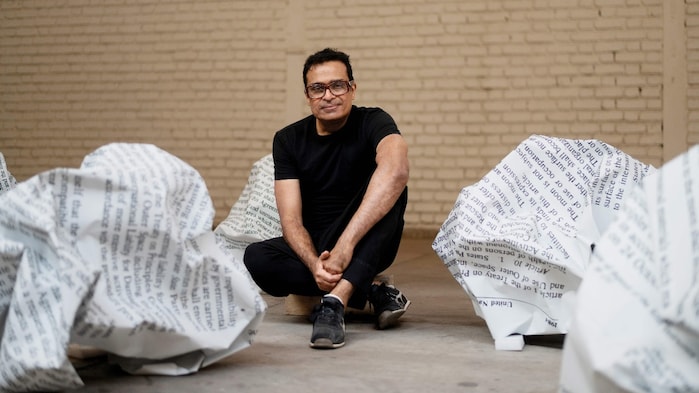
“Science seeks clarity between true and false; art inhabits ambivalence. When I reference something like cosmic latte, it functions as both data and metaphor — and a dimension of playfulness too,” he attempts to explain his train of thought. As with the artist’s famous trilogy ‘Public Notice’ (2003-10), which deconstructs famous speeches by Jawaharlal Nehru, Mahatma Gandhi, and Swami Vivekananda, several works in this exhibition addressed historical episodes like the Cold War and Space Race. “I’m drawn to those moments because they reveal us at our most visionary and most self-destructive, often simultaneously. One of my earlier works, ‘Project A119,’ is technologically audacious and existentially absurd at once. Such episodes mirror our hunger to explore alongside our capacity for violence.”
A DAY IN THE LIFE OF…
A typical studio day for Jitish oscillates between research and intuition — sometimes beginning with archival fragments, sometimes directly on a canvas. “There are periods of research tracing footnotes, and others when I am simply following a stain as it moves across a surface. It’s often a shift between research and open-ended inquiry,” he says. This suburban Mumbai native was drawn to art from his early days, though he says there wasn’t a standout epiphany. Drawing gave him an early medium of expression, where a few marks on paper could create depth, shadows could denote time and atmosphere, and worlds could emerge from marks.
“Even as a child, I often sensed that when you look up at the sky and then return your gaze to the street or life around you, the street itself feels altered,” he says. “The earliest impulse I recall as a child was to draw incessantly. That’s when you feel you can produce the world on paper with simply a few marks — a horizontal line can produce a horizon, and a circle in the sky can produce the sun. This ability to produce or generate the world is the earliest recall of my gravitation towards art.”
As the curtains draw on Jitish’s show in Delhi, we wonder: in which universe would art lovers find him next?
Continue Reading