- Home
- Celebrities
Amaan and Ayaan Ali Bangash on keeping Indian classical music alive for a new generation
For Grammy-winning, seventh-generation sarod maestros Amaan and Ayaan Ali Bangash, tradition has always been a starting point rather than a boundary. In conversation with HELLO! India, the brothers reflect on experimentation, technology, legacy and the evolving relationship between music, place and luxury
offline
Share this:
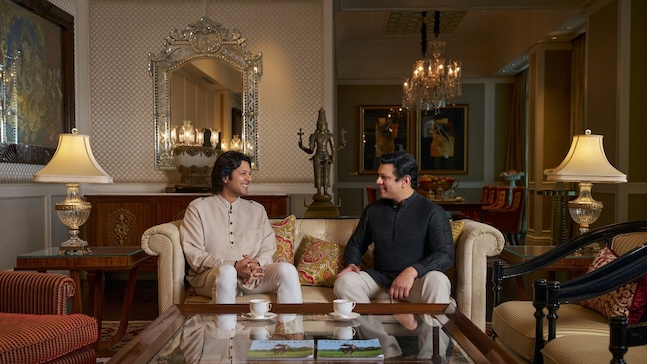
For Grammy-winning, seventh-generation sarod maestros Amaan and Ayaan Ali Bangash, tradition has always been a starting point rather than a boundary. Their long-standing association with The Leela Palaces, Hotels & Resorts, spanning more than 15 years, now enters a new chapter with A Living Raga, an album created exclusively for the hospitality group as part of its Melodies by The Leela curation. Launched to mark The Leela’s four-decade milestone, the 14-track album explores what “True Indian Luxury” can sound like, bringing the duo’s classical roots into dialogue with electronica alongside longtime collaborators Karsh Kale and Sawan Dutta. In conversation with HELLO! India, Amaan and Ayaan reflect on experimentation, technology, legacy and the evolving relationship between music, place and luxury.
(Also Read: Celebrities with the most notable M.F. Husain art collection)
HELLO! India: How did you ensure that classical music, which is usually associated with tradition, complemented electronica rather than competed with it?
Amaan and Ayaan Ali Bangash: For us, the two were never meant to compete. Indian classical music has always been a living tradition, with each generation finding its own way of interpreting what it inherits. With A Living Raga, the classical foundation remains at the heart of the compositions, while contemporary sonic elements create a new soundscape around it. We were interested in what happens when these two languages meet naturally, rather than trying to make one sound like the other. The contemporary elements bring texture, atmosphere and a different sense of movement, while the ragas retain their emotional depth and identity.
HELLO! India: As seventh-generation musicians, how do you decide which traditions are non-negotiable and where you're willing to experiment?
Amaan and Ayaan Ali Bangash: The essence of the tradition is non-negotiable. The discipline, the grammar of the raga, the depth of expression and the relationship between the musician and the music are things we carry with us very consciously. Beyond that, there is tremendous room to explore. Every generation inherits a tradition, but also brings its own experiences, influences and way of listening to it. We don't see experimentation as moving away from tradition, we see it as part of keeping tradition alive.
HELLO! India: Your family has carried this musical legacy for generations. What conversations do you think your father or grandfather would have had with you about a project like this?
Amaan and Ayaan Ali Bangash: I imagine they would have reminded us that tradition is not something you simply inherit, it is something you have to understand, live with and eventually contribute to. Our father, Ustad Amjad Ali Khan, has always represented both a deep reverence for the classical tradition and an openness to the world around it. That has shaped how we approach our own music. We think he would have encouraged us to remain honest to the music while finding our own voice within it. Perhaps he would also have reminded us that the raga is bigger than any one generation. We are only one link in a much longer chain, and our responsibility is to leave that chain richer for the generation that comes after us.
(Also Read: HELLO! Exclusive: Living the high life with Nicky Hilton Rothschild)
HELLO! India: As artists rooted in centuries-old traditions, where do you see technology helping creativity, and where should it never replace the human touch?
Amaan and Ayaan Ali Bangash: Technology can be an extraordinary creative tool. It can help musicians explore new textures, build soundscapes and bring ideas together in ways that were not possible before. With A Living Raga, contemporary production allowed us to create another layer around the classical foundation and explore how the music could speak to a contemporary listener. But technology should remain a tool; it should never replace the human experience at the heart of music. A raga is not simply a sequence of notes. It carries intention, emotion, improvisation and lived experience. Those things come from years of learning, listening and performing. Technology can shape how that emotion is heard, but it cannot replace the human being who feels it in the first place.
HELLO! India: From intimate live performances to composing A Living Raga, your relationship with The Leela has spanned over 15 years. As luxury hospitality becomes more experience-led, what role do you think music plays in creating a lasting emotional connection?
Amaan and Ayaan Ali Bangash: Music has a unique ability to become part of a memory. A particular melody can transport you back to a place and, more importantly, to the feeling you experienced in that moment. That makes music especially powerful in hospitality, where the experience is ultimately about creating memories and emotions. Our association with The Leela over the past 15 years has allowed us to explore that relationship between music and place in a very meaningful way, with music becoming an intrinsic part of the sensory experience across its hotels. A Living Raga feels like a natural evolution of that journey, bringing together our musical heritage, contemporary influences and The Leela's vision of True Indian Luxury. As The Leela celebrates four decades of True Indian Luxury, it feels particularly meaningful to be part of this milestone through a work that brings together our shared appreciation for India's musical heritage and our belief in continually finding new ways to experience it.
HELLO! India: If you could perform one raga in an unexpected setting anywhere in the world, where would it be?
Amaan and Ayaan Ali Bangash: We would love to perform a raga somewhere where the setting itself becomes part of the music. Perhaps somewhere completely removed from the concert hall: Under an open night sky in the desert, beside the ocean, or even in a historic space where the acoustics become part of the experience. A raga changes with the time, the atmosphere and the people listening to it, so the setting can become part of its interpretation. That is one of the things we find most beautiful about Indian classical music: it is never exactly the same twice. Give it a new place, a new moment and a new audience, and it discovers another expression of itself.
(Also Read: Dubai’s “Olsen twins” on sisterhood and success)
Advertisement