- Home
- Fashion
Fashion’s biggest superstars aren’t on camera; they’re on the football field
Football is no longer defined simply by tackles and passes by a jersey-clad side of 11. Nor is fashion solely about couture that glides down the runway. The ever-evolving world has proved that sports and style’s true convergence is only at its kick-off
offline
Share this:
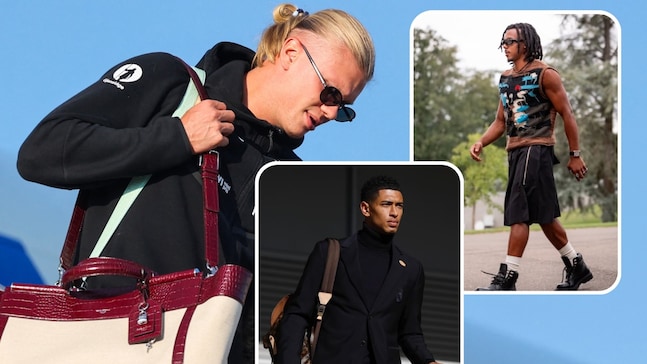
The atmosphere at Clairefontaine is electric. The paparazzi; who anxiously await the arrival of the country’s national team at their training camp, are buzzing with excitement. Several waves and primed poses later, Jules Koundé sashays in. The cameras go berserk. His outfit; a Simone Rocha pleated midi skirt, a knit tank that puts his hours of strength training on display and Timberland boots, cause enough of a clamour for the images to go viral in hours and consecutively deem him one of the sport’s most stylish stars.
(Also Read: How the FIFA World Cup 2026 sparked men's biggest luxury bag trend)
As far as sartorial chops go, his team mate Ibrahima Konaté isn’t far behind. The Real Madrid defender turns up for the first day of their training season in a spiffy tailored shirt and tie, complete with a blazer and olive-toned culottes. Dabblers in fashion as a form of personal expression, Koundé and Konaté’s playful rivalry extends beyond the field. On the Barcelona defender turning Clairefontaine's arrivals into a sartorial challenge, Konaté exclaimed, “I'm here to compete with you—it’s going to be war between you and me!”
For decades, football has proved to be the world’s most widely-followed sport. Millions across continents unite to dribble balls and score goals in 90 minutes while even more are avid viewers of the sport throughout its seasons. The FIFA World Cup Final has consistently ranked as the most-watched single sporting event on Earth. It’s evident that the influence held by the sport—and by extension, it’s players—is immense. While fantasy leagues draw into it through the year and football greats like Cristiano Ronaldo and Lionel Messi have a superstardom of their own, the yield that the world’s most beloved sport has on global style is rising; consistently, furiously and very fashionably.
The ongoing FIFA World Cup 2026—which sought the arrival of footballers from a record-breaking 45 countries into the host nations—has been a visual display of soccer’s greatest hits; and we aren’t referring to goals here. The Côte d’Ivoire national team made headlines before they even kicked a ball at the 2026 FIFA World Cup when they touched down in Philadelphia wearing white ensembles paired with orange and yellow tie-dye blazers, designed by Ivorian couturier Ibrahim Fernandez. The Japanese team translated their national virtue of precision to style when theycontinued their multi-decade tradition by arriving in navy blue three-piece Dunhill suits. But it was Spain’s touchdown into America that made history for fashion and football. The La Roja squad made their entrance felt in blue-and-beige Loewe ensembles, for what is the Spanish designer label’s first-ever partnership dressing a national team; which included designing their tailored suits, polo shirts, leather Puzzle bags and XL Amazona 180 totes.
(Also Read: The sports world is making a statement with jewellery)
Individual star power has raked in the fashion points at the ongoing World Cup. Cristiano Ronaldo turned heads all the way from the tarmac when he strided in wearing a custom-tailored suit by Portuguese fashion house Sacoor Brothers, which he paired with Gucci luggage. The Al-Nassr legend has a two decade-long fondness for the Italian designer label and often picks the famous monogrammed wear when he’s off-duty.
While their official kits remain a constant on the field, that hasn’t stopped footballers from experimenting with accessories. Before winning the semi-final against France, Spanish teenage sensation Yamine Lamal paired his team training kit with a double dose of designer accessories costing upwards of $8,000—a pink Bottega Cubo hand pouch in one hand and a brown Bottega Veneta crossbody on his shoulder. Norwegian superstriker Erling Haaland may have exited the tournament after the quarter-finals but sightings of his designer bag collection have propelled him to global popularity that will stay long past the World Cup ends. He arrived with the ultra-rare Hermès HAC 50 Endless Road in-hand, toted around a black and orange canvas Hermès HAC 40 during his World Cup stint and left the country on a chartered flight with a canvas and alligator tote slung on his shoulder; an unreleased Dolce & Gabbana piece from their upcoming Spring/Summer 2027 collection.
English star Jude Bellingham brought quiet luxury to Alabama when he checked into his hotel in a neutral Louis Vuitton ensemble with luggage to match. The Real Madrid midfielder, who is the face of Louis Vuitton and fronts their many campaigns, is a prime example of luxury fashion’s growing intersection with the sport. His La Liga team mate Kylian Mbappé is a global brand ambassador for Dior and appears in their Sauvage fragrance campaigns as well. Zegna named Ousmane Dembélé as an ambassador earlier this summer; marking their first official entry into football. In the past too, football legend Zinedine Zidane has been the face of Montblanc; proving that the convergence of both worlds has been years in the offing.
Football is no longer defined simply by tackles and passes by a jersey-clad side of 11. Nor is fashion solely about couture that glides down the runway. The ever-evolving world has proved that sports and style’s true convergence; helmed by designer off-duty bags, luxury partnerships and an influence over billions of fans, is only at its kick-off. The game is yet to begin.
(Also Read: Fashion labels shaping FIFA World Cup 2026 style)
Advertisement