- Home
- Fashion
HELLO! India Exclusive: Dhurandhar's Divani connection
While Aditya Dhar's Dhurandhar rides the hysteria of an applauding audience, HELLO takes a moment to delve into the costume curation by Divani for one of the songs, which highlights the couture label's adherence to showcasing the most authentic form of Zardozi, a heritage Indian embroidery that finds its history embedded in undivided Hindustan.
offline
Share this:
While watching Dhurandhar, which is clearly enjoying a dream run at the box office, do take note of a song Shararat, sung by Madhubanti Bagchi and Jasmine Sandlas. The number is trending not just for the catchy music composed by Shashwat Sachdev, but viewers are also floored by the authenticity of the world created that Aditya Dhar, the writer and director, set out to depict in the film.
The picturisation, centred around the wedding of the lead protagonist, Hamza Ali Mazari, depicts how the well-to-do of Karachi celebrate special occasions even as they have their hands conveniently tucked into the nefarious underworld. And, one of the major reasons the concept could be fabulously delivered was because of the clothes worn by the leads in that sequence, namely Ranveer Singh, Akshaye Khanna, Arjun Rampal and Sara Arjun. All four of them, as well as Bagchi and Sandlas, who were seen on screen, were in authentic zardozi embellished outfits handcrafted with precision by Delhi-based couture label, Divani.
Incidentally, this was Divani's first-ever creative collaboration for a mainstream Hindi movie that is being toasted for all the right reasons. "What we achieved pictorially is satisfying only because we didn't manoeuvre the expression of the craft. The idea was to showcase Zardozi in its most authentic form so that people could witness its grandeur on a big screen and be inspired by it. Only then will they gauge the importance of patronising something so magnificent so that it is sustained. Divani has been dedicated to passionately practising old-world Zardozi with the aim of reviving its lost glory; hence, this was a good platform to let the magic of the artisanship speak for itself," says Sanya Dhir, the founder of Divani.
The catalyst for the collaboration, acknowledges Dhir, was Smriti Chauhan, the costume designer for the film, who understood the ethos of Divani and allowed them ample creative liberty so that the originality of the craft showcased on screen wasn't compromised.
"They gave us a complete download of the world they were conjuring in the narrative and vested their trust in the way we work with the heritage craft of Zardozi. It was a smooth project where we got to put up on a podium as big and mainstream as Dhurandhar, the beauty of Zardozi that comes adorned with the value of heritage and heirloom. Divani has always been acknowledged and respected as a niche brand driven by the concept of art, heritage and craft that is India-centric and hand-done. While the talks for this project were on for one year, we did not cut corners even though we knew that the viewfinder wouldn't actually be scrutinising the costumes or the embroidery closely. In our hearts, we knew that the ensembles were heirloom quality because the Zardozi on them was intricate and authentic, not cheap, machine-done knockoffs. Hence, the quiet luxury sings on screen," explains Dhir.
For the last eight years, the brand has been building its legacy of reviving old-world Zardozi bit by bit so that they create a niche amongst true craft purveyors on the strength of its vision and work. "We repeatedly steered clear of media or film associations where we feared that our work would be undervalued or misconstrued. When you showcase the truest form of a heritage craft, you want to work with those who understand the craft and, two, create an apt canvas for its exquisite artistry to shine forth. Unfortunately, film fashion today serves up a more cacophonous energy than a craft-centric one because people are more invested in trends than timelessness. The glamour isn't inherent or Indian, it's fleeting and borrowed. Smriti came with a moodboard that was absolutely different and suited our purpose. Shararat is trending today, but the costumes seen on the actors are all about classics that are thoroughly Indian!" Dhir is confident.
Deconstructing what the actors wore, the founder says that while the magnificence of Zardozi was highlighted, none of the ensembles overshadowed the personality of the characters. For instance, for Arjun Rampal, who played Major Iqbal, the look was kept sharp, clean and understated. The colours were minimal and the silhouette clean, allowing his presence to speak for itself. "The embroidery was deliberately restricted to the collar and buttons to maintain a sharp, understated aesthetic. For Akshaye Khanna as Rehman Dakait, the look was crafted to capture quiet intensity and raw authority. The palette stayed deep with textures. Embellishments were kept minimal, with a bold crest featuring a tiger motif, allowing the character's underlying unpredictability to speak for itself," says Dhir.
Sara Arjun's look as Yalina featured the brand's signature 'Lampi-Chaddi' lehenga, paired with a finely crafted Zardoz kurti, finished with Divani's handcrafted naqshi-jhallar, designed and handmade by their in-house craftsmen. "The look was complemented with a one-of-a-kind Ek Taar Tissue Odhana, detailed with semi-precious pearls and emeralds, along with age-old naqshi-challa work. Completed with hand-rolled naqshi-jhallar trims and rich handwoven Banarasi fabric, the look reflected a balance of texture, tradition and cinematic placement."
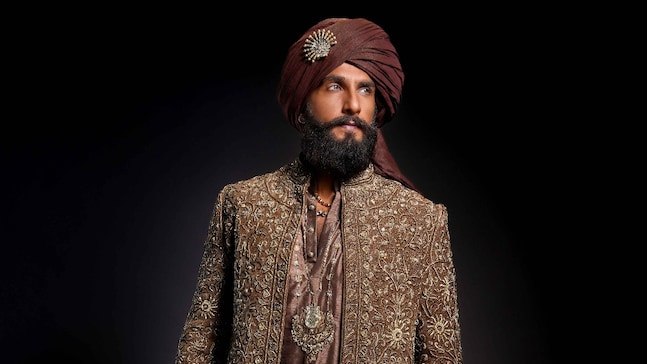
Among the many distinctive looks was, of course, reserved for the male lead, Ranveer Singh, playing Hamza Ali Mazari. Inspired by the elaborate robes of the 19th century, Divani came up with a re-interpretation of a 'khilat' once presented to the royal family of Patiala. The look blended heritage with tradition, making it feel both meaningful and seamlessly placed within the story. "The Patiala Khilat served as the archival anchor for a costume shaped through our collaboration with Chauhan for this magnum opus!" Dhir ends with a hint of pride lacing her happy eyes.
Advertisement