- Home
- Fashion
The timelessness of Indian weaves, from Chikankari to Kanjeevaram
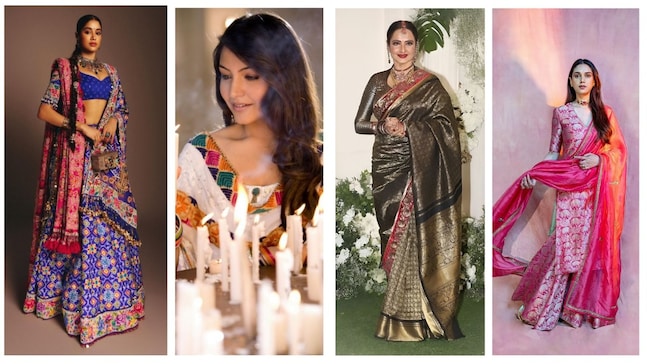
From the luxurious gold lustre of a Kanjeevaram saree to the vibrant threads of Phulkari, HELLO! India looks at India's most popular textiles that weave stories of legacy and tradition
offline
Share this:
India is a myriad of cultures. Within India's cultural fabric, though, lies its living legacy—textiles. Indian weaves endure because they tell stories: of regions, rituals, and resilience. Long before fashion cycles existed, Indian weaves mastered the art of reinvention, through changing trends, silhouettes, occasions, history and politics, all while staying true to traditions. Whether worn at weddings, rituals, or styled into modern wardrobes, these fabrics continue to feel relevant, luxurious, and deeply personal. Their timelessness lies in this beautiful balance: heritage that evolves, not erodes. Today, we travel through regions to bring you traditional Indian weaves that bind us together with every stitch.
Draped in royalty: The Banarasi weave
Originating from Varanasi, Banarasi silk is synonymous with opulence. Known for its rich silk base and intricate zari work in gold and silver, this weave has been a bridal staple for centuries. Mughal-inspired motifs—florals, jaals, and bels—give Banarasi sarees their unmistakable grandeur. Despite its royal past, Banarasi silk continues to evolve today in lighter weaves, contemporary colours, and fusion drapes, making it a timeless investment piece.
(Also Read: Celebrating Indian couture, from craft to creators)
Banarasi sarees, suits and dupattas remain a popular choice in women's trousseaus today. Labels like Raw Mango, Ekaya and Tilfi Banaras, among others, uphold the very essence of Banarasi weaves in the modern setting, for the modern woman.
Southern sophistication in Kanjeevaram
Hailing from Kanchipuram, Kanjeevaram silk is celebrated for its durability, lustre, and temple-inspired motifs. Woven with pure mulberry silk and heavy zari, these sarees are often heirlooms passed from mother to daughter. The contrast borders and mythological designs lend them a ceremonial gravitas, yet modern iterations experiment with minimal patterns and pastel tones, proving that tradition can be both powerful and progressive.
The unmatched sheen of these jewel-toned fabrics has found homes in many wardrobes, including those of celebrities. It would be unfair to begin this list with anyone but the effortlessly stylish Rekha, for whom the Kanjeevaram saree today is part of her identity. Deepika Padukone wore an ethereal Kanjeevaram saree for her wedding reception to Ranveer Singh. Sobhita Dhulipala wore a resplendent, richly-hued saree for her wedding to Naga Chaitanya. The list is endless.
(Also Read: The magic of 'Umrao Jaan' and the timeless allure of kanjeevaram sarees is why Rekha still reigns)
Blooms of Phulkari
Rooted in the cultural heart of Punjab, Phulkari is not just embroidery—it is an expression of joy, celebration, and community. Literally translating to “flower work,” Phulkari is characterised by vibrant silk threads hand-embroidered on sturdy khadi or cotton bases, often with bold geometric and floral motifs. Traditionally worn during weddings and festivals, each piece once marked milestones in a woman’s life.
Today, Bollywood has played a huge role in its growing significance beyond the mere fashion statement. Kareena Kapoor Khan in Jab We Met, and Anushka Sharma in Phillauri and Rab Ne Bana Di Jodi, are some of the cases in point that have given rise to the popularity of this weave in recent times. Hidden gems in Patiala, like Punjla by Ankit Punjla, continue to give life to this artfully created weave for women of all ages.
The precision of Patan Patola
Patola from Patan is the pinnacle of weaving mastery. Using the rare double Ikat technique, both warp and weft threads are resist-dyed before weaving, resulting in perfectly symmetrical patterns. Traditionally worn by royalty and aristocracy, Patola sarees are prized for their craftsmanship and longevity. Their bold geometry and vibrant hues ensure they remain relevant even today.
Nita Ambani is perhaps among the most prominent figures to have shone the spotlight brightly on this traditional Indian weave. Others who have made a significant contribution in bringing it to the limelight are Bollywood stars Deepika Padukone, Janhvi Kapoor and Ananya Panday, among others.
(Also Read: The pleats that encaptures the spirit of Maharashtra)
The delicateness of Chikankari
Originating from Lucknow, Chikankari is the epitome of understated elegance. This delicate hand embroidery—traditionally done with white thread on muslin, cotton, or silk—features intricate floral and paisley motifs that feel almost whisper-soft on fabric. Once patronised by Mughal royalty, Chikankari has effortlessly transitioned into everyday luxury, especially in India’s warm climate. Its beauty lies in subtlety: the closer you look, the more exquisite the craftsmanship reveals itself.
Designer duo Abu Jani and Sandeep Khosla, through their couture label, have put this weave back on the fashion map in a way that they're synonymous with the brand today. In the years ahead, Bollywood stars have shown their love for the weave in more ways than one. From Alia Bhatt to Deepika Padukone, the love for Chikankari is far from fading.
(Also Read: HELLO! India Exclusive: The textile tales from Awadh)
Edited by Sabrina Mathews
Advertisement