- Home
- Fashion
Inside Sabyasachi’s New Delhi store, more is more
A museum, a marketplace and a theatre of the imagination, the revered couturier’s new 26,000-square-foot Chhatarpur flagship turns fashion retail into an immersive world of history, craft, idiosyncratic beauty and unapologetic excess
offline
Share this:
The stuffed Bengal tiger should have been the first clue. Or perhaps it was the procession of Dutch and Chinese porcelain, the fine bone china, the marble sculptures, the antique carpets and the chandeliers unfurling from the ceiling like enormous crystal flowers. The music was another giveaway: Madonna’s Like a Virgin, rendered in Hindi, followed by a soundtrack as eclectic as the rooms themselves. This was not going to be a conventional store visit.
(Also read: The rise of concept stores in 2025 and 7 of them to visit in India)
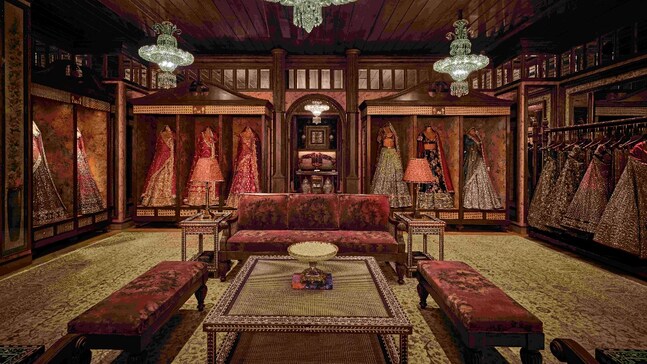
Yesterday, a group of journalists first gathered at The Imperial’s Spice Route for a tête-à-tête with Sabyasachi Mukherjee over a rather sumptuous lunch before being driven through Delhi traffic to Chhatarpur. What awaited was the designer’s newest and largest Indian flagship: 26,000 square feet of fashion, jewellery, art, antiques and curiosities, conceived less as a retail destination than as a fully immersive Sabyasachi universe. The space houses approximately 120 chandeliers, hundreds of artworks, antique carpets, textiles, mirrors and decorative objects.
Sabyasachi has always understood the seduction of the physical store. Here, that instinct has been turned up several notches. Rooms open into rooms; corridors reveal more corridors. Blue-and-white porcelain vases stand alongside paintings, furniture and sculpture. There are cabinets of curiosities, embroidered mirrors, mosaic-tiled bathrooms and stuffed animal sculptures painstakingly made at an atelier in Kolkata to eerily replicate their real counterparts. The tiger, naturally, is a Bengal tiger. Elsewhere, the visual language moves from European antiques to the bustle of Calcutta, with one gallery channeling the energy of Chowringhee and another recalling the crowded eccentricity of Kolkata’s New Market.
It is all, as Sabyasachi might put it, a little bit of everything.
But underneath the excess is a serious preoccupation with history. Speaking to the assembled press, Sabyasachi talked about museums at a moment when the truth itself can feel increasingly slippery. “Between propaganda, fake news, between what is being obliterated or what is being rewritten, where do you go to find the truth?” he asked. “At least I go to museums.” For him, museums are “important beacons of truth, of information”—repositories not simply of objects, but of memory.
That explains why The Metropolitan Museum of Art looms particularly large over this new chapter of the Sabyasachi story. Josh Romm, the museum’s Head of Global Licensing and Partnerships, was present at the Delhi launch as the house prepares to return to New York Fashion Week this September with the first chapter of its multi-year collaboration with the institution. The inaugural collection is high jewellery inspired by Byzantine art and the Met’s vast holdings, drawing on 5,000 years of history. It will debut in New York on September 15.
For an Indian designer, the significance of that relationship is difficult to miss. The Met is not simply another fashion partner; it is one of the world’s great cultural institutions, and its recognition of Sabyasachi places Indian craftsmanship, design and material culture within a much larger conversation about how history travels. Sabyasachi described the collaboration as important because “when like-minded people and institutions come together, they can collectively create massive change.” More importantly, he said, it gives him access to “5,000 years of their wonderful archives” to create “future artefacts and heirlooms for a modern generation.”
There is a neat circularity to it. The designer who has built an empire out of looking backwards is now being invited by a museum to look backwards even further in order to imagine forwards.
And then, there are the clothes.
Enter the fashion rooms and the museum gives way to a flood of pure fashion: lehengas and sarees dripping with embroidery, brocade, zardozi and gota patti; waterfalls of sequins. The colours are Crayola-pure: raspberry, peacock blue, emerald and pink martini. Men’s sherwanis sit alongside straight jackets and Bolshoi jackets. A Pashmina shawl worked with tilla embroidery costs upwards of ₹5 lakh. Everywhere, craft seems to accumulate upon craft, embroidery upon embroidery, until the clothes become almost architectural.
Yet Sabyasachi himself remains surprisingly suspicious of the conversation surrounding luxury fashion. “I hate the word custom,” he said. “And I really don’t like the word couture, honestly.” His objection is not to craft but to the status games that can accompany it. Custom dressing, he argued, can become an exercise in exclusivity rather than individuality: “If you’re going to wear custom, it really means that you have no individual style.”
His solution is almost perversely democratic. “A real star or a real confident dresser can pick up something from a rack that 500 other people have access to and wear it differently and look at their own,” he said. It is also why he has little interest in conventional celebrity dressing. “I don’t want you to buy my clothes because you want to look better than your neighbour,” he said. “I want people to buy my clothes because it’s good clothes, good craftsmanship.”
The jewellery offers another, considerably more extravagant, proposition. The High Jewellery salon is a cabinet of precious stones: jadau, uncut diamonds, polkis, emeralds, rubies and amethysts set in 18- and 21-karat gold. One emerald piece is priced at approximately ₹3 crore. There are necklaces, bracelets and rings whose stones have been selected, hammered, shaped and set with the kind of labour that makes the word “accessory” feel inadequate.
And then there is the tea room, tucked into this enormous theatricality like a pause in the middle of a sentence. Because everything here has been thought through. The objects, the music, the lighting, the carpets, the route through the rooms, the placement of the clothes. Even the excess has architecture.
Perhaps that is what makes the store work. It is not simply maximalism for maximalism’s sake. It is Sabyasachi’s argument that fashion can be a form of cultural preservation—and that retail can still be an experience rather than a transaction.
“I think the biggest thing that they struggle with is authenticity and identity,” he said of the younger generation. “There is no moving forward and no having an identity without knowing what was your past and where you came from.” So, yes, there is more. More colour. More porcelain. More embroidery. More jewellery. More chandeliers. More history. More things to look at. But somewhere between the Bengal tiger, the Calcutta references, the Met collaboration and the seemingly endless parade of extraordinary clothes, maximalism begins to feel less decorative and more like a point of view.
Sabyasachi is not merely selling the past. He is asking what might happen when you live inside it long enough to make something new.
(Also read: Harrods to welcome Sabyasachi High Jewellery's shimmering showcase)
Advertisement