- Home
- Food
HELLO! India Exclusive: “Food is the most powerful archive we have”: Chef Sanjeev Kapoor
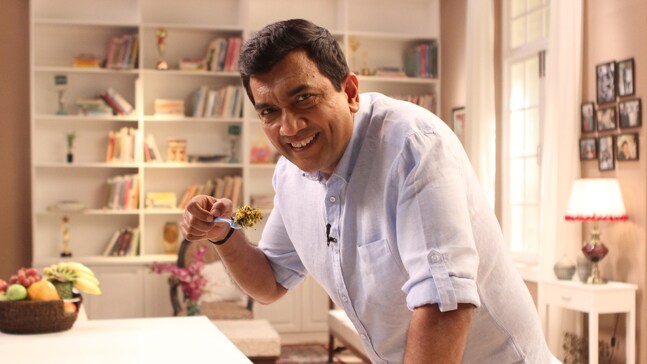
Chef Sanjeev Kapoor speaks exclusively to HELLO! India on the global appeal of Indian cuisine, his journey as an Indian culinary superstar and how Indian families "don’t pass down recipes on paper" but instead, pass them down "through smell, sound and touch"
offline
Share this:
Think Indian chefs and Chef Sanjeev Kapoor is instantly bound to be the individual you envision. Rightfully so, as the celebrated Indian has spent over three decades on-screen; since Khana Khazana aired in 1993, educating the country about its rich culinary history. But that was only the beginning. His breakthrough television show ran for nearly 20 years, post which Kapoor went on to author over 150 best-selling cookbooks (which you're certain to spot in most Indian homes), enter entrepreneurship with Wonderchef and judge MasterChef India when it first arrived in 2010. And that was simply the start of the legendary Indian chef's success. With several years, brand ambassadorships and television appearances under his belt—most notably, his recent appearance on MasterChef Australia’s 18th season for the show’s Mystery Box challenge—Chef Sanjeev Kapoor speaks exclusively to HELLO! India's Associate Editor, Dayle Pereira-Alemao on the global appeal of Indian cuisine, his journey as an Indian culinary superstar and more.
(Also Read: India’s dining scene is embracing culinary crossovers)
HELLO! India: You recently appeared on MasterChef Australia’s season 18. What do you hope international audiences take away from it?
Chef Sanjeev Kapoor: I want them to realise Indian cuisine isn’t one cuisine; it’s a thousand dialects speaking through food. And if they still think Indian cooking is “all about spices,” they’re in for a shock. It’s technique, precision, restraint, and centuries of culinary engineering.
HELLO! India: After covering Indian cuisine for decades, is there still a regional cuisine you feel deserves greater attention?
Chef Sanjeev Kapoor: Always. India is a culinary universe...you don’t “finish” it. The Northeast is the biggest blind spot. It’s bold, ingredient-driven, and unapologetically local—nothing like the stereotype of “Indian food” the world carries. But honestly, the same is true for Odisha, Chhattisgarh, Uttarakhand, Himachal’s mountain kitchens, tribal food traditions, and the quiet brilliance of home cooks who never make it to restaurant menus. The real revolution now is simple: Stop obsessing over the five dishes that became global ambassadors. Start paying attention to what India actually eats.
HELLO! India: Do you think the way Indian cuisine is presented on an international stage has changed from when you first started your career?
Chef Sanjeev Kapoor: Completely. When I started, Indian food abroad was stuck in a predictable loop: the same dishes, the same assumptions, the same “this is what Indian food tastes like.” Today, the world is finally curious. They want regionality, technique, authenticity; not clichés. And Indian chefs have stopped playing defence. We’re not diluting our food to make it palatable. We’re presenting it exactly as it is and telling the world, “This is us. Come discover it.”
(Also Read: Art-inspired restaurants to dine with artistic flair)
HELLO! India: Is there a dish that immediately takes you back to your childhood?
Chef Sanjeev Kapoor: My mother’s kadhi-chawal. One bite and the entire world disappears.
HELLO! India: Do you think food plays a role in keeping family traditions and memories alive?
Chef Sanjeev Kapoor: Food is the most powerful archive we have. Families don’t pass down recipes on paper, they pass them down through smell, sound, touch. The crackle of tadka, the feel of shaping laddoos, the exact moment a roti puffs… these things stay with you long after everything else changes. And when families move, food becomes the anchor. A pickle, a festive sweet, a simple dal—they can bring back an entire childhood in one bite. Food doesn’t just nourish us. It remembers for us.
HELLO! India: What do you think made Khana Khazana resonate so deeply with audiences?
Chef Sanjeev Kapoor: (Smiles) I think stars were aligned. It was simple, it was warm, and it didn’t pretend. When we started, a chef on Indian TV was a novelty. I realised quickly that people didn’t want restaurant drama. They wanted clarity, confidence, and recipes that actually worked. If someone watched the show and thought, “I can make this tonight,” we had succeeded. Khana Khazana didn’t just teach recipes, it became part of people’s kitchens, routines, and memories. That’s a connection you can’t fake.
HELLO! India: From television to books to entrepreneurship, what has each chapter of your career taught you about the culinary business?
Chef Sanjeev Kapoor: Each chapter sharpened a different muscle. Television taught me how to speak to millions without losing the soul of a dish. Books taught me discipline: Once a recipe is printed, it has to stand on its own. Entrepreneurship, especially with Wonderchef, taught me to think beyond the kitchen-to understand how people actually live and cook. I’ve always believed in staying restless. Every project teaches me something, and I carry that learning into whatever comes next.
(Also Read: Prasadam's timeless place in Indian cuisine)
Advertisement