- Home
- Lifestyle
A rain-soaked escape into Rajasthan’s past
The rugged exterior of this centuries-old, off-the-tourist-map fort hardly prepares you for the indulgence that awaited within. What began as just a weekend staycation to escape from the chaos and claustrophobia of Mumbai, had turned out to be an impressive slow-luxury experience
offline
Share this:
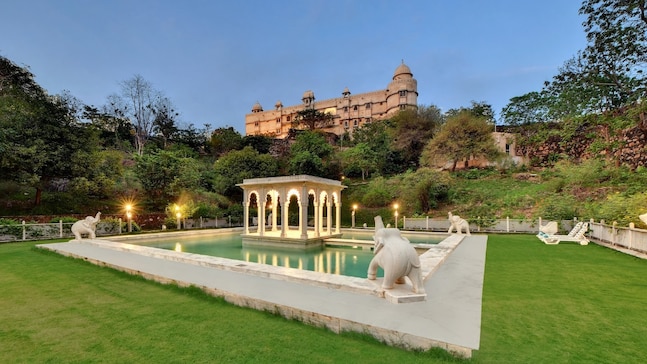
It was raining without a pause, and the city had once again resorted to surviving on the ‘spirit of Mumbai’. The all-round dysfunction was making even a pluviophile like me dread the incessant downpours. I needed a break; from the waterlogged streets, from the grey skies, and from my rain boots. So, when the opportunity to spend a weekend at an old, off-the-tourist-map fort in Rajasthan arrived in my mailbox, it felt nothing short of providential. I was expecting Rajasthan as promised by the movies—sun-baked forts rising from parched landscapes, dusty roads stretching into the horizon, and cloudless skies washed in brilliant blue. But as my car made its way from Udaipur Airport to Bambora—a distance of merely 40 kms—I was greeted by a lush green landscape echoing with shrill calls of peacocks. The air was fragrant with petrichor. It seemed as if the rain gods had meticulously choreographed the scene to make me fall in love with the monsoon all over again! And it was on this dramatic backdrop that the somber Bambora Fort; erstwhile a significant Sisodia outpost, revealed itself. Rising from the hilltop, it stood like a resilient sentinel, silently watching over the valleys it had guarded for more than three centuries.
(Also Read: Escape the scorch at these luxury hill retreats that promise the chicest summer reset)
The story of Bambora dates back to 1711, when the thikana, or estate, was granted to Kunwar Samant Singh by Maharana of Udaipur, Sangram Singh II of the Sisodia dynasty, in recognition of his valor at the Battle of the Khari River. Unlike the elaborate pleasure palaces that Rajasthan is known for, Bambora was built with a far more practical purpose; that of a strategic military outpost. In an age when many heritage properties are remembered for their grandeur, Bambora stands apart with its quiet sense of duty. Upon entering the fort, its thick stone walls, watchtowers, and zigzag approach path—a classic example of medieval military architecture designed to slow advancing armies—immediately reminded me of its martial past. Today, the fort has gotten a new life as The Fern Bambora Fort Udaipur, Series by Marriott, and is replete with contemporary comforts and modern amenities. Yet, unlike most restored heritage properties, here luxury adapts to history, not the other way around. The fort is never relegated to a mere backdrop; it remains the protagonist. The new additions are made only where they were needed, and that too with such restraint that it is almost impossible to distinguish them from the original structure. The old fortifications and watchtowers still stand looking out over the same landscape they once guarded. Rather than borrowing design ideas from elsewhere, the rooms take their cues from the Rajput architecture that defines this part of Mewar.
I was staying in one of the three 600 square-footed Hazel Suites and what made me instantly fall in love were the huge jharokhas framing the malachite-and-emerald-washed landscape outside that could have been lifted from a meticulously painted Rajasthani miniature. And the second thing that had my heart was the pristine asymmetrical clawfoot bathtub where I would go on to spend an obscene amount of time indulging in bubble baths. But for me, the most crucial part of a good staycation is definitely its food. And Chef Hasnur Raja and his team didn’t disappoint! The evening was spent sitting by the jharokha, sipping piping-hot masala chai and savouring freshly made, golden-brown moong dal kachoris. The earthy warmth of the masala chai; the freshly made, flaky moong dal kachoris fragrant with cumin, fennel, and a whisper of asafoetida; the quietude of a remote fort punctuated only by the shrill calls of peacocks; and an inky-blue monsoon sky slowly blurring the horizon of a serene, sprawling emerald landscape—it was the perfect blend of drama and romance.
(Also Read: HELLO! India Exclusive: The energising escape leading the world of wellness)
Next came an evening of cultural immersion. The local Rajasthani artists took over the lawns of the fort, and against the dramatic backdrop of centuries-old stone walls, the performance—an ode to Rajasthan’s rich and throbbing cultural heritage—unfolded with robust folk vocals reverberating through the fort’s ancient corridors, and dancers moved with breathtaking precision—twirling swords, performing with flames, and balancing towering stacks of handis with effortless grace atop their heads. If it was not dramatic enough, Mother Nature then took it upon herself to add some more theatrical flourish. As the night descended, rain came down in torrents as dazzling silver streaks of lightning ripped across the darkened sky. The shrill calls of the peacocks gave way to rolling thunder, while fierce gusts of wind lashed against the fort's ochre walls. I settled into the warmth of the 1711 AD Lounge for a leisurely dinner—it was a scrumptious continental spread—accompanied by a few glasses of fine wine before calling it a day.
I had never before woken to the crow of a rooster, let alone to the piercing calls of peacocks. The next morning, that changed. As dawn broke over Bambora, the fort stirred to a chorus of peacocks, their piercing calls waking me with a start. With the rain tapping gently outside and the scent of petrichor filling the air, I found myself longing for a steaming bowl of spicy Maggi—the ultimate monsoon indulgence! When I sheepishly mentioned my craving to the chef, he simply smiled and asked me to give him some time. I later discovered that my humble request had travelled nearly 30 minutes from a local shop to the fort on a bicycle. It was in this small but unforgettable gesture that perfectly captured the spirit of Bambora’s hospitality. It was proof that the staff understood the assignment—that true luxury lies in the smallest details, in going out of the way to ensure every whim and wish of the guests was met, and met with genuine warmth and a smile.
By 9 am, it was time for a short excursion to the nearby Jaisamand Lake. Scattered around the vast expanse of water—the world's second-largest artificial freshwater lake after Egypt's Aswan Reservoir—are evocative remnants of Mewar's royal past in the form of intricate chhatris and jharokhas. The lake’s marbled embankment or bund also has a serene Shiva temple that lends the landscape a quiet spiritual dimension. There is also a tinge of romance and melancholy that lingers in the air. Perched atop a hillock, one can also spot the rather dramatically named Ruthi Rani ka Mahal, or the palace of the sulking queen! Built between 1685 and 1691 as Hawa Mahal—a summer palace—by Maharana Jai Singh for his queen, it later became known as Ruthi Rani ka Mahal. Legend has it that the queen, deeply hurt and angered by the Maharana’s conduct on a particular night, left the royal palace and chose to live here in self-imposed exile. The palace has long since surrendered itself to the forest; its weathered walls are now veiled in creepers, breeding myths and folklore…some of which even claim a haunting by the estranged queen. As my boat drifted across the breeze-caressed waters of Jaisamand, it felt like a journey through the many layers of Mewar, where history, architecture, myth, romance, and spirituality coexisted in perfect harmony.
Back at the fort, a different kind of sensory experience awaited. A leisurely lunch of Rajasthani specialties—headlined by a beautifully prepared, perfectly spiced laal maas—lulled me back into the life of a lotus-eater. A short siesta later, I headed to Zodiac Spa & Salon for a restorative aromatherapy session that perfectly echoed the slow, unhurried rhythm of my weekend at Bambora Fort. The next day was a Sunday, and began the morning with an indulgent soak in the bathtub—the warm bubbles cocooning me in comfort, while the symphony of rain and peacocks outside created the perfect soundtrack for a slow-luxury ritual. The rest of the day was dedicated to the fine art of doing nothing. But like every dream, this little escape had an expiry date. By evening, it was time to leave behind this languid world and return to the rhythms of everyday life—a world away from the dancing peacocks, rain-soaked mornings and unhurried hours that had defined my weekend in Bambora.
Perhaps that is the true luxury of The Fern Bambora Fort: not just the grandeur of a centuries-old fortress or the comforts it offers, but the freedom to slow down, the warmth of personalised attention and the rare privilege of simply being present.
(Also Read: Your long weekend monsoon escape starts here)
Advertisement