- Home
- Royalty
This Palace in Jodhpur is a lesson in the art of the royal wedding
India’s first private royal residence to become a heritage hotel — Ajit Bhawan — is still, nearly a century on, a lived-in family home, which is precisely what makes it one of the country’s most quietly persuasive wedding addresses.
offline
Share this:
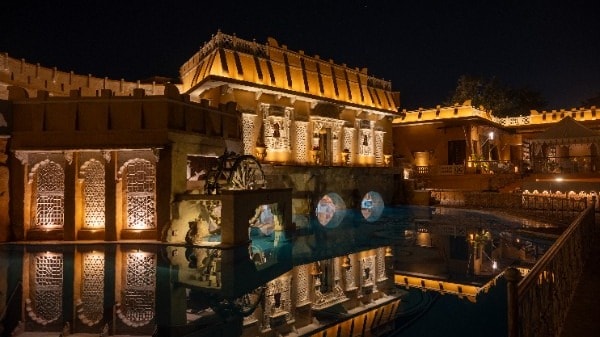
Upon entering Ajit Bhawan, you are welcomed by grandeur and legacy in equal measure. Stories seem to reside in every nook and corner, and every turn reveals something new, inviting you to find a story somewhere within the red sandstone walls. Exuding regalia without feeling removed from the world around it, the property makes an almost immediate case for itself as a wedding destination.
Built in 1927 as the residence of Maharaj Dhiraj Sir Ajit Singh of Marwar-Jodhpur, Ajit Bhawan stands as India’s first private residence converted into a heritage hotel. That conversion came in the early 1980s, when Rani Usha Devi and Maharaj Swaroop Singh opened a section of the palace as a 12-key retreat, at a time when heritage hotels, as a category, did not exist in India.
Nearly a century later, it retains the feeling of a lived-in royal home, with its architecture, heirlooms, artwork, and traditions woven into the experience rather than simply being put on display. Today the property holds 64 rooms, including 30 suites — with no two of them alike — which was a structural consequence of the building being a home first and a hotel second.
For weddings, there are equally compelling settings: The 10,000-square-foot Zenana Garden can host up to 400 guests, while the Garden Restaurant accommodates a 250-person sit-down celebration, also providing a space for a stage and mandap. Dining runs across four distinct venues — the multi-cuisine Jodhpur Café, the Garden Restaurant, J-Bar, and Dhani — so a four-day celebration can move rooms without moving hotels. The Jodhpur Café can host around 200 guests, making the property particularly well suited to celebrations that unfold over several days.
A TASTE OF ROYALTY
A property this layered rewards multiple sets of eyes. The pool with its hand-drawn shape surrounded by blossoms all across, the magnificence of the royal thalis, and even the traditional emblems that were dispersed throughout the property. You'll also find corners to disappear into, every one of them more photogenic than the last, which serves as the perfect backdrop if you are planning a wedding there.
Lunch at the Jodhpur Café was an expansive introduction to the property’s approach to hospitality, with a spread that moved effortlessly between Indian, Asian, and continental flavours.
Also Read: World's most luxurious hotels for an unforgettable getaway
The Ajit Suite, with blue-washed walls, resembles the city outside. In addition are the generous proportions and a bathroom spacious enough to feel like another room altogether. The interiors balanced traditional and royal without becoming overly formal, with modern amenities like jacuzzis folded into the heritage setting. And because no two rooms at Ajit Bhawan are the same, a stay here comes with a sense of discovery built into it.
Afternoons also offer a glimpse of what the property could become, especially during a wedding. There is something particularly appealing about a wedding destination that does not feel like a venue temporarily dressed for an occasion, but rather a world your guests can actually live in for a few days.
By evening, the world comes alive in the garden. Candles illuminate the space as traditional music fills the air, performed by local musicians whose presence made the dinner feel authentically native. The chef sent out an Asian menu that was especially curated for us, which kept arriving long after appetite had conceded. Chicken skewers, noodles, dim sum, and bowls.
A lit up garden in winters, guests gathered around tables, music in the background, and plates continuing to arrive; any wedding made special just with a sense of intimate moments.
At Ajit Bhawan, the property’s Lost Recipes dinner — an experience curated by Chef Bikram Chandra Khadka that revives dishes from the royal kitchens of Marwar - is an experience of its own. Made from the ingredients that were available back then such as whole red chillies, garlic, curd, and ghee, these dishes were originally sealed and buried in the earth to cook slowly over coal, a technique built for hunting parties. While Khad Maans dates to the era of Rao Jodha, Sikari Murghi comes from Rao Maldeo’s time, a warrior kitchen’s answer to scarce ingredients, along with Bajre Ki Raab, the millet drink desert communities lived on. The Mand, a layered rice, was extraordinary on the strength of its saffron alone. There was storytelling woven into the dinner, a sense that we were being given access to something rather than simply served something. And perhaps, that is the most interesting kind of luxury.
THE CITY AS A VENUE
Beyond the property, Jodhpur reveals itself in soft layers. Somewhere between Mehrangarh Fort and the winding streets of the Blue City, people are warm, curious, and generous with their stories, so much so that the destination almost invites you. The hospitality of the city people runs ahead of anything anyone has ever experienced.
Also Read: 5 of the world's most spectacular castles
Mehrangarh, of course, is an obvious addition to any wedding itinerary. For guests who want to step away from the celebrations for an afternoon, the fort offers history, architecture and one of the most arresting views of the city. And that, perhaps, is the luxury of choosing a place like this. The property gives you the privacy, grandeur and hospitality of a royal residence, while Jodhpur supplies the culture, colour, architecture, food, and stories beyond its gates.
THE HOUSE BEHIND THE HOTEL
More than just a hotel, the property is first and foremost a royal residence. The royal family’s living spaces are filled with the traces of the family’s history: antique furniture, photographs, weapons, tables, and objects collected over generations. The castle itself is divided between the two branches of the family, and seeing the portion still associated with the household gave the property a sense of intimacy that a conventional heritage hotel could never quite recreate. There was also time to speak with Nitin Sud, Cluster General Manager, whose warmth and knowledge added another layer to the stay. It was clear that the property’s greatest asset is not simply its red sandstone, royal provenance or beautiful gardens, but the people who keep its history alive.
And perhaps that is what makes Ajit Bhawan such an evocative wedding destination. It gives you the grandeur expected of a royal celebration, but also something more difficult to find: a sense of belonging. You can arrive for the wedding, stay for the stories, leave the palace for the city, and return to the same gardens by evening. For a few days, Jodhpur becomes more than a backdrop. It becomes part of the celebration itself.
Advertisement