- Home
- Fashion
Remembering Yayoi Kusama’s infinite world of dots
From the polka dots that first appeared in the hallucinations of a troubled child to the Infinity Mirror Rooms that turned art into an immersive global phenomenon, the Japanese artist spent seven decades dismantling conventions and blurring the boundaries between art, fashion, and popular culture. HELLO! pays tribute to the icon.
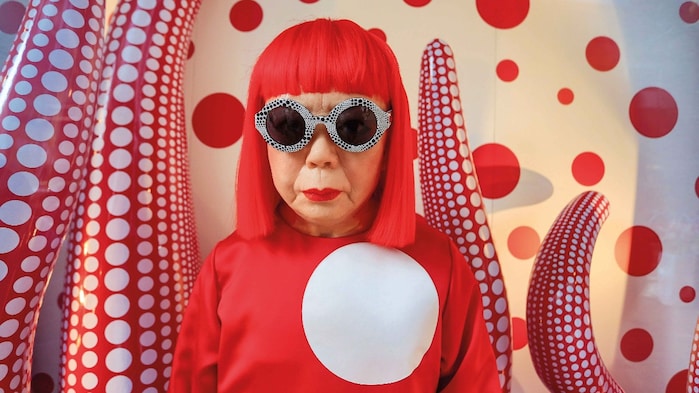

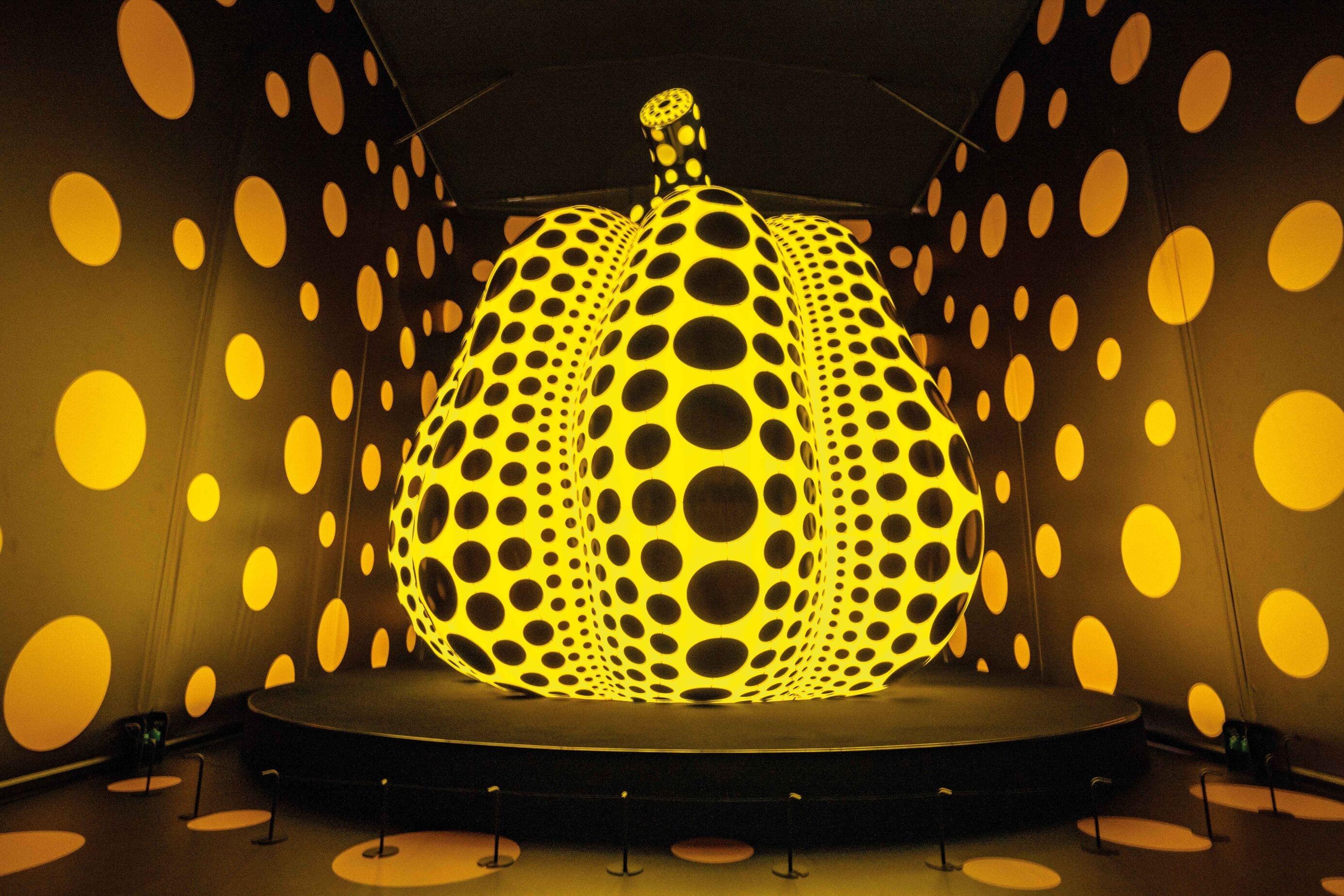
There is a particular kind of recognition that belongs only to the very few: recognising the artist at one glance. A field of polka dots. A yellow pumpkin. A room of flickering lights reflected into infinity. Yayoi Kusama, the Japanese avant garde multidisciplinary artist whose work explored repetition, infinity, and self obliteration, achieved this status. By the time of her death in Tokyo on August 14, aged 97, the artist extraordinaire’s visual language had travelled far beyond galleries and museums, into fashion, commerce, social media, and popular culture.
The dots did not begin as a branding exercise. They began in childhood. Born in Matsumoto, Japan, in 1929, Kusama grew up in a prosperous family that ran a seed business, but her home life was deeply unhappy. Her father was unfaithful, and her mother was hostile to her desire to make art. As a child, she experienced vivid hallucinations: Flowers seemed to swarm around her, while patterns of dots and nets appeared to cover rooms, her body, and the world around her. Art became a way of confronting those visions. She later said she translated the hallucinations and obsessions that plagued her into paintings and sculptures.
At 13, Kusama was conscripted to work in a factory, making fabric for Japanese army parachutes during the WWII. She went on to study Nihonga, the formal Japanese painting tradition, in Kyoto but found its conventions restrictive. In 1957, she left Japan for the US, arriving in New York at a time when the city was rewriting the rules of contemporary art.
Kusama did not merely enter that conversation. She disrupted it. So much so that The Museum of Modern Art describes her as a vital figure in New York’s avant garde avenue. Her early ‘Infinity Nets’ — vast canvasses covered in thousands of repeated marks — challenged the dominance of Abstract Expressionism. Then came ‘Accumulations’ — everyday furniture covered with hand-sewn, phallic forms. Confrontational, strange, and deliberately excessive, the work placed Kusama among the artists defining pop, minimalist, and early feminist art.
She was also determined to make art impossible to ignore. In the 1960s, Kusama staged happenings in public spaces, painting polka dots onto naked bodies in performances that challenged sexual conventions, capitalism, and the Vietnam War. At the 1966 Venice Biennale, after being refused permission to exhibit in the official Japanese pavilion, she covered the lawn nearby with 1,500 mirrored balls as part of ‘Narcissus Garden’ and danced among them in a leotard, turning rejection into spectacle.
The polka dot, meanwhile, was becoming something much larger than a motif. Kusama saw dots as cosmic particles — each individual point part of something infinite. “Our earth is only one polka dot among a million stars in the cosmos,” she once said, later taking that idea off the canvas and putting the viewer inside it.
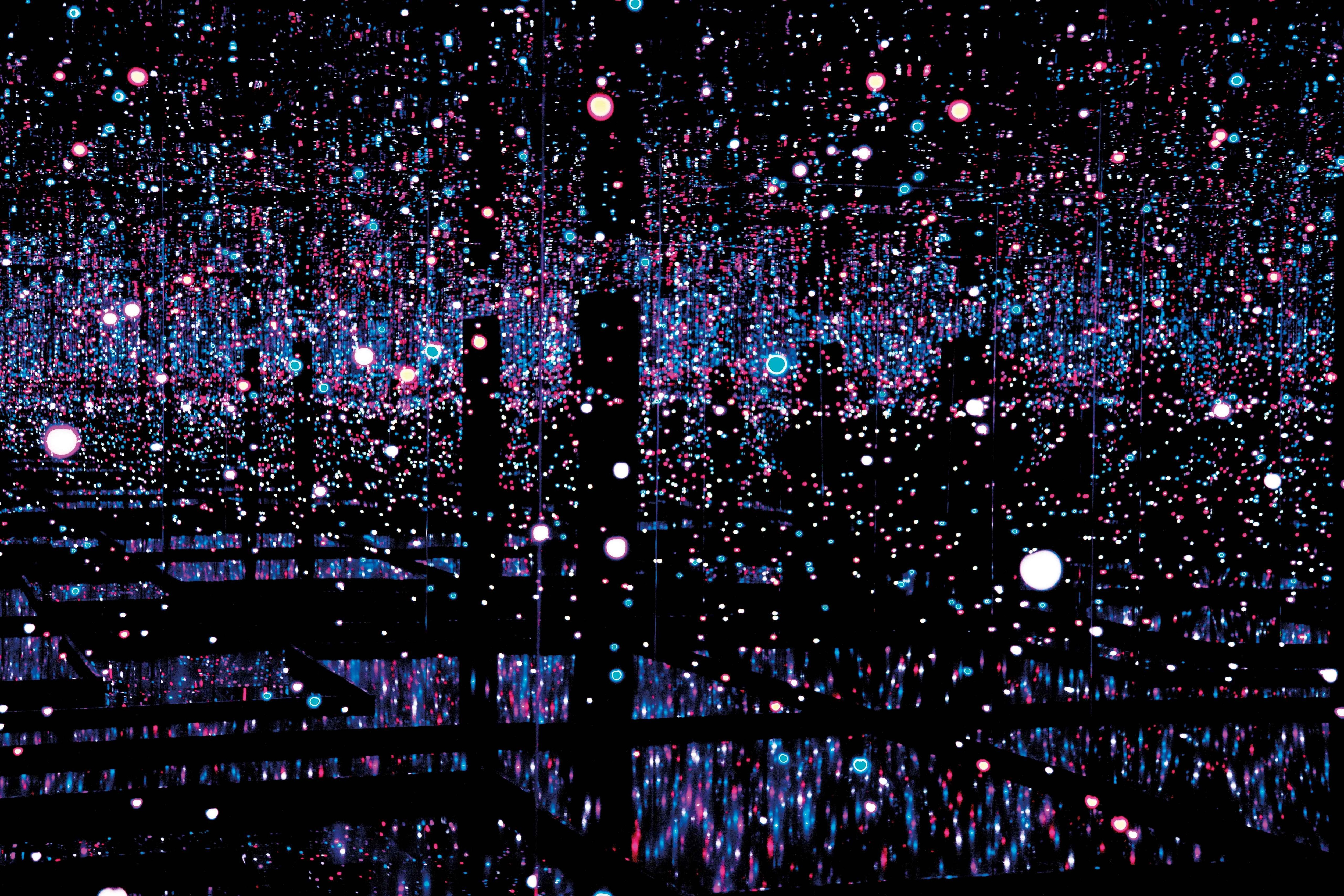
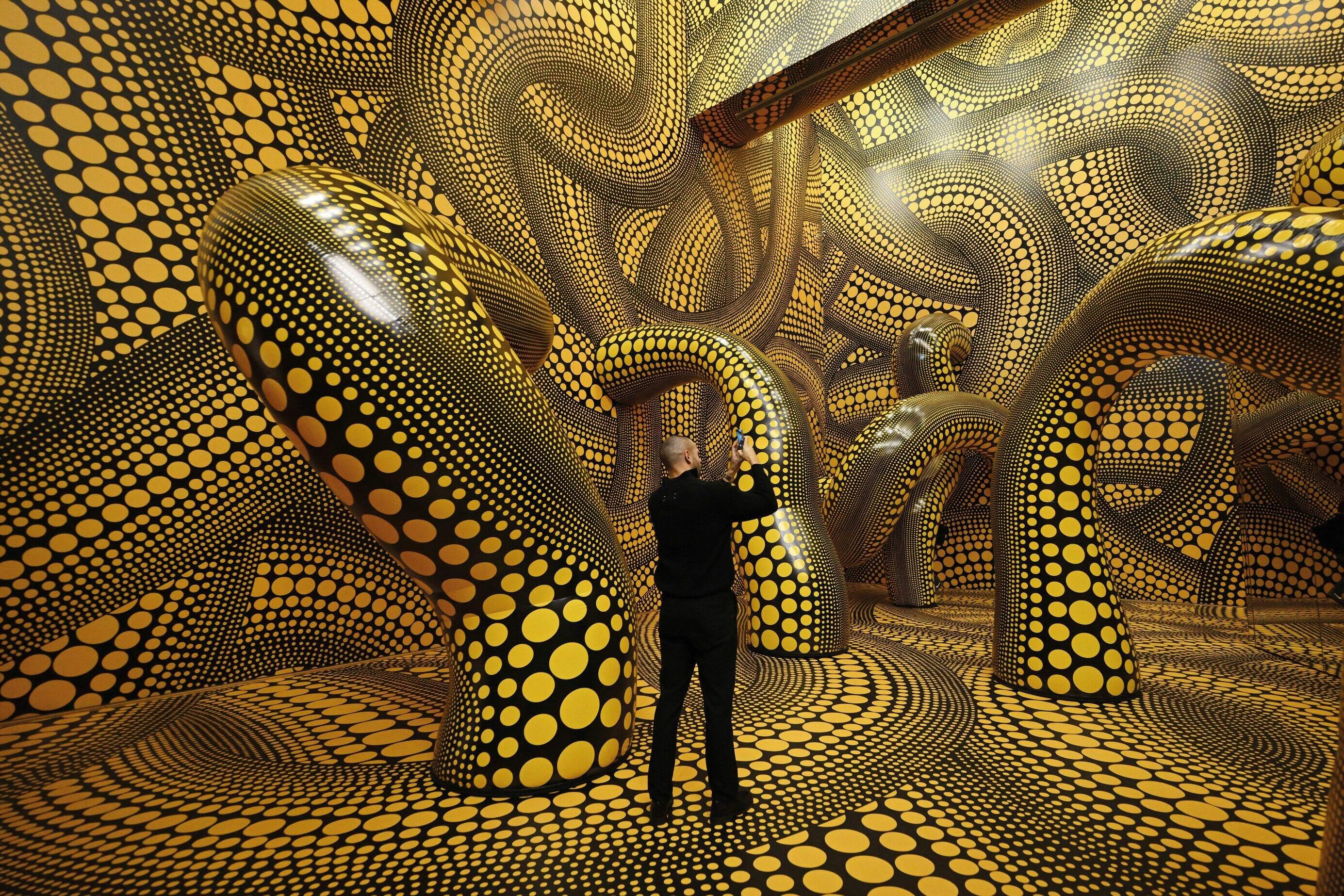
Her first Infinity Mirror Room ‘Phalli’s Field’ appeared in New York in 1965. The installation used mirrors to multiply hundreds of soft, polka-dotted forms until a single room appeared endless. It was a radical shift: The artwork was no longer something to stand before but somewhere to enter.
Decades later, the same rooms would become global cultural phenomena. Long before Instagram, Kusama understood the power of an image that made the viewer part of the picture. Before the advent of the social-media era, her mirrored spaces had become among the most photographed contemporary artworks in the world, drawing millions to exhibitions. India, too, entered that universe.
In 2023, the Nita Mukesh Ambani Cultural Centre brought her Infinity Mirrored Room — ‘The Eternally Infinite Light of the Universe Illuminating the Quest for Truth 2020’ — to Mumbai, marking the work’s first presentation in India. With its suspended lights endlessly reflected across mirrored walls, the installation became part of the centre’s permanent collection, alongside Kusama’s ‘Clouds.’
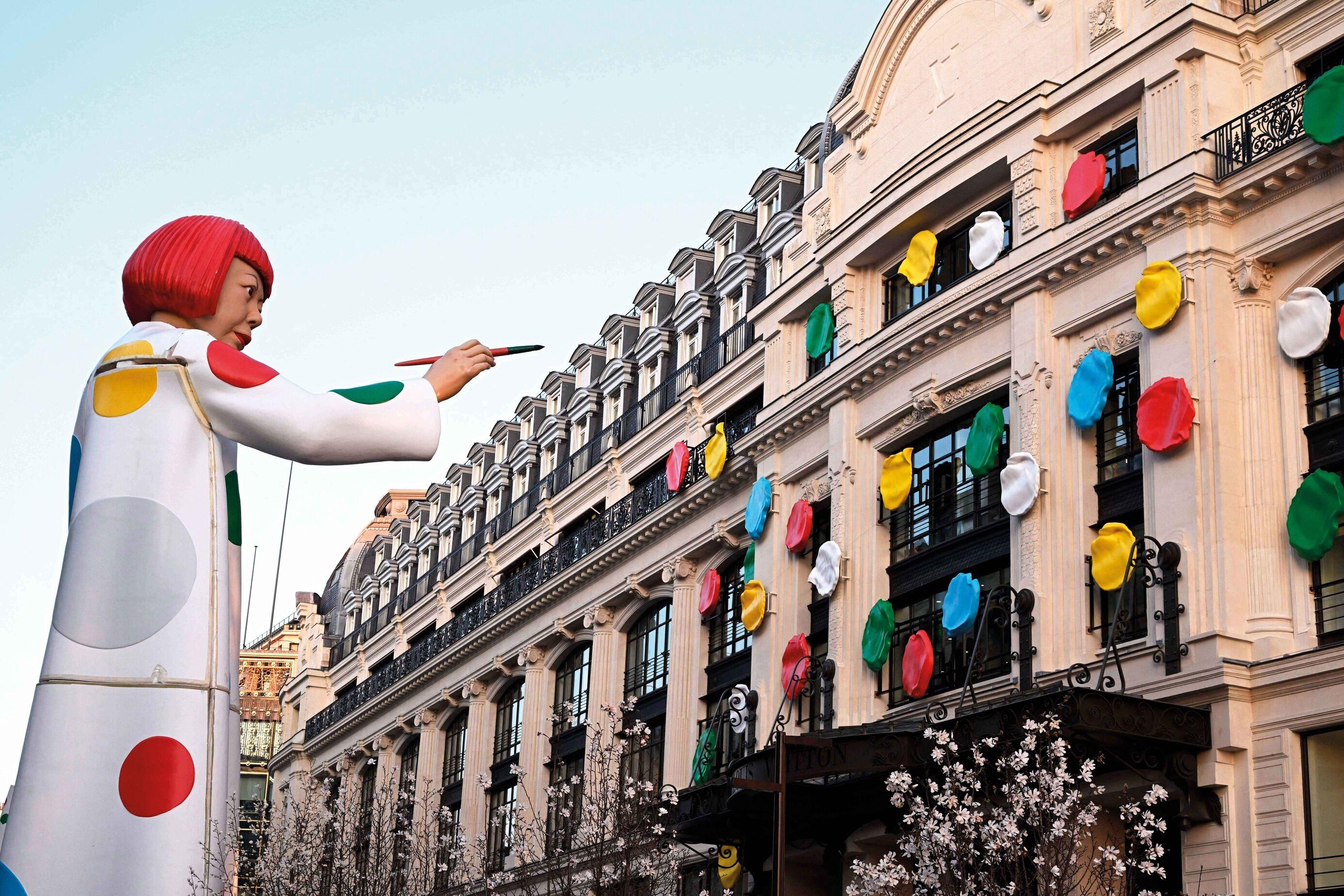
Her influence eventually extended far beyond the art world. Her red wig and polka-dotted clothes became part of her visual identity. Collaborations followed with Marc Jacobs, Louis Vuitton, Lancôme, and others. The artist who had once operated at the margins of the establishment became a global pop cultural figure, her dots appearing on everything from luxury goods to cosmetics.
There was an irony in that transformation. Kusama had spent her early career fighting to be taken seriously by an art world that often overlooked women, Asian artists, and so-called outsiders. Overcoming these hurdles, she became so ubiquitous that the boundary between artwork, artist, and brand almost disappeared. Yet she never stopped creating.
After returning to Japan in the 1970s, Kusama voluntarily entered a psychiatric hospital in Tokyo in 1977 and would live there for the rest of her life, working from a nearby studio. Her mental health became inseparable from how the world discussed her, sometimes unfairly overshadowing the discipline and ambition of the art itself.
She continued painting until her final days. And perhaps that is the simplest way to understand her legacy. Kusama took the things that frightened her — the hallucinations, the idea of infinity, even the limits imposed on her as a woman and an outsider — and reproduced them until they became something else entirely.
A dot became a universe. A room became infinity. And an artist once considered radical became an icon of the culture she had spent her life shaking up.
Continue Reading