- Home
- Fashion
Why India Couture Week was about more than just beautiful clothes
Against the backdrop of a city in turmoil, India Couture Week became a test of whether the country’s highest form of dressmaking could still justify its place—and its purpose
offline
Share this:
The skies above Delhi had turned the colour of wet concrete, heavy with monsoon rain and heavier still with uncertainty. A few kilometres from the Taj Palace hotel, where the FDCI x Hyundai India Couture Week was unfolding in all its embroidered splendour, students continued to gather at Jantar Mantar, raising slogans that have, over the past weeks, become part of the city’s soundtrack. The tension was impossible to ignore. Inside, conversations were no longer confined to guest lists, front-row seating or celebrity showstoppers—many of whom pulled out at the last minute amid the current climate. They drifted towards whether couture should continue at all.
(Also Read: India Couture Week 2026 ends on a dazzling high)
It was an uncomfortable question, but not an unreasonable one.
What place does couture have when the world outside feels increasingly fractured? Is it an indulgence, or can it still claim relevance beyond its rarefied clientele?
The answer lies in remembering what couture really is. Behind every embroidered lehenga, hand-cut jacket and handwoven saree are hundreds of artisans—embroiderers, dyers, pattern cutters, tailors and karigars—whose work sustains an ecosystem that stretches far beyond the runway. Couture is luxury, certainly, but it is also one of the last places where craftsmanship still dictates the pace of creation.
If it is to remain relevant, however, craftsmanship alone is no longer enough. Indian couture has already proved it can execute the impossible by hand. The more pressing challenge is whether it can still surprise.
This season offered reasons to believe that it can.
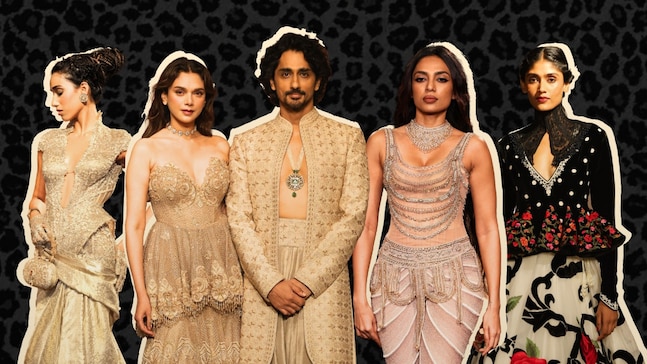
Anamika Khanna opened India Couture Week at Hyderabad’s Taj Falaknuma Palace by bringing the Kolkata artisans she has worked with for decades to demonstrate their craft, reminding audiences that couture begins long before a garment reaches the runway. Jayanti Reddy, meanwhile, made a compelling case for restraint, proving that good tailoring can be just as luxurious as heavy embroidery. Built on lighter fabrics and considered embellishment, her collection prioritised ease without sacrificing craftsmanship, with Aditi Rao Hydari and Siddharth bringing the designer's quiet vision to a fitting close. Kunal Rawal continued to refine contemporary Indian menswear through impeccably tailored sherwanis cinched with fabric belts, while Falguni Shane Peacock delivered some of the week’s most memorable outerwear: boxy, embellished men’s jackets that felt somewhere between the ornate tailoring of a Mexican charro and the theatrical grandeur of the Bolshoi.
The clearest argument came from Tarun Tahiliani, who marked three decades of his label not with a victory lap but with an exhibition-cum-runway presentation that transformed Bikaner House into something closer to a living museum. Within its gilded rooms, fashion unfolded as a glorious bombardment of ideas. Chikankari, Kashida, gota patti, sculptural silhouettes and a riot of colour tumbled from room to room, each more tactile than the last. Less an exhibition than a journey through three decades of a designer still in restless conversation with beauty.
The clothes themselves felt similarly assured. A floor-length emerald velvet column reduced the body to its purest expression: an attenuated silhouette sculpted in moulded velvet, with a tightly nipped waist, jutting hips and narrow shoulders transforming the wearer into what felt like a living line drawing. Elsewhere, mother-of-pearl embroidery rendered onto transparent tulle appeared, at first glance, to be an elaborate jewelled necklace before turning out to be painstaking appliqué worked into silk. A saree used gota patti and jaali embroidery to mimic antique brocade, while filigreed Nehru jackets demonstrated that Indian menswear remains one of the country’s most underappreciated design achievements. The point was not maximalism for its own sake. It was mastery. God, as Tahiliani reminded us, remains in the details.
If Tahiliani represented the culmination of Indian couture’s past and present, Rohit Bal represented something more emotional: the extraordinary resilience of legacy. There has long been anxiety surrounding what happens when a designer becomes bigger than the person himself. Can a house survive without calcifying into nostalgia?
At Rohit Bal, the chandeliers lifted. The models stirred from their slumber. Suddenly we were floating across a lotus-filled lake—part Kashmir, part A Midsummer Night’s Dream. Then came the clothes: a masterclass in intoxicating colour, impeccable tailoring, extraordinary fabric manipulation and embroidery.
Never has an angrakha looked so compelling, whether paired with a gold-embroidered jacket, an unbuttoned floral greatcoat trailing embroidered roses or a sharply tailored peplum. Even the menswear was anything but conventional. A men’s corset paired with an Elizabethan ruff could easily have felt like costume, but instead it came across as a bold new direction for couture menswear.
The real triumph lay in the execution. Every look, no matter how elaborate, felt considered and impeccably crafted. The embroidered flowers, the trailing vines and perfectly cut jackets reaffirmed that Gudda’s legacy is not merely being preserved; it is flourishing in the hands of those who continue to bring his vision to life.
The week’s most forward-looking collection, however, belonged to Rimzim Dadu.
For years, Dadu has challenged assumptions about what Indian couture can be by manipulating steel into total obedience. This season, she turned instead to mother-of-pearl, stretching the very definition of material itself. Metal, silver and nacre undulated across the body like liquid waves, becoming garments that fitted almost like a second skin. Fashion has always been obsessed with embellishment. Dadu seemed interested instead in transformation. Rather than layering embroidery onto cloth, she questioned the cloth itself.
At a moment when so much luxury fashion globally risks becoming formulaic—another corseted gown, another embellished lehenga, another viral silhouette—it was refreshing to encounter a designer asking entirely different questions.
Not what can we decorate? But what can we invent?
That spirit of invention ultimately distinguished the strongest collections from the merely competent. They understood that Indian couture no longer needs to prove its technical ability. That argument was won decades ago. The embroidery is extraordinary. The craftsmanship is unmatched. The ateliers remain among the finest anywhere in the world.
The challenge now is one of ideas.
How do you make couture feel urgent? How do you acknowledge history without becoming trapped inside it? How do you celebrate Indian craft without reducing it to heritage tourism?
Tarun Tahiliani answered by building on a design aesthetic he has spent thirty years perfecting. Rohit Bal answered by proving that legacy can still evolve. Rimzim Dadu answered by suggesting that the future of couture may lie not only in embroidery, but in entirely new materials.
Rahul Mishra, the final designer to close the calendar, presented one of the season’s most ambitious collections, even if its exhibition format blunted the emotional force it had possessed on the Paris runway. Inspired by temple architecture and sculpture, Devi transformed textiles into something resembling carved stone. Presented instead as an exhibition, with models standing motionless on plinths as guests circled them, that sense of discovery gradually disappeared. The clothes became objects to document rather than garments to experience.
The finale illustrated the problem. As the apsaras gathered around Sobhita Dhulipala—cast as the Devi—slowly adorning her, the symbolism was clear enough. Yet from much of the room, the choreography was lost behind a crowd of spectators holding their phones aloft. What should have been the emotional crescendo became another bottleneck in an already congested presentation. The idea remained compelling. The staging, not quite so.
Perhaps there was another lesson, too. With several celebrities choosing not to attend as the city grappled with unrest, the week was forced to rely less on star power and more on the collections themselves. That felt like a welcome reminder. Too often, Indian couture leans on celebrity appearances to validate its existence, when couture’s real protagonists should be the clothes. The great couture houses in Paris rarely need a famous face on the runway to command attention. Neither should India.
Outside the Taj Palace, Delhi carried on with its unrest. Inside, couture continued to make its own case for relevance. Couture has never been constrained by cost. Its true currency has always been imagination. And this season, despite the clouds gathering over the capital, that imagination—and the craftsmanship behind it—remained gloriously, stubbornly alive.
(Also Read: India Couture Week 2026 opens with a stunning showcase of contemporary couture)
Advertisement