- Home
- Lifestyle
HELLO! India Exclusive: A glimpse into maximalist maestro Adil Ahmad's ancestral abode
Aiwan-e-Ahmad, the designer’s ancestral Lucknow home, is a lesson in artful excess, where every chandelier, every candelabra, every brass talisman has a story to tell. As Adil delights in restoring the mansion to its erstwhile glory, HELLO! gets a tour of its striking rooms filled with art and artefacts


The invitations arrive months in advance. These are formal invitations on thick cards that can be propped up on a desk or a fireplace. The type is formal and curlicued, and one can read the invite with their eyes closed. The invite is from Adil Ahmad, and he’s asked you to a celebration for his mother, Saida Ahmad, whose birthday party in Lucknow everyone is going to. Well, sort of. Some people haven’t been asked — not yet anyway — and the heartburn is profound. There’s a perfect programme attached to the invite and the fete — for that’s what it is — will be at the Ahmad’s family home, Aiwan-e-Ahmad, in Lucknow, within dipping distance of the river Gomti. Guests pack for several outfit changes. Jewels are pulled out of storage and slipped into velvet boxes for travel. Egos are carefully locked up in closets. Hotels have started filling up across Lucknow.
Festivities are de rigueur at Aiwan-eAhmad, and following family tradition, Adil is a lavish host. The stories from bashes of yore are legendary — Begum Akhtar, Bismillah Khan, Pandit Jawaharlal Nehru and his daughter and former prime minister Indira Gandhi. Adil has continued the custom in this universe of warmth, generosity, and vigour, intellectual and youthful.
Aiwan-e-Ahmad was built in the 1950s and designed by the noted Ipswich-born architect, Claude Blatley. Bombay Gymkhana at the triangular end of Azad Maidan, Parsi Colony, Cusrow Baug and the posh Breach Candy Hospital in Mumbai are all Blatley’s designs that have endured with great elegance over the years. Like all grand houses of the era, Adil’s Lucknow home has long driveways leading to porches and deep verandahs that open into an enfilade of rooms — living, dining, guest and more. So unapologetically maximalist is the style that it’s safe to say beige isn’t Adil’s go-to colour.
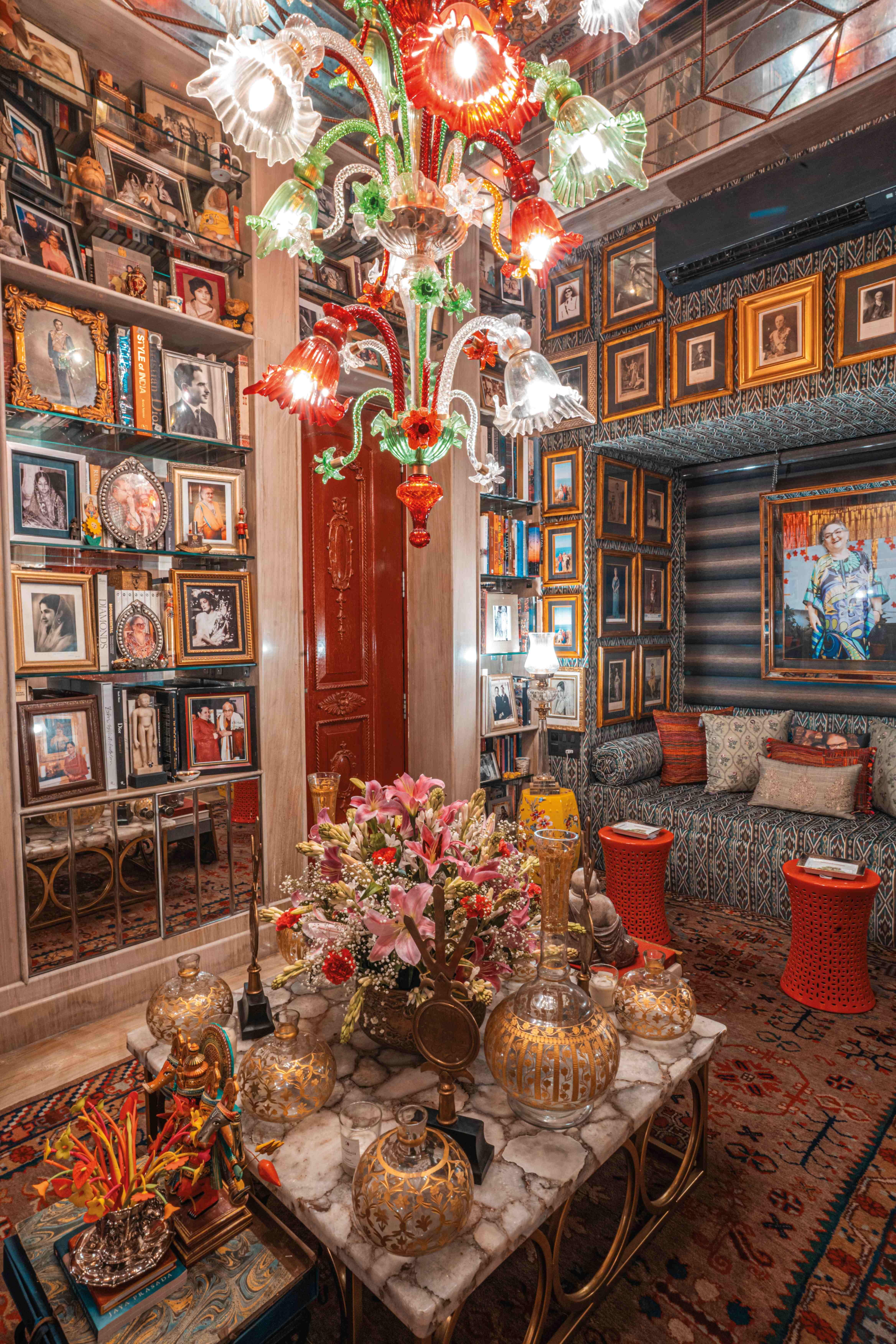
Each room is lavishly layered with exquisite carpets, polished brass, onyx, marble, custom-designed wallpapers, framed photos of family and friends, great arrangements of fresh flowers, and books on art, architecture, the classics and much more. The effect is heady and dazzling. Graydon Carter, the waspish former editor of Vanity Fair, had once said, “Life is all about seating and lighting.” He should have spoken to Adil, who keeps the lights dimmed and has candles lit everywhere.
Just one look at the library, for example, is a revelation. To make the room pop even more than it already is, a pair of bright scarlet Chinese garden stools function as tables. The coffee table is a wonder of onyx fused into Perspex, lending it some kind of voodoo as it rests on highly polished hoops of burnished copper. The room has handblown glasses in the Mughal tradition — fine, filigreed, funnelled and flecked with gold — antique brass talismans line up on the table, a deliciously layered Murano-inspired chandelier twinkles and winks overhead. On a table is a charming hand-painted Hanumanji from a street artist in Banaras, along with framed photographs of family grandees, including one rather low-key one of Adil with the Dalai Lama.
For his own bedroom, Adil, given the rest of the home, kept it rather “modest” — his words, if indeed one can describe it so. The Himalayan mountains of cushions from Ravissant, Hermès, Good Earth, and his own design pile his divan. His bedspread was made from cuttings done by local weaver women from his country home in Kichha Deep in the foothills of Uttarakhand. The lamps made from vases from the famous Capri shop, Tavassi, were shipped carefully from the wicked island.
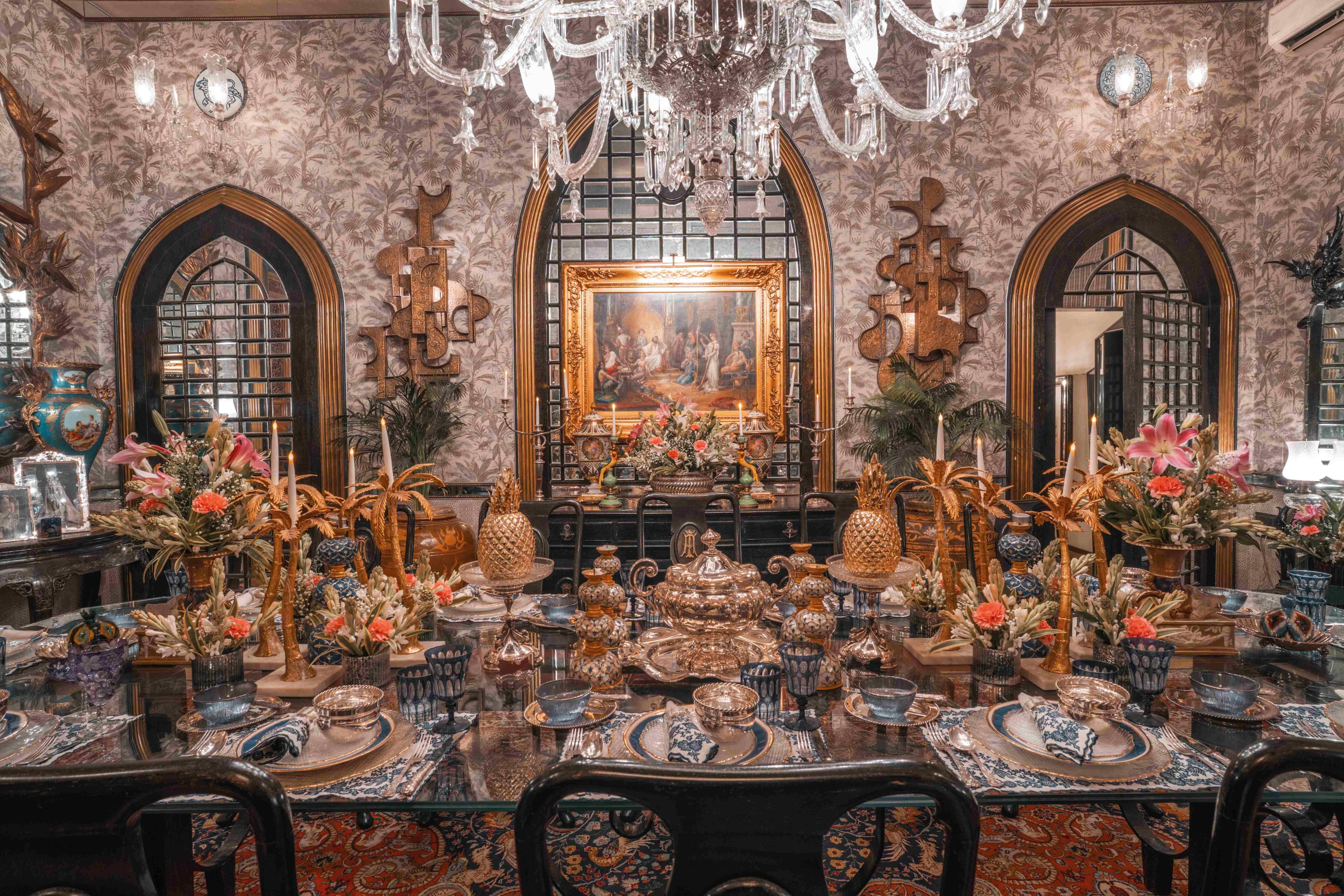
In the dining room, guests eat sitdown, settled on Queen Anne chairs, with napkins matching the perfect blue of the monogrammed crockery made of well-preserved Wedgwood and gleaming silver. Ethereal candelabras shaped like palms by Michael Aram sway high up above bowls of rosebuds, orange lilies, amaryllis, and poinsettias. When asked about his favourite designers, Adil names a few — like Alberto Pinto, the Moroccan interior designer known for drawing upon NeoClassicism and Orientalism. Alberto called entertaining a form of art. He should have popped into Lucknow.
Adil also loves the agelessness of ‘The biggest inspiration for anyone in art design, thought, spirituality, elegance, whimsy and zaniness is this great country of ours’ Nancy Lancaster, particularly the Coach House on the grounds of Haseley Court in England. He also likes the cut and eclecticism of David Hicks (for many, an acquired taste). David’s combination of bold palettes and geometric designs have held attention for years. India, of course, is his abiding teacher. “The biggest inspiration for anyone in art design, thought, spirituality, elegance, whimsy and zaniness is this great country of ours,” says Adil with a big Buddha smile. There’s a reason behind all these details. Adil has created something that harks to the past, and yet because of his humour, intelligence and being rooted in the present, his home is utterly in the present. He has created joy.
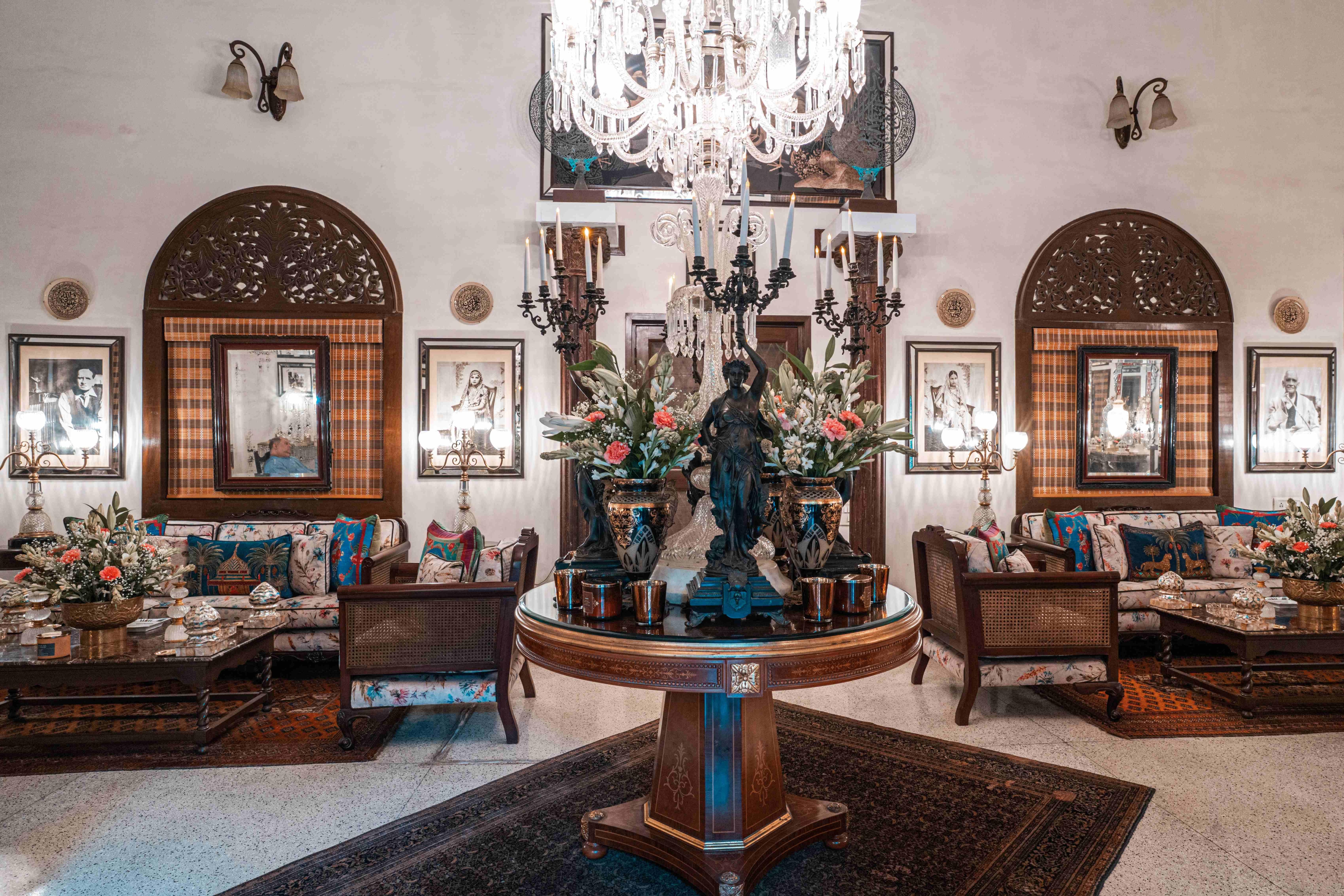
Aiwan-e-Ahmad has seen many changes over the years — some of them happy and some perhaps not as much. “For 30 years,” says Adil, “this house was a mute spectator to the vicissitudes of time and family issues. My mother kept her faith and has lived in the hope that once again, our home would be alive to the sound of people and parties — as it was in my grandfather’s time — and when she had come to this house as a young bride in the 1970s.”
Adil could have been a little younger than his mother when he quit school in Grade 8 and literally ran away to become a designer. He was all of 14 and has been designing homes ever since. This writer was astounded to see him deliver a full home while he was himself seated in his far-off farm, and the project was a new hotel in the Himalayas. His team camped up in the mountains, shipped materials, installed rooms, unfurled carpets, plastered wallpapers, installed mirrors and paintings, placed objects — some mere and other d’art — set up lamps, tables, books and flowers on tables, and lit candles. And voila! All this from 450km away. When asked why he didn’t go to the site himself, he said, somewhat embarrassedly, “I’m terrified of mountain flights.”
Back in Lucknow, the lights have been turned on at Aiwan-e-Ahmad, the vast tent in the garden has been turned into a fairy wonderland. Guests are pouring in looking like exotic Birds of Paradise. Elderly grandees, aristos, pumping young people, royals — some glittering, others clapped out — stiff army folk, artists, writers, intellectuals, a clutch of arriviste… All are welcome to this great home. Adil looks sanguine. His mother, Saida, looks blissfully happy.
“This is what I came back to Lucknow for. To make this home a happy, joy-filled, boisterous, eclectic house full of people I love and who love me. And today, by God’s grace, I’ve been able to restore and renovate it back to its former glory in memory of my beloved grandfather. In doing so, I feel I’ve renewed my mother’s faith in the All Mighty, and our life’s come full circle,” Adil smiles.
Interview by Nikhil Khanna
Photography by Maroof Culmen
This story was featured in the Vol 1. Issue 5 of HELLO! India. For more exclusive stories, subscribe to the magazine here.