- Home
- Lifestyle
HELLO! India Exclusive: Shaan and Maahi Mukherjee's life in perfect harmony
This father-son duo always hit the right notes — especially in concert. HELLO! unearths their thoughts on comparisons, carving a distinct sound, lessons in music and life, and the harmony that defines their bond
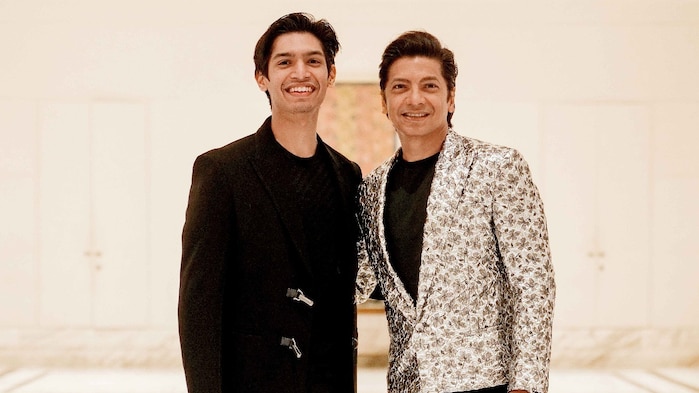

The familiar humming of ‘Chaand Sifarish’ begins, but something’s different. The timbre, albeit similar to the untrained ear, is a tad disparate. The softness we’re accustomed to has an unpolished edge to it, but fresh and expressive nonetheless… That’s the essence of Shaan and Maahi Mukherjee — the musical father-son duo comprising one of India’s most successful playback singers in recent years, and a chip off the old block. When one hits the crescendo, the other manages the diminuendo. The tenor of one complements the baritone of the other.
All in rhythm, the melody mellifluous. Shaan arrived with ‘Musu Musu Hasi’ in 1999 and proceeded to become one of the most popular playback singers of the 2000s, with back-to-back chart-toppers — both upbeat tracks that carry us to the dance floor, and soulful ballads we feel in our bones. ‘Deewangi Deewangi,’ ‘Hey Shona,’ ‘Aao Milo Chale,’ ‘Dus Bahane,’ ‘Jab Se Tere Naina,’ ‘Behti Hawa’ and ‘My Dil Goes Mmm’ all boast his soothing voice, as do his album tracks ‘Tanha Dil’ and ‘Bhool Ja.’
A little over 25 years later, Shubh Mukherjee — who goes by Maahi as his stage name — made an appearance, crooning the same songs he — and we — grew up listening to. All of 20 years old, he has already been signed on by Saregama, debuted with ‘Tera Kya Karoon’ for Netflix movie Naadaniyan, and followed it with solo hits ‘Talab,’ ‘Sorry,’ ‘Jaadugari,’ and ‘Arzoo,’ his latest viral track. “I like that Maahi puts his own spin on songs. He doesn’t try to emulate the original — be it my voice or any other singer,” shares the proud dad. “It’s always fun to watch him perform from the wings, interacting with the audience so confidently. I used to be nervous when he took to the mic, but lately, I’ve been feeling a lot more confident about his stage presence.”
While Shaan has always been known for emotional restraint and grace in his music, he’s made it clear it isn’t an approach he’d want to instill in Maahi. “This is simply my take on how to deliver an emotion, and also me as a person. I’d not want to influence Maahi on how he approaches his renditions. I’m sure he will have his own take on it.”
THE INEVITABLE COMPARISONS
Being born to a music icon who has dabbled in nearly every genre could be daunting to any individual starting out in the same field. While Maahi is aware his father’s voice is a lot smoother and polished (“mine isn’t there yet”), the parallels drawn between them so far have been a lot more favourable than not. “The audience gives me and my music a chance because they love Dad so much!” he laughs in relief. “That, honestly, is the biggest privilege, just to have their attention. I’m extremely grateful for it.”
FINDING HIS SOUND
“A son would naturally look to his father for inspiration, and I’m blessed to be able to do so. At the same time, I’m also trying to carve out my own niche. If people listen to my original music, they’d be able to understand my style, my vibe,” the 20-year-old reflects. “They enjoy my adaptations of Dad’s songs, but checking out my tracks may give them a different perspective.”

While it’s been incredibly helpful “to have Dad as a musical cheat sheet,” Maahi is now more certain about the music he hopes to be known for. He does hold an interest in playback singing, but he’s more focussed on non-film music at present — if his solo hits weren’t indication enough. “Playback singing will happen when it has to, but I’m still developing my sound. I’ve been dabbling with different sonics over the past few years and may be close to narrowing down on one. Like ‘Arzoo,’ my latest track — it’s peppy, it’s fresh, it’s different.”
IN RHYTHM ON STAGE — AND OFF
There’s a sense of security that Maahi feels around Shaan, unsurprising for a father-son dynamic. The sentiment spills over from home to the stage when they perform together. “Growing up, when I had just started singing on stage, he was like a safety net. Performing with him came without the pressure of failing,” he says. “I knew he’d be there to pick up a line I might forget, or a high note I may struggle with.”
LESSONS PASSED ON
As a mentor, there’s one thing Shaan would like his son to bear in mind: practice voice hygiene — keep his voice rested and hydrated, steer clear of shouting, and train within his range. Most of all, he’d want him to “stay positive, believe in himself, and put his best foot forward without ever worrying about the outcome.” Maahi admits he’s learned a tremendous lot from his dad, but one thing stands out: “Mind over body. It’s a great piece of advice Dad imparted in us early on. That when you believe you can do something, you can push your limits to achieve it. We see his mental fortitude in action every day.”
A MUSICAL FAMILY
If they were to describe their relationship in one musical term, both, unsurprisingly, respond with “harmony.” “In music, intervals are the space between two notes. They’re very different to the ear but sound great together. One builds the other. That’s how I’d describe our relationship,” smiles Maahi. Shaan adds to the thought with more musical terms: “A chord involves three notes. For us, there’s me, Maahi and Soham [my elder son]. And, of course, the scale — the root note, the most important in the chord — is their mother, Radhika.”
In the coming years, when audiences look at the two Mukherjees, Maahi hopes they find both the continuation of a legacy and the beginning of a completely new story. “I’m very blessed to be carrying Dad’s incredible legacy forward, but at the same time, I’m also charting out my own path — the same way my father continued his father’s legacy,” explains Maahi, referring to his grandfather Manas Mukherjee, a popular Bengali music director and composer. The duo often jam at home — Maahi on the guitar and Shaan toplining the chord progressions.
While they’ve composed a few songs together, none have yet to see the light of day. They may just make it to our playlists soon. One never knows…
This story was featured in the Vol 1. Issue 7 of HELLO! India. For more exclusive stories, subscribe to the magazine here.