- Home
- Fashion
The curious case of the missing saree
Barring some intermittent sightings, the traditional Indian free-flowing six yard was conspicuous by its absence on the 2026 Cannes red carpet under the garb of interpretations inspired by western silhouettes.
offline
Share this:
Who would have thought that it would take a Hussain Rehar for the shape agnostic, free-flowing saree to have its moment on this year’s Cannes Film Festival red carpet, after all,
When the celebrated fashion designer, looking every bit a royal in his resham-embroidered pink silk chapkan, walked out with actress and singer Sanam Saeed in a scintillating Mukaish jaal embroidered dark green saree for a dinner gala, it was Pakistan’s ode to heritage crafts and the six yards taking centre stage before the world.
And with every spark of the flashbulbs — fashion commentators applauded how unapologetically Hussain presented South East Asian textile traditions and his love for the original saree drape on an international event — the interpretations of the garment put forward by Indian designers appeared lacklustre and at best, confused.
SUPERFLUOS REIMAGINATION
Before we discuss Alia Bhatt’s ‘saree’ looks, let’s deconstruct the Manish Malhotra custom couture Diana Penty wore. Another saree, carefully reimagined until it no longer was a saree at all.
Interesting yes, perhaps. But memorable? Hardly. Another red carpet look that disappeared the moment the flashbulbs dimmed.
The pattern is quite conspicuous now: saree-inspired silhouettes, crafted by the country’s famous couturiers, have become Cannes’ preferred costume for most Indian celebrities — all the nostalgia of drape, none of the actual garment.
Clearly, the striking picture of Aishwarya Rai Bachchan, debuting at the 2002 Cannes Film Festival to premiere her critically acclaimed Sanjay Leela Bhansali film Devdas, in a golden yellow embroidered Neeta Lulla organza saree, is going to be just that — an archived memory never to be reprised.
(Also Read: How Indianisation swept the global red carpet)
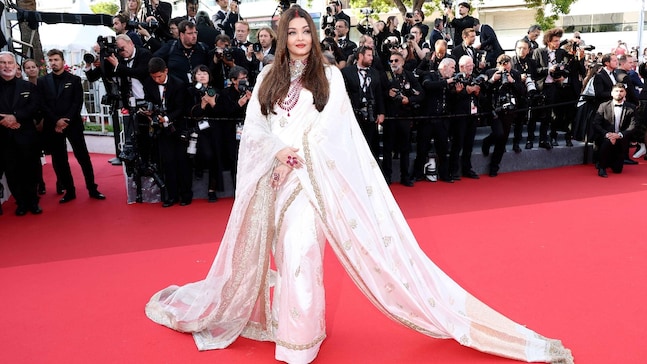
And to think that Manish had dressed Aishwarya in a handwoven kadwa Banarasi saree for the Cannes 2025 red carpet. The ivory and gold look featured a long, sheer Chanderi silk dupatta as well, with intricate gold embroidery and sequin detailing, adding a dramatic flair. The saree featured handwoven brocade motifs and hand-embroidered zari detailing in real silver. The star — the Indian OG always at Cannes — tied it all together with 500 carats of Mozambique rubies and uncut diamonds set in 18k gold around her neck from Manish Malhotra Jewellery.
The point being; why reimagine and reinterpret the grand saree when it is already spectacular in its original avatar!
A GOWN PASSED OFF AS A SAREE
As shared by Indian couturier Tarun Tahiliani, Alia Bhatt’s third look at Cannes 2026 was envisioned as a custom draped concept saree — where Victorian corsetry met the fluidity of Indian drape traditions. The look, styled by Rhea Kapoor, brought together sculpted draping, archival floral embroidery, with delicate pearl payals, a bindi and nose pin — a subtle nod to Indian femininity.
Yet, the overall mood carried a strong Victorian undertone: the corseted bodice, the parasol, the posture — almost like an English lady stepped out of a Victorian novel, only reinterpreted through an Indian lens.
For her second look by Tarun Tahiliani, Alia wore a chintz-inspired ‘saree gown’. At first glance, the look read as romantic couture — corsetry, draped volume, and faded florals.
The ‘saree’ remained, but again, almost in an echo.
That said, it also raises a larger question. Why does the saree so often need to be ‘reimagined’ through stitched, sculpted, pre-draped formats to feel contemporary? Why does it need a corseted look to be read as high fashion?
The saree is perhaps one of the few unstitched garments that modern people still wear as part of everyday culture. Its uniqueness lies precisely in that — its freedom, its movement, its lack of imposed structure. And yet, the garment is dying by a thousand slow cuts at the altar of ‘saree-inspired gowns’.
Tarun Tahiliani’s mastery over drape is undeniable, and there is no questioning his craftsmanship. But the saree itself has a language powerful enough without being reconstructed into a gown-like silhouette. It can be transformed endlessly while still remaining unstitched — and that is its greatest strength.
SAVING GRACE
There were fresh departures, though, from the noise of corseted, constructed clutter, Indian fashion biggies are indulging in to be noticed.
In the race for global validation where originality and authenticity seems compromised, the look Aditi Rao Hydari carried in her champagne silk tissue saree could be a cue for couturiers who dress up Indian celebrities for international events to revere classics over constructions, graceful elegance over excesses, traditions over unnecessary makeovers.
While Huma Qureshi’s dusty lavender Katan silk Banarasi from Shanti Banaras could have been styled and accessorised more effectively, Aditi in a JADE by Monica and Karishma hand block printed drape that shone with intricate Kasab embroidery proved that in an age of over-styled nostalgia, simply wearing a saree as a saree feels quietly radical.
Amidst all the theatrics of reinvention, timeless elegance needs no reimagining. It is only grace, and the innate confidence in tradition that speaks eloquently for itself.
(Also Read: Alia Bhatt is a modern maharani on the Côte d'Azur)
Advertisement